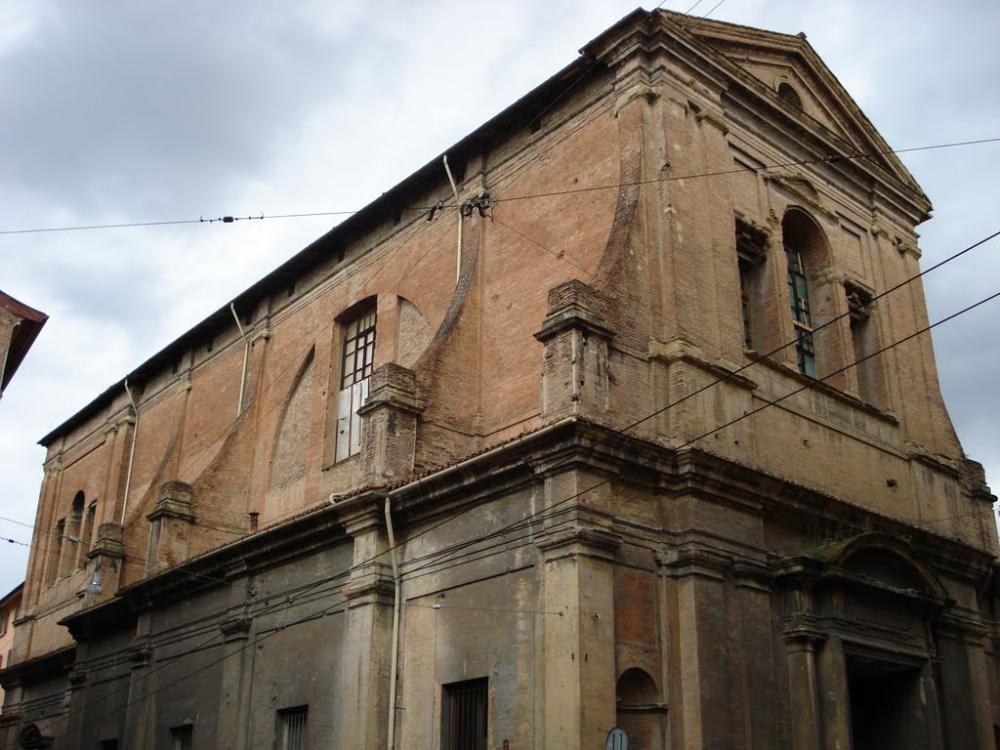
Suppressed during the Napoleonic era and subjected to changes in use, the complex of the canons of Porto was restored in the early seventies, on the occasion of the transfer of the Academy of Fine Arts to that building. Established in 1829 at the monastery of Classe, and of the Municipal Art Gallery founded that year around a core of works from religious corporations. Gradually enriched by purchases and donations, between the 19th and 20th centuries the art collection of the Academy Gallery was reorganized thanks to museographic interventions by Corrado Ricci. From the 1980s onward, interest in contemporary art encouraged the acquisition of new works.
In 1999, some rooms on the main floor and ground floor, previously occupied by the Academy and the Ornithological and Natural Sciences Museum, became available: thanks to the recovery of these new spaces, in 2002 the Loggetta Lombardesca became the seat of the “MAR” (City Art Museum of Ravenna). The Museum preserves a significant core of over three hundred works, from the 14th to the 20th century, documenting the Romagna artistic scene in relation to influences and connections with Emilia, particularly Ferrara, as well as Veneto, Tuscany, and the Marche.
Small panels and polyptychs testify to the production of Lorenzo Monaco, the Master of the Scrovegni Choir, Guglielmo Veneziano, Matteo di Giovanni, Taddeo di Bartolo, and Antonio Vivarini; followed by classicism in Romagna -Longhi, Rondinelli, Zaganelli, Palmezzano- and the artistic developments of the territory (15th-16th centuries), from Bartolomeo Montagna to Cima da Conegliano, Paris Bordon, Dosso, Bastianino, and Bastarolo. Giorgio Vasari (Lamentation over the Dead Christ, 1548), Jacopo Ligozzi, and Camillo Procaccini represent Mannerism and the Counter-Reformation, respectively. Paintings by Guercino (St. Romuald), the Gennari brothers, Alessandro Tiarini, and Cecco Bravo illustrate the 17th century along with works by Carlo Cignani, Marcantonio Franceschini, and Gian Gioseffo Dal Sole.
The 18th century is represented by Luigi Crespi and Arcangelo Resani, while Andrea and Domenico Barbiani testify to a workshop that operated in Ravenna for one hundred and fifty years starting from the early 17th century. Also notable in the city’s artistic heritage is the funerary monument of Guidarello Guidarelli, attributed to Tullio Lombardo (1525) and turned into legend by Gabriele d’Annunzio. Giambattista Bassi, Telemaco Signorini, Giuseppe Abbati, Arturo Moradei, Luigi Serra, and Ettore Tito represent 19th-century painting, while Domenico Baccarini, Giuseppe Ugonia, and Ercole Drei refer to the early 20th-century artistic scene in Faenza.
Significant are the photodynamics of Carlo Ludovico Bragaglia, testifying to Romagna’s Futurism, and a large group of works from the 1950s onwards, including pieces by Accardi, Bendini, Boetti, Castellani, Cattelan, Festa, Francese, Guidi, Manzoni, Morlotti, Paladino, Pozzati, Ruggeri, Saetti, Schifano, Vedova, and Veronesi. A drawing by Klimt recalls the importance of Ravenna mosaics for the education of the Viennese master. Mosaic art is central to the International Documentation Center on Mosaic (CIDM).
Established in 2003, this section was created to promote research, study, and enhancement of mosaics, documented, for the contemporary period, by Afro, Balthus, Campigli, Capogrossi, Chagall, Corpora, Fioroni, Guttuso, Mathieu, Saetti, Santomaso, Vedova, Ontani, and Paladino, among others. In 2011, the CIDM presented to the public the six most recent acquisitions: the panels “Blu oltremare” and “Croce Blu” by the Friulian artist Lino Linossi; “La Folla” by Luca Barberini; “Lens” by Arianna Gallo; “Fruscio” by the Japanese Takako Hirai; and “Movimento n. 14” by the CaCO3 group. It also promoted events such as: G.A.E.M., an exhibition of young international artists selected through the GAEM 2011 competition (Young Artists and Mosaic) to promote mosaic as a contemporary language, the installation “Il mostro della laguna” (2011), and within the 2nd Mosaic Festival the exhibition “Frattur-Arte” (2011).
MAR’s exhibition activity is notable for the particular attention given to the founders of 20th-century art historiography and criticism. The exhibitions “From Renoir to de Staël, Roberto Longhi and the Modern” (2003) and “Turner Monet Pollock. From Romanticism to Informal Art: Homage to Francesco Arcangeli” (2006) charted the crucial transitions of our time. These are accompanied by retrospectives dedicated to major 20th-century figures such as Aldo Mondino, Alberto Giacometti, Mimmo Paladino, and Felice Casorati, alongside “Critica in Arte”, a series of events dedicated to young artists and curators.
The initiative, with a militant spirit, aims to shed light on the new identities of criticism and the artistic expressions of recent generations. Within the framework of the series, solo exhibitions have been held for David Casini, Silvia Camporesi, Sara Rossi, Ivan Malerba, Stefania Galegati, Matteo Montani, Francesco Barocco, Dacia Manto, Pietro Ruffo, Marinella Senatore, Chiara Lecca, Alterazione Video, and Ettore Favini. Among other events hosted by MAR should be remembered: “The Care of Beauty. Museums, Histories, Landscapes for Corrado Ricci” and “The Enigmas of a Painting. From Nicolò Rondinelli to Baldassarre Carrari” in 2008, “The Traveling Artist from Gauguin to Klee, from Matisse to Ontani,” “Abstract” and “Eugenio Carmi. Harmonies of the Invisible. Imaginary Beauty (works 1948-2009)” in 2009, “The Pre-Raphaelites and the Italian Dream. From Beato Angelico to Perugino, from Rossetti to Burne-Jones,” “Tonino Guerra Poet, Painter” and the solo show of Concetto Pozzati “Suspended Time” in 2010.
The year 2011 saw “Italy has Awakened 1945-1953. Art in Italy in the Postwar Period, from De Chirico to Guttuso, from Fontana to Burri”; “Alphabet of History under the Carpet,” the RAM 2011 exhibition, a biennial selection that has allowed young visual artists from the area to grow and gain recognition regionally, nationally, and internationally for ten years; “Pablo Echaurren. Leaving a Mark (1969-2011)”, and “Praise of the Hand. Drawings from the Academy of Fine Arts of Saint Petersburg.” The Museum also annually hosts the award ceremony for the Golden Sails career award and the exhibition of the “Marina di Ravenna Prize” (see profile), an event dedicated to important figures in the art world, which over the years has featured artists of the caliber of Luca Alinari, Gianfranco Baruchello, Davide Benati, Vasco Bendini, Eugenio Carmi, Vittorio D’Augusta, Georges Mathieu, Mario Nanni, Achille Perilli, Tullio Pericoli, Graziano Pompili, Antonio Possenti, Concetto Pozzati, Arnulf Rainer, Germano Sartelli and many others.
Between December and January 2012, the works of the 5 young artists winners of the 55th edition of the Prize will be exhibited at this venue. Intense educational activities offer opportunities to engage with the museum’s realms and become protagonists in the creative process. Numerous thematic paths are designed for elementary, middle, and high school students and planned to integrate with the school curriculum.