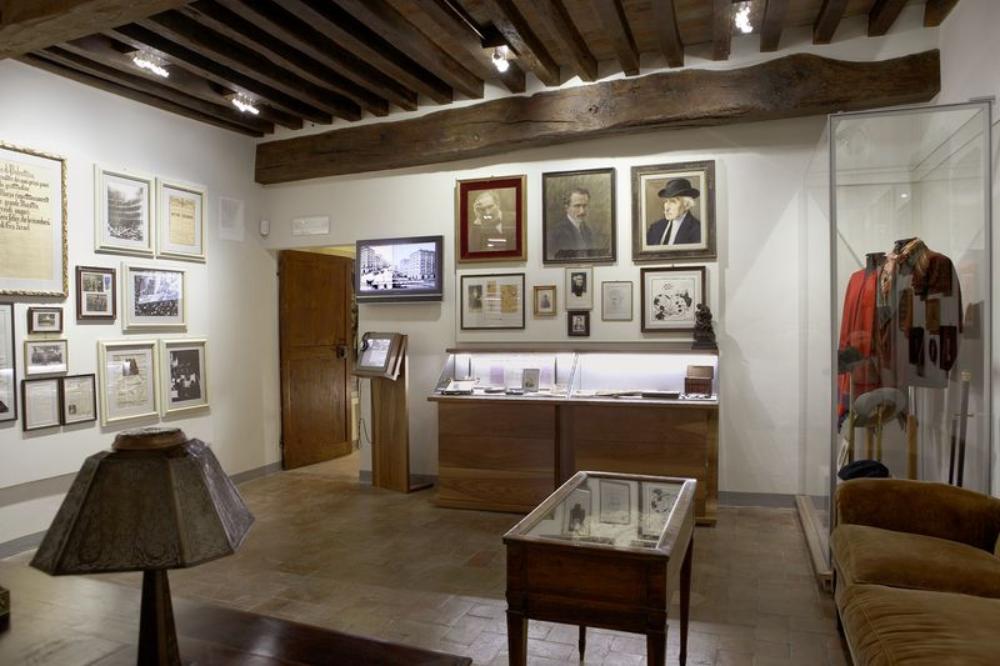


Conceived and designed already at the end of the 1950s, on the initiative of the Municipality of Cesena, the museum was inaugurated in 1969 (under the name of Historical Museum of Antiquity) inside the large and monumental space beneath the famous library built between 1447 and 1452 by Matteo Nuti at the behest of Malatesta Novello. The museum’s exhibition, noted from the start for its strictly educational approach in the arrangement of the various collections accumulated since the early 19th century in the premises annexed to the library, has been updated several times according to more modern exhibition and museographic criteria. It houses important evidence illustrating the history of Cesena and the surrounding territory from the first prehistoric settlements up to the Malatesta age. The itinerary opens with geological and prehistoric collections, thus reconstructing the mosaic of environmental contexts and cultural events that shaped the physiognomy of the territory around Cesena before the Romagna center entered the orbit of Rome. Varied and composite, the landscape of pre-Roman archaeological finds includes – to mention the most significant examples – the late Neolithic village of Provezza, artifacts of the Diana culture (Late Neolithic) from the Marzocchi Furnace of S. Egidio, ceramics related to the water cult of the Panighina spring of Bertinoro, materials from the sites of Diegaro, Valle Felici di Cervia, Capocolle di Bertinoro, Guado della Fornasaccia, Mensa Matelica of Ravenna. The Umbrian ‘facies,’ which characterizes the second Iron Age in Romagna, has two important strongholds in the settlements of Casa del Diavolo and S. Egidio. The rich historical documentation relating to the Roman period, which began in the mid-3rd century BC with the arrival of the first settlers, develops from the urban area evidence and then passes to that of the surrounding territory and the centuriated area, gradually shedding light on rural and domestic life, elements of military armor and attire, artistic craftsmanship, productive activities and trade, and building techniques. Moreover, fragments of floor mosaics from the small town on via Tiberti, preserved in the museum’s atrium, the interesting coin collection, and a substantial number of largely funerary inscriptions deserve mention, while some stone monuments perpetuate in their inscriptions the memory of various moments of city life. Worthy of attention, as an exemplary and at the same time curious document of humanistic erudition and the tradition of local studies, is the false inscription drafted in the 16th century aimed at guaranteeing historical truth to the prohibition of crossing the Rubicon river, allegedly violated by Caesar according to literary sources. A special mention must also be reserved for the famous pair of large gilded silver dining plates with figurative scenes, undoubtedly one of the main discoveries of regional archaeology. Extremely refined and prestigious objects (each weighing over six kilograms of metal) and therefore ‘hoarded’ by intentional concealment, they appear to have belonged to one of the aristocratic families of Ravenna in late antiquity. The itinerary ends with an interesting display of medieval and Malatesta-era ceramics, some of which were found during excavation works beneath the library flooring.
Information about the Archaeological Museum of Cesena
Via Montalti, 6,
47521 Cesena (Forlì-Cesena)
0547355727
[email protected]
https://www.cesenacultura.it
Source: MIBACT