



After the death in 1226 and following the canonization of St. Francis, Pope Gregory IX laid the first stone on the ground that was to see the construction of the “specialis ecclesia”. The Basilica, consecrated in 1253 by Innocent IV, is made up of the superimposition of two churches, lower and upper, which correspond to two different construction phases, in which elements of Umbrian Romanesque merge with the Gothic language of French origin. It was started in July 1228 and completed in 1230, when the body of the Saint was translated there. The design highlights the dual function: the lower church intended to become a crypt and the upper one for preaching. The decorative scheme of the two churches represents the most important pictorial complex of 13th and 14th century art; in fact, among the most eminent artists of the 1200s and 1300s in Italy worked here, starting with Cimabue, Giotto, Simone Martini, Pietro Lorenzetti, Jacopo Torriti and others.
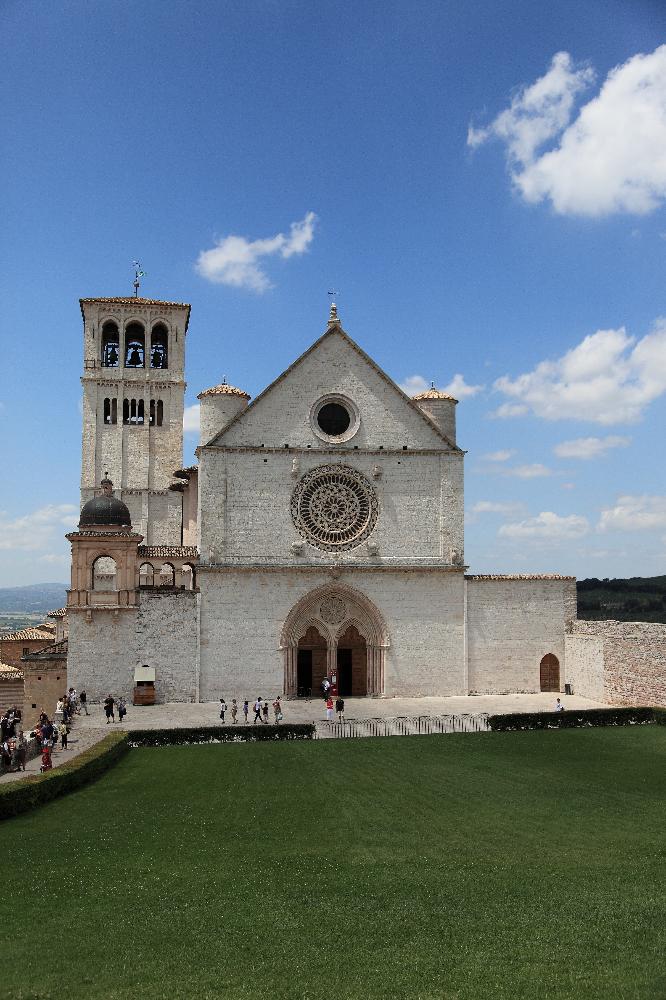
The facade of the upper church is characterized by simple lines and crowned by a triangular pediment according to the local Gothic taste. The twin portal and, in the center of the middle register, the cosmatesque rose window among the relief symbols of the Evangelists. On the left side, the loggia of Blessings built in 1607.
Lower church: accessed through a portal from the second half of the 13th century; the interior features an Egyptian cross plan with a semicircular apse and a short barrel-vaulted transept. The simple nave consists of four bays with lowered rib vaults. On the sides of each bay, there are pointed arches that open into the side chapels located on the two long sides and at the transept ends.
Frescoes of the Master of St. Francis: painted around 1253 and of notable iconographic interest, they are attributed to the painter known as Master of St. Francis, of Umbrian origin influenced by the personality of Giunta Pisano.
Right side chapels:
I chapel of St. Louis or St. Stephen with frescoes by Doni and Giorgetti, with a quadrifoil window by Giovanni di Bonino and collaborators. In the passage to the next St. Lawrence chapel, frescoes from the second half of the 14th century.
II chapel of St. Anthony of Padua with frescoes by Sermei, with a quadrifoil window by Giotto’s masters and Giovanni di Bonino.
III chapel, of Magdalene, frescoes executed by Giotto and his collaborators.
In the presbytery, the high altar is the work of Roman marble workers. In the four vault spandrels, frescoes depicting Allegories of the Franciscan Virtues and the Glory of St. Francis dating to the first two decades of the 1300s. The right arm of the crossing is covered by two bands of fresco decoration by Giotto’s collaborators under the master’s direction; in the first band from the right, work by Cimabue, Madonna with Child on the throne, four angels and St. Francis and other frescoes; in the second band from the right, Crucifixion by Giotto and other frescoes.
Chapel of St. Nicholas with frescoes by Giotto’s disciples. The left arm of the crossing is entirely decorated with frescoes made between 1315 and 1320 by Pietro Lorenzetti and assistants. Chapel of St. John the Baptist with fresco by Pietro Lorenzetti depicting the Madonna with Child and Saints Francis and John the Baptist, and a bifora showing Cimabuesque and Roman features. Above the tribune at the back of the niche, frescoes attributed to Puccio Capanna.
The chapel of St. Martin is entirely decorated with frescoes by Simone Martini between 1312 and 1320. In the archivolt of the entrance arch are depicted Saints, and in the rest of the chapel, Stories of St. Martin.
Upper church: a single nave with four bays, transept and polygonal apse, entirely covered by ribbed vaults of ogival shape supported by ribs that end with bundled pilasters. The brightness of the environment is provided both by the presence of large mullioned windows in the nave and apse, and by the presence of quadrilobed windows. The architectural solutions adopted are derived from Gothic styles from beyond the Alps, faithfully applied in the church, while maintaining characteristics of the Italian tradition.
The transept and apse are entirely decorated with a vast cycle of frescoes carried out by Cimabue starting from 1277. In the left arm of the crossing, the Crucifixion, followed by five apocalyptic scenes. The frescoes of the apse depict the Stories of Mary. The right arm of the crossing presents the Deeds of St. Peter, the work of several masters connected to Cimabue. To Cimabue are also attributed the frescoes of the crossing depicting the Four Evangelists. At the height of the third bay, in the vault of the bay, frescoes by Jacopo Torriti; at the height of the first bay, the four Doctors of the Church, attributable to several masters including the Master of Isaac and the Master of the Capture. On the walls of the nave, above the gallery and beside the windows, Stories from the Old and New Testament attributed to Jacopo Torriti, the Master of Pentecost, the Master of the Capture and the Master of Isaac.
In the lowest register of the nave, in three scenes separated each by false twisted columns unified by a false corbel and the coffered ceiling, unfold the twenty-eight Stories of St. Francis by Giotto and other authors such as the Master of Isaac, the Master of the Capture, the Master of the Crucifix of Montefalco and the Master of Saint Cecilia. The cycle is inspired by the Life (Legenda maior) by Bonaventure of Bagnoregio.
Information about Basilica of San Francesco
Piazza San Francesco,
06081 Assisi (Perugia)
075819001
[email protected]
https://www.sanfrancescoassisi.org
Source: MIBACT