The irregular basin of Piazza San Gaetano is all that remains of a much larger open space, once the civic and religious heart of ancient Naples. This area has always been identified as the Roman Forum, which overlapped the earlier Greek agora.
Archaeological investigations show that the Roman-era arrangement, dating from the 1st century AD, echoed an even older layout. As early as the 5th century BC, a central square had been outlined, using the natural slope of the hill to create two levels above and below the plateia—later known as the decumanus maximus (the main road) and today’s Via Tribunali. Stone retaining walls and a grand staircase connected the lower commercial area to the upper zone reserved for political use.
Today, a true archaeological area lies about 10 meters beneath the church of San Lorenzo Maggiore. In the 18th-century cloister, you can see part of the macellum, the Roman market dating to the second half of the 1st century AD: a rectangular porticoed space lined with small shops, with a mosaic-paved courtyard and a central tholos—a circular building used for selling food. The excavation’s deeper layers reveal the complex development of the entire site.
A Greek-period road (a stenopos, later known as the cardo of Neapolis) runs beneath the church’s transept, covered by a 5th-century AD pavement.
The ancient road flanked the eastern side of a Roman building laid out in three wings, which supported the terrace above. The marketplace was set here, helping to define the lower section of the Forum.
This structure included nine shop units (tabernae), each featuring two barrel-vaulted rooms opening onto the road. These hosted both crafts and commerce, including a bakery and dyeing vats for fabrics. At the end of the cardo, on the right, is the cryptoporticus (covered market), divided into small rooms with masonry counters for displaying goods.
Three of these spaces were exceptions—they were likely the erarium, where the city’s treasury was kept. This organization remained until the late 5th century AD, when floods covered the area and major changes followed, culminating in the 13th century with the construction of the Gothic basilica and monastery, which permanently erased all previous structures.
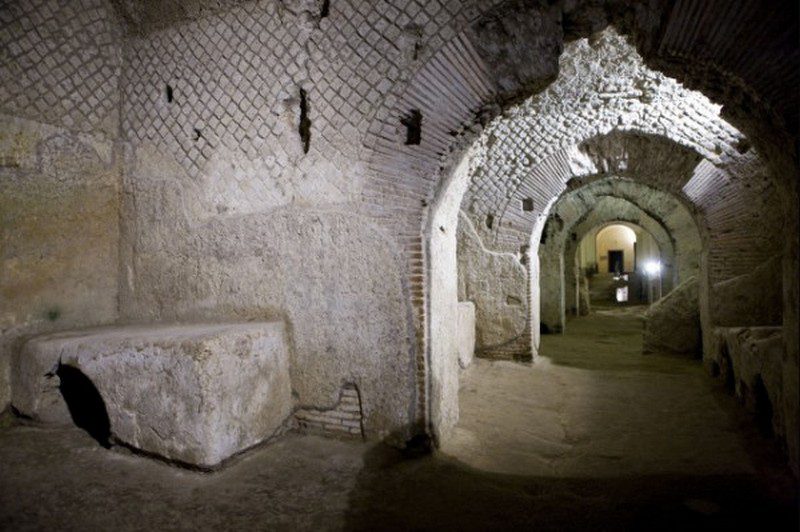
Recently, a new section has been added to the traditional visitor route. This connects seamlessly to the existing archaeological area via a passageway in the portico, creating an evocative path that restores unity to the ancient building.
In this expanded area, a monumental late-Hellenistic hydraulic work sits within a large hall, designed to channel water by exploiting the natural slope. Three vaulted rooms, all paved in mosaics and adjoining each other, follow. The central one features a large pool-fountain.
This refined structure, unearthed in the southwestern sector of the complex, may be a schola, or meeting place of a sacred or artisanal guild.
The building’s layout distinguishes it from adjacent commercial spaces, both for its greater age and its richer wall and floor decorations. Connected to the archaeological area is the Museum of the Work of San Lorenzo Maggiore, set up in the 16th-century rooms around the civic tower next to the basilica.
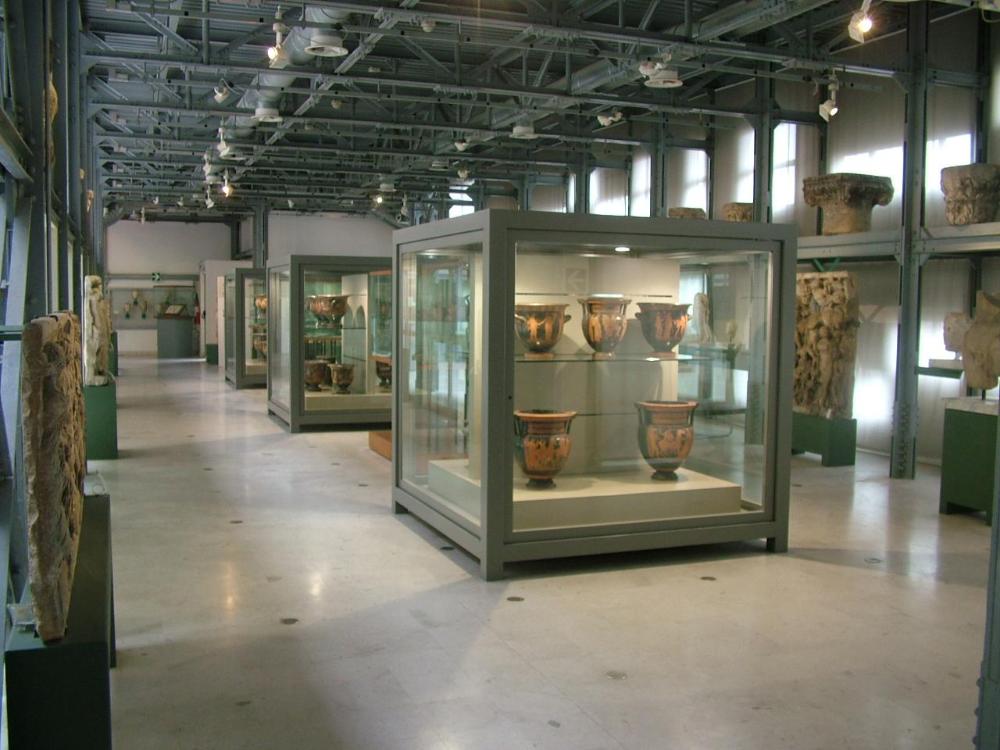
The museum offers a fascinating journey through Naples’ history from classical times up to the 19th century. Exhibited chronologically, from Greek and then Roman antiquities (Republican and Imperial eras), through late antique, early Christian, and Byzantine objects, moving to the Early Middle Ages with Swabian and Norman artifacts, followed by the Angevin and Aragonese periods, and finally, rooms displaying precious 18th- and 19th-century nativity figurines from the monastery’s collection.
Each work is displayed in a setting faithful to its original context, helping visitors understand its story by recreating the authentic light, space, and purpose for which it was made.