


L’irregular basin of piazza San Gaetano is what remains of a larger open space corresponding to the civil and religious center of the ancient city: this area has always been recognized as the Roman Forum, which in turn coincides with the agora of the Greek city.
Archaeological investigations have shown that the Roman-era layout, dating back to the 1st century AD, followed an older organization. Already from the 5th century BC, a square was drawn in the center of the Greco-Roman settlement which, taking advantage of the hill slope, was distributed on two levels, upstream and downstream from the plateia, later decumanus maximus (main street), corresponding to the current via Tribunali, with the necessary construction of retaining walls and a staircase connecting the lower area, intended for commercial activities, with the upper part, reserved for political functions.
A true archaeological area now extends about 10 meters deep beneath the church of San Lorenzo Maggiore. Inside the eighteenth-century cloister, part of the macellum, the Roman market, dating to the second half of the 1st century AD, is visible: it consisted of a rectangular porticoed space, on which shops opened, and an uncovered courtyard paved with mosaics, at the center of which was placed a tholos, a circular building intended for the sale of food. However, it is the lower excavation levels that clarify the complex structure of the entire area.
The Greek age is recalled by the layout of a street, a stenopos, later defined as the cardo (axis) of Neapolis, brought to light below the transept of the church, covered by a pavement from the 5th century AD.
The ancient road ran along the eastern side of a complex Roman building that, spreading over three wings, also served as artificial support for the terrace above, on which the market was later positioned, simultaneously helping to define the lower portion of the Forum.
The building was made up of a series of nine shops (tabernae), each consisting of two barrel-vaulted rooms opening onto the street, where commercial and craft activities took place: a furnace and vats for dyeing textiles have been identified there. At the end of the cardo, on the right, you reach the cryptoporticus (covered market), divided into small hooked rooms equipped with masonry counters for displaying goods.
Only three of these were an exception, probably constituting the aerarium, where the city treasury was kept. This arrangement remained in use until the late 5th century AD, when, after the area was filled with alluvial deposits, subsequent transformations began, culminating in the 13th century with the construction of the convent and the Gothic basilica, which led to the definitive obliteration of all previous structures.
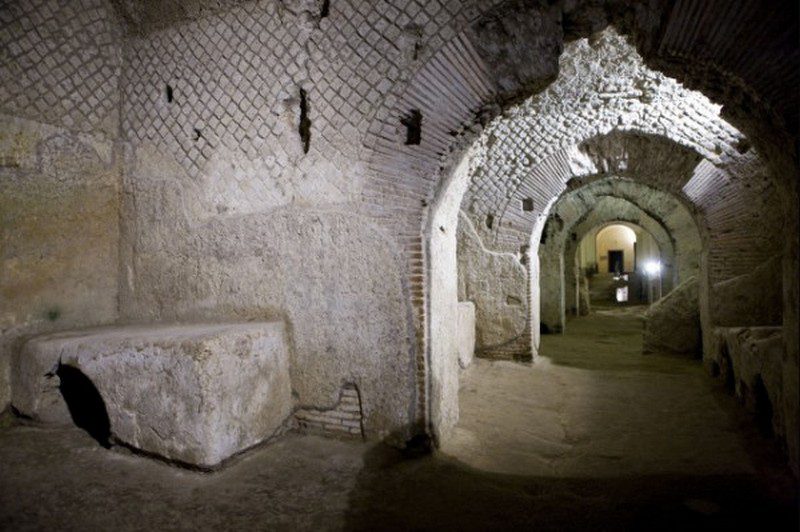
In recent years, a new sector has been added to the traditional route, which develops continuously with the area already accessible, connected through a passage inside the portico, with a suggestive path that restores unity to the ancient building.
In this new area, inside a vast room, there is a monumental hydraulic work dating back to the late Hellenistic era, which served to channel water flow by exploiting natural slopes. It is followed by three large vaulted rooms communicating with each other and paved with mosaics, the central one housing a large basin-fountain.
In this refined building uncovered in the southwestern sector of the complex, a preliminary analysis perhaps allows the recognition of a schola, headquarters of sacred or artisan guilds.
The building, complex from a planimetric point of view, differs from the adjacent commercial environments both for greater antiquity and for the presence of prestigious wall and floor decorations. Connected to the excavation area is the Museum of the Opera of San Lorenzo Maggiore, arranged in the 16th-century rooms around and in the Civic Tower, which adjoins the Basilica.
It presents to the public a true cross-section of the history of Naples from the classical age to the nineteenth century. In its scientific layout, in ascending chronological order over the various levels of the building, one passes from archaeological finds of Greek period to those of Roman, republican and imperial eras; from late-antique to paleochristian and then Byzantine testimonies; from the early Middle Ages and the Swabian and Norman civilizations to the Angevin and Aragonese ages, finally arriving at the rooms that house the nineteenth-century nativity scenes of the prestigious convent collection.
The works are inserted in their original contexts to promote a correct and complete understanding of what is exhibited, physically reconstructing the spaces where they were placed and seeking the same lighting and perspective conditions and the same purposes for which they were created.



