


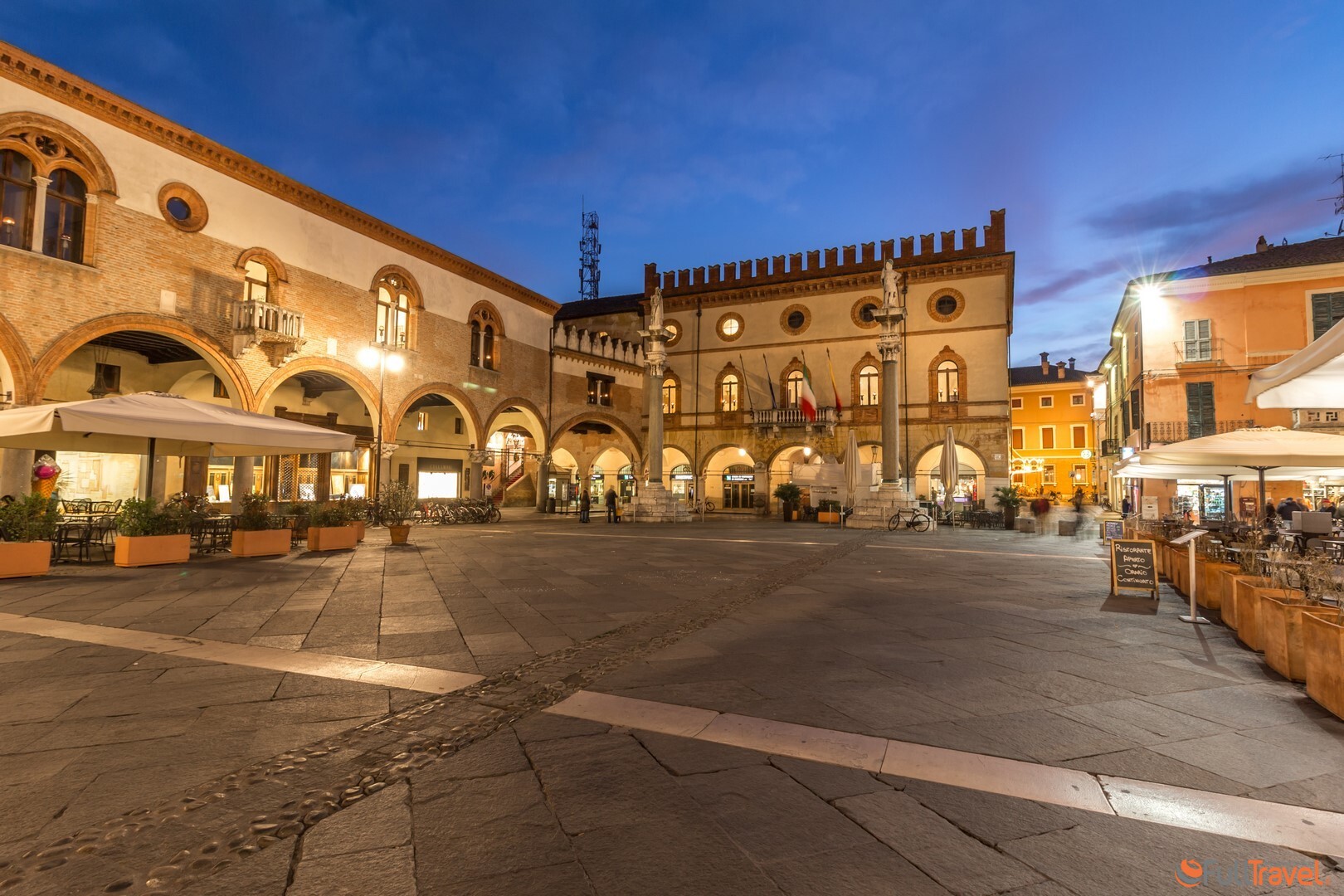

La ciudad de Rávena, en Emilia Romaña, guarda un tesoro: se trata de ocho monumentos religiosos de los siglos V y VI d.C., inscritos por la UNESCO en la lista de patrimonio mundial no solo por su refinamiento artístico, sino sobre todo por ser representativos de la historia de la ciudad en ese período.
- Places of Interest in Ravenna: Main Monuments
- Ravenna, Capital of the Western Roman Empire
- 1 Mausoleum of Galla Placidia
- 2 Neonian Baptistery
- Ravenna, Ostrogothic Capital
- 3 Archiepiscopal Chapel
- 4 Saint Apollinaris Nuovo
- 5 Baptistery of the Arians
- 6 Mausoleum of Theodoric
- Ravenna, Byzantine Capital
- 7 Church of San Vitale
- 8 Church of Sant’Apollinare in Classe
- Other monuments and museums not to be missed in Ravenna
- 9 Palace of Theodoric
- 10 Dante Center of the Conventual Franciscan Friars
- 11 Dante Museum
- 12 National Museum of Ravenna
- 13 National Museum of Underwater Activities
- Other recommended museums in Ravenna
En el transcurso de ciento cincuenta años, de hecho, Rávena será la capital del imperio romano de Occidente, capital de los ostrogodos y capital del imperio bizantino en Europa. Cada uno de estos momentos históricos produjo monumentos bellísimos y simbólicos de los mensajes políticos y religiosos contemporáneos, narrados principalmente a través de un uso magistral del arte musivo que impresionó a Carl Jung e inspiró a Gustav Klimt.
Places of Interest in Ravenna: Main Monuments
Ravenna, Capital of the Western Roman Empire
In 402, Emperor Honorius decided to transfer the imperial residence from Milan, which was overly exposed to the danger of invasions by the Visigoths of Alaric, to Ravenna, which thus effectively became the capital of the Western Roman Empire. The city experienced significant expansion during this period, its appearance as a provincial town changed radically, and its bishop became a metropolitan. This period saw the construction of the Mausoleum of Galla Placidia and the Neonian Baptistery.
1 Mausoleum of Galla Placidia
The Mausoleum of Galla Placidia was an imperial funerary monument, probably built to bury Galla Placidia, daughter of Theodosius and regent of the Western Empire for her son Valentinian III. As in all early Christian monuments in Ravenna, the very simple, plain brick exterior contrasts with the splendor and richness of the internal mosaic decoration whose subjects develop, on multiple interpretative levels, the theme of the victory of eternal life over death. The dominant color is blue, which serves as the background to the starry sky of the dome and the floral decorations framing the lunettes. One of them shows the representation of the Good Shepherd, a subject widespread in popular catacomb art but here in one of the first monumental representations. The Good Shepherd wears imperial robes, emphasizing the similarity between the ruler and God.

2 Neonian Baptistery
The mosaics of the Neonian Baptistery are a hymn to life, with the Baptism of Christ as the main scene. Here the skillful use of mosaic tesserae manages to convey even the transparency of the water of the Jordan River.

Ravenna, Ostrogothic Capital
In 476, in Ravenna, the king of the Heruli, Odoacer, deposed Emperor Romulus Augustulus. This date conventionally marks the end of the Western Roman Empire and the beginning of the Middle Ages. In 488, the Ostrogothic king, Theodoric, was commissioned by Zenon, Eastern Roman Emperor, to overthrow Odoacer. After a long siege of Ravenna, Theodoric finally succeeded as victor in 493, and the city thus became the Ostrogothic capital. Religiously, Theodoric was a follower of Arianism, the doctrine condemned during the Council of Nicaea, which asserted a substantial inferiority of Christ’s divine nature compared to that of God. However, he adopted a policy of détente towards Christians and Jews.
3 Archiepiscopal Chapel
The Archiepiscopal Chapel, dating to 495, commissioned by Bishop Peter II, is a celebration of orthodox Christianity. The main mosaic represents Christ the warrior crushing the beasts of Arian heresy: it is a clear message against Theodoric’s religious ideology, who was however tolerated by the ruler.
4 Saint Apollinaris Nuovo
Conversely, the church of Our Lord Jesus Christ, renamed Saint Apollinaris Nuovo when in the 9th century the relics of Saint Apollinaris were transferred there from the homonymous basilica of Classe, was originally built as Theodoric’s palace church and therefore consecrated to Arianism. For this reason, with the subsequent Byzantine conquest of Ravenna, it was re-consecrated to orthodox Christian worship, and the mosaics of the lower band of the side walls of the central nave were significantly modified by Bishop Agnellus. The subject consists of two processions, respectively of Holy Martyrs and Holy Virgins. Their style is typical of Byzantine art: the figures are repetitive and lack individual characterization, perspective and a ground plane are absent, so they appear to float on a monochrome and flat background. On the sides of the two processions are some architectural elements that geographically situate the composition: on the left side of the procession of the Holy Virgins the port of Classe is depicted, with three ships aligned vertically to give a “bird’s eye” perspective.

On the right side of the procession of the Holy Martyrs, instead, appears Theodoric’s palace, where the figures that were supposed to appear among the arches of the portico (certainly the king with his court) suffer a damnatio memoriae and are replaced by some white curtains.

5 Baptistery of the Arians
The Baptistery of the Arians, octagonal in plan, ideologically contrasts with the Neonian Baptistery, which is also called the “Orthodox Baptistery”. It is the only known baptistery in Italy built specifically for Arian worship. The surface of its mosaic decoration is smaller than that of the Neonian Baptistery. The main subject is the same (the Baptism of Christ), but the figures are generally more flattened and simplified. The background is no longer blue, but golden, following a trend aimed at making the figures more abstract and symbolic and flooded with an otherworldly light. Identifying Arian elements in the baptistery requires considerable interpretative skill of the symbols. For example, in the depiction of the etimasia, that is the empty throne that Christ will occupy on the day of the Last Judgment, his divine insignia (alpha and omega) are absent, replaced by a shroud, a sign of his human nature, consistent with Arian doctrine. The Baptistery of the Arians was built by the Gothic king Theodoric (493-526) as a baptistery for the ancient Arian Cathedral, today the Church of the Holy Spirit. It was later reconciled with orthodox worship during the time of Archbishop Agnellus, as an oratory dedicated to the Virgin Mary.
6 Mausoleum of Theodoric
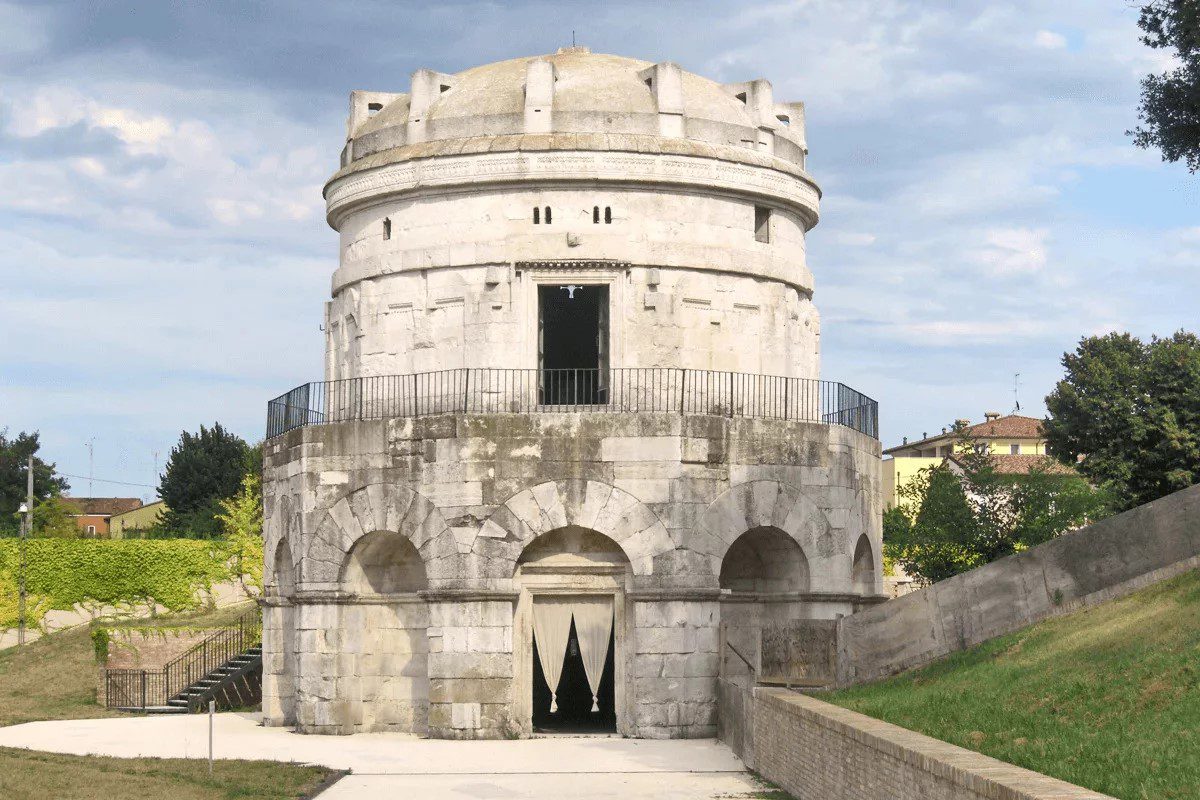
The Mausoleum of Theodoric is unique compared to other contemporary monuments: it is built of Aurisina stone rather than bricks, as a tribute to Diocletian’s palace in Split, and does not feature mosaic decorations. The roof is made from a single stone block nearly eleven meters in diameter. Inside, there is a red porphyry basin, originally the ruler’s sarcophagus. The Mausoleum of Theodoric was erected around 520 A.D., while King Theodoric was still alive, in the Gothic burial area. The decagonal building, made of large squared blocks of Aurisina stone, consists of two superimposed chambers. The upper, recessed order is capped by a circular cornice with a decorative frieze. The monument is covered by a monolith of exceptional dimensions, with twelve double-sloped brackets.
Ravenna, Byzantine Capital
When Justinian became emperor of the East, he wanted to reconquer the Western lands that meanwhile had fallen into the hands of the barbarians, including Ostrogothic Italy. He thus undertook the so-called Gothic War which, by the mid-6th century, ensured him control of the peninsula. Ravenna became capital again, and to strengthen the city’s power, Justinian established the office of archbishop, appointing Maximian, his trusted man, to this role. Ravenna remained Byzantine until 751, when it was conquered by the Lombards.
7 Church of San Vitale
Maximian completed the Church of San Vitale, a masterpiece of early Christian art in Ravenna. The church is made up of various geometric blocks juxtaposed (the central body, the apse, and the dome lantern), particularly evident when viewing the building from the outside. The interior, however, is surprising: the masses are made light through the addition of apses open with numerous arches, supported by pierced capitals and impost blocks that seem to literally suspend the arches in the air.

The mosaics, in which the presence of golden backgrounds dominates, the stuccos and the marbles create plays of light that further lighten the space, making the visit a unique experience. Among the mosaic depictions stand out those of Justinian and his wife Theodora with their respective courts. The figures are portrayed frontally to give more hieratic solemnity, and the compositions strictly follow the hierarchical order of characters. The position of the rulers, their robes, and the accompanying objects highlight the theocratic value of the empire. References to orthodox Christianity are not missing, particularly the reaffirmation of the Trinity: the sky of the Apocalypse, for example, with its twenty-seven stars (a multiple of three), is a symbol of the fight against heresies.

8 Church of Sant’Apollinare in Classe
A few kilometers from Ravenna lies Classe, formerly the city’s port and home to a Roman naval fleet. The location houses the Church of Sant’Apollinare in Classe, built to house the relics of Apollinaris, the first bishop of Ravenna. The basilica of Sant’Apollinare in Classe was consecrated by Archbishop Maximian in 549 A.D. It features a polygonal apse on the outside and a circular one inside, flanked by prothesis and diaconicon, and a early medieval crypt. Its elegant three-nave interior naturally directs the eye toward the apse mosaic, where the saint, in a praying pose, stands at the center of a bucolic landscape.
Above him, the cross inscribed in a blue sky is pointed to by God’s hand emerging from the clouds: once again, an affirmation of the orthodox interpretation of Christ’s divine nature.

The rich mosaic decoration includes the representation of Sant’Apollinare against a lush landscape in the apse basin and the figures of the four Ravenna bishops in the spaces between the windows (6th century), while the presbytery depicts the sacrifices of the Old Testament and the granting of privileges to the church of Ravenna (7th century).
Other monuments and museums not to be missed in Ravenna
9 Palace of Theodoric
The Palace of Theodoric consists of a building of uncertain interpretation dating back to the 7th or 8th centuries; the currently most accredited opinion is that the ruin, consisting of a body with a large portal above which opens a wide niche with a bifora, corresponds to the narthex of the church of San Salvatore ad Calchi (whose last phase dates back to the 9th-10th century). In any case, the building rises in the ancient palatine area, on the remains of the true palace of Theodoric and a previous grandiose construction. It currently houses interesting fragments of floor mosaic found on the spot (1st-7th century AD) inside and under the porch.
10 Dante Center of the Conventual Franciscan Friars
Located in the former convent of San Francesco along with the Dante Museum, the collection, opened to the public for the first time in 1990 after the major restorations of the Franciscan cloisters, exhibits a selection of over 500 small bronzes and over 2000 among medals and coins representing Dante or Dantean themes; a sector is dedicated to Dante illustrations and includes illustrated editions, graphic collections without text, oil and tempera paintings. Particularly notable are the largest and smallest editions of the Divine Comedy and the microcalligraphic edition by G. Cossovel (1888).
The second cloister, called “Cassa,” is the exhibition venue of the International Medal Biennial, small Dantean sculpture, and art exhibitions dedicated to Dante curated by the Dante Center. In the large room between the two cloisters on the first floor of the minorite complex is the library of the Center which, founded in 1964 by Father Severino Ragazzini, houses about eleven thousand volumes including manuscripts, incunabula, sixteenth-century books, and translations of Dante’s work.
11 Dante Museum
The Dante Museum located in the former convent of San Francesco, on the first floor of the seventeenth-century cloister called “Dante,” next to the Poet’s tomb, decorated by a bas-relief by Pietro Lombardo in 1483, and rebuilt in 1780 by Camillo Morigia. It is divided into two sections curated respectively by the Opera di Dante of the Municipality of Ravenna and the Dante Center of the Conventual Franciscan Friars. In the first, inaugurated in 1921 on the initiative of the Committee for the celebrations of the sixth centenary of Dante’s death coordinated by Corrado Ricci, are collected the tributes sent in 1908 and 1921, when D’Annunzio’s enterprise in Fiume had made Dante the symbol of Irredentism, the box that contained the Poet’s bones, as well as the projects awarded in the competition promoted by the Ministry of Public Education in 1921 for the decoration of the interior of the adjacent Basilica of San Francesco.

12 National Museum of Ravenna
The National Museum of Ravenna, established in 1885, has been housed since the early twentieth century in the prestigious premises of the former Benedictine monastery of San Vitale. The original core of the museum’s heritage consists of collections formed during the eighteenth century by the Camaldolese monks of Classe, later enriched through donations, acquisitions, discoveries, and excavations. Currently, the museum is presented as a collection of heterogeneous collections grouped into three fundamental categories: lapidary, excavation finds, and art collections. The lapidary, mostly displayed along the two cloisters of the monastery, consists of an interesting collection of inscriptions and funerary steles and stone artifacts from the Roman, early Christian, Byzantine, Romanesque, Gothic, Renaissance, and Baroque periods. On the upper floors are exposed mosaics and archaeological materials, especially from the territory of Classe, as well as so-called minor art collections. The collections include bronzes and plaques, ivories, icons, weapons and armor, ceramics. Additionally, the museum houses the important cycle of fourteenth-century frescoes detached from the ancient church of Santa Chiara in Ravenna, works by Pietro da Rimini.
13 National Museum of Underwater Activities
The National Museum of Underwater Activities was inaugurated in Marina di Ravenna by “The Historical Diving Society, Italia“, in premises provided by the Municipal Administration. Its purpose is to promote the study of the history of underwater activities also through temporary exhibitions, organization of conferences, and publication of informative materials. In the various sections, there are prints from the 1700s and 1800s, dioramas, one of the first Italian decompression chambers, diver and scuba equipment, work materials, and underwater photography tools. One area is dedicated to the military navy and the underwater assault vehicle of the last world conflict, known as the “pig.” It also preserves the original cast of the statue submerged in the waters of S. Fruttuoso in Liguria, depicting the Christ of the Abyss, a work by the sculptor Guido Galletti.
Other recommended museums in Ravenna
- Antico porto di Classe, Ravenna
- Biblioteca Classense, Ravenna
- Domus of the stone carpets, Ravenna
- The puppet house, Ravenna
- Archbishopric Museum of Ravenna
- City art museum, Ravenna
- Museum of the Risorgimento of Ravenna
- Educational museum of the territory, Ravenna
- Ravenna Museum of Natural Sciences “Alfredo Brandolini”, Ravenna
- Small doll and other toys museum, Ravenna
- The Planetarium of Ravenna
- Dante Alighieri Theatre, Ravenna
- Luigi Rasi Theatre, Ravenna