
The tourist customer journey is increasingly digital, even in Italy. It has long been so in its first phase, where the internet user, using their device (typically a smartphone), searches for the best offers.

Add us to your preferred sources.

Online you can compare flights, hotels, and experiences and you can comfortably search for the best price and the most suitable proposals for different needs. The number of listings online regarding cultural tours, guided visits, wine and food experiences, outdoor activities, and more is growing. On the web, you can find everything, even the most original experiences.
The concept of travel has changed, becoming more personalized and customizable. Tourists are more aware of their choices than in the past and less willing to passively accept the “standard” offers from accommodations and tour operators. The vacation is built to measure, online. The research and booking phase is when not only the buyer is convinced to make a purchase but also literally falls in love with the trip. They are won over. According to a study by consulting firm McKinsey, the average purchase process can last over a month and involve about 45 touchpoints, the “contact points” between customer and company scattered along the customer journey.
Summary
Digitizing the post-booking phase
When talking about the travel e-commerce, also thanks to the great success of OTA (Online Travel Agencies) like Booking.com or Expedia.it, the digital experience of the traveler is easy and quick. Today, you can book and even pay for a trip in just a few clicks, selecting any type of accommodation from large hotels to short-term rentals. And the trip can be organized and paid for completely online, adding transportation options and experiences.
The moment before the actual trip, also called pre-arrival, is particularly suitable for creating engagement. You don’t need to come up with anything extraordinary: well-crafted newsletters, high-quality photos, and if you have the budget, some videos or virtual tours of accommodations are enough.
Abandoning the tourist to themselves after booking would be a serious mistake because the possibility of free cancellation is always around the corner. And even when the travel day finally arrives, the level of attention and the quality of the digital offering must remain high to ensure tourist satisfaction and earn a positive review.
The last mile is still analog
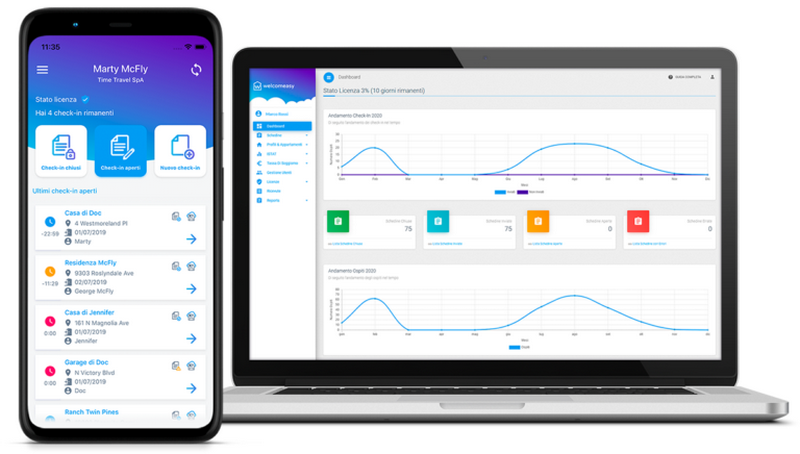
“The level of digitization of the tourist customer journey drastically decreases as we approach the vacation moment from the research and booking stages, when the tourist arrives at the property” comments Paolo Zennaro, CEO of Welcomeasy, a startup committed to digitalizing the last mile of the customer journey through a dedicated app to streamline all check-in procedures.
According to professionals from the Digital Innovation Observatory in Tourism (Politecnico di Milano), the need for social distancing has accelerated the digitization of the customer journey. But there is still a long way to go. In 2020, only 30% of accommodation facilities had already adopted mobile payment solutions and offered online or smartphone check-in, while in 2019, just 8% did.
The pandemic boosted digitization
The pandemic severely impacted the travel sector, including the digital one, which experienced a decline of over 9 billion euros in 2020 compared to 2019.
“But if we want to look optimistically towards the future, the coronavirus emergency has given a significant push towards digitalization” emphasizes Zennaro – “because, in a sense, it forced us towards a cultural shift. As of August 2021, over 10,000 check-ins have been completed with our app. I am fortunate to have first-hand information that comes directly from our clients: hoteliers, property managers, B&B operators, etc., located in various tourist destinations across Italy. What came out this summer is that there is a strong interest in relying on technology to work better”.
Operators’ needs
Operators need tools that allow them to work comfortably from a computer or, better yet, a smartphone. First to facilitate communication with guests, then to minimize all sorts of bureaucratic burdens and finally to guarantee a fully digital customer journey, responding to tourist expectations.
“A hotel owner, a property manager, or even the simple owner of a vacation apartment can find a valuable ally in an app that allows check-in in 30 seconds, like ours. If the guest is delayed because they need to transcribe all the necessary check-in data by hand, they become impatient at best, and at worst, they decide to leave a less positive review of our work” explains Zennaro.
Time saved using an app can be reinvested in the relationship with the guest, to offer tips and information about the territory. And there are many other digital tools that help hospitality professionals make a good impression and foster customer loyalty. Some are free, like instant messaging apps for easy and direct communication. Others include virtual tour tools of accommodations, self-check-in devices that securely give keys to guests at any hour of the day or night, and so on.
Technology is no longer scary
The tendency to use digital tools is growing, extending even to small family-run establishments and owners of houses and apartments for short-term rent. But there is still a lot of work to do to steer tourism towards a development that truly embraces new technologies. This is because many phases and processes typical of Travel need to be reprogrammed, such as welcoming, with the goal of integrating physical and online tourist experiences, optimizing digital channels at 360°.
To really understand how things are going, it’s necessary to wait a few more months for the 2021 tourism and digitalization data to become available. Also, after a fairly successful summer tourist season, with a faster-than-expected restart, in the autumn and winter months of this year, the return of MICE travel, related to meetings and corporate fairs, is expected. The Covid situation seems stable enough to allow the resumption of business travel, considered less essential.
An increase in bookings outside the summer season and a return to rates comparable to 2019 might finally convince even the most cautious and skeptical operators to invest in digitalization.
Pubblicato in Digital Travel
Be the first to comment