

Trani is a picturesque town in northern Bari. Known for its cathedral, Trani is also distinguished by its historic center with the Jewish quarter, its marina, and the Frederickian castle. Here are 10 things to see in Trani and what to do in the Apulian city, the main places of interest.
Where is Trani located?
Trani is a city in Apulia located north of Bari, a provincial capital (along with Andria and Barletta) since 2004. It features interesting noble palaces, a picturesque marina, a charming historic center, the majestic cathedral, and the castle of Frederick II. Its strategic position on the Adriatic Sea has made it an important commercial and cultural center since ancient times.
Legend has it that Trani was founded by Tyrrhenus (Tirenum), son of Diomedes. The city was an important trading hub of the lower Adriatic, according to sources such as the Ordinamenta Maris, the oldest maritime code of the Middle Ages. After the destruction of nearby Canosa, Trani gained greater importance, also thanks to its natural harbor that favored early settlements.
Trani is easily reachable by car, train, and plane (Bari airport) and has several points of interest. Depending on your available time, we recommend a series of things to do and see in Trani, in one day, a weekend, or multiple days.
Trani, what to see in the Apulian capital
1 Trani Cathedral
Trani Cathedral is undoubtedly the symbol of the city and one of the most important examples of Apulian Romanesque architecture. Located on a promontory a short distance from the marina, its majestic presence suddenly reveals itself to visitors coming from the historic center.
The cathedral consists of three overlapping churches:
- The Hypogeum of San Leucio, dating back to the 5th-7th centuries (accessible halfway along the left nave)
- The Church of Santa Maria della Scala from the 11th century (accessible from the end of the inner naves)
- The basilica dedicated to San Nicola Pellegrino, whose construction began in the 12th century
The façade, made of Trani stone, features a double staircase accessible from the right and left sides. The rich entrance portal is a copy of the bronze door visible inside, created by Barisano da Trani in the 12th century, depicting symbolic, arabesque, and human figures.
For architecture enthusiasts, the Trani cathedral floor plan offers an interesting study of its unique structure. Some curiosities about Trani Cathedral include the fact that it is the only Apulian Romanesque cathedral built directly on the sea and that its bell tower, about 60 meters high, dates back to the 13th century.

Trani Cathedral – ©Photo Anna Bruno/FullTravel.it
2 Diocesan Museum
The Diocesan Museum of Trani is located inside the Palazzo Lodispoto next to the cathedral and the bell tower. Inside there are sculptures, stone material, tombs, and capitals. Of great importance are the panels with Saint Nicholas of Myra and Jerome, Saint Redento and Saint Magnus, and a 14th-century altar of French art. The museum is open on odd days from 10:00 am to 12:00 pm. In summer it is also open on Tuesdays and Thursdays from 5:30 pm to 7:00 pm. On Sundays it is open by appointment only.

3 The Castle of Trani
Originally, the castle communicated directly with the sea, but today this connection no longer exists. Its strategic position, opposite the cathedral, highlights its historical and architectural importance. The original wooden drawbridge has been replaced by a stone one, but the keep and the three corner towers still date back to the Frederick II era.
For interested visitors, tickets for the Castle of Trani are available on site. The opening hours and prices of the Castle of Trani vary depending on the season, so it is advisable to check in advance. The reviews of the Swabian Castle of Trani are generally very positive, with visitors particularly appreciating the panoramic view from the top and the rich history of the place.

4 The port
Trani is a charming destination in Apulia. Rich in history, a visit to Trani can only begin at the port where it is easy to come across fishermen returning from the sea. The port was the old center of the city but even today it is a meeting place. Inside the harbor, there are different types of boats: fishing boats, sailboats, and pleasure craft. The port is located between the promontory of the cathedral and that of the fort of Sant’Andrea. Here you’ll find the palazzo Caccetta, in late Gothic style, and the church of All Saints, in Romanesque style. A walk along the port, among the stalls of fresh fish, is an unmissable experience for those visiting Trani.

5 The Jewish Quarter
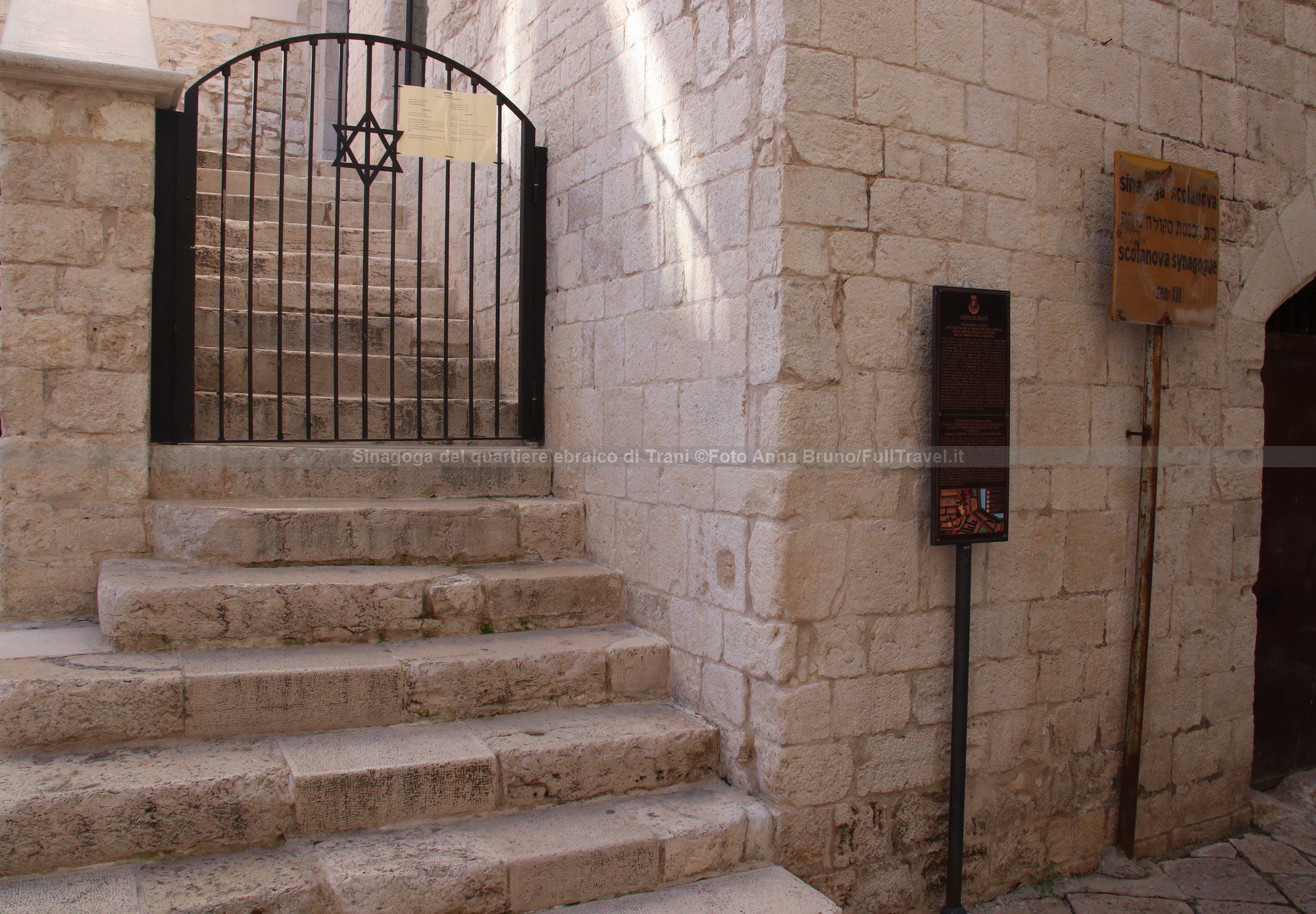
Near the marina begins a maze of streets intersecting in the Jewish quarter of Trani, a fascinating labyrinth of alleys that stretch near the marina. The entrance to the quarter is marked by the Porta della Giudecca (Old Gate), which leads to Via la Giudea. This historic neighborhood, located along the city walls, bears witness to the Lombard and Swabian dominations.
In the past, the quarter housed four synagogues, of which only two have reached us:
- The Synagogue of Santa Maria di Scolanova
- The Synagogue of Sant’Anna (Great Synagogue) from the 13th century, which today houses the Jewish museum
A visit to the Jewish quarter is essential to fully understand the rich multicultural history of Trani.
6 The historic center
The historic center of Trani features narrow streets intersecting with alleys and tiny squares. The historic center is a treasure chest that houses noble palaces and historic churches. This treasure chest of history preserves noble palaces and historic churches, offering visitors a dive into the city’s past.
Among the most notable churches in the historic center are:
- The Church of San Francesco
- The Church of Sant’Andrea
- The Church of Santa Chiara (in Baroque style)
- The Church of San Giacomo, in Romanesque style, whose crypt preserves the relics of San Nicola Pellegrino
Getting lost in the narrow streets of Trani’s historic center is a unique experience that allows you to discover the city’s authentic soul. For those with little time, Trani in a day can be explored by focusing on the historic center and its main monuments.

7 Carriage Museum of Trani
The Carriage Museum of Trani is a private collection of the Telesio family. Since 1956 it has housed a collection of 34 carriages of various models for morning, evening, ladies, hunting, as well as coachmen’s uniforms and horse harnesses. The importance of this collection demonstrates the craftsmanship of the time and tells the history of noble splendors with authenticity and style. This unique collection of its kind shows the artisanal skill of the era and narrates the story of aristocratic grandeur with authenticity and style. It is a must-see attraction for enthusiasts of history and culture.

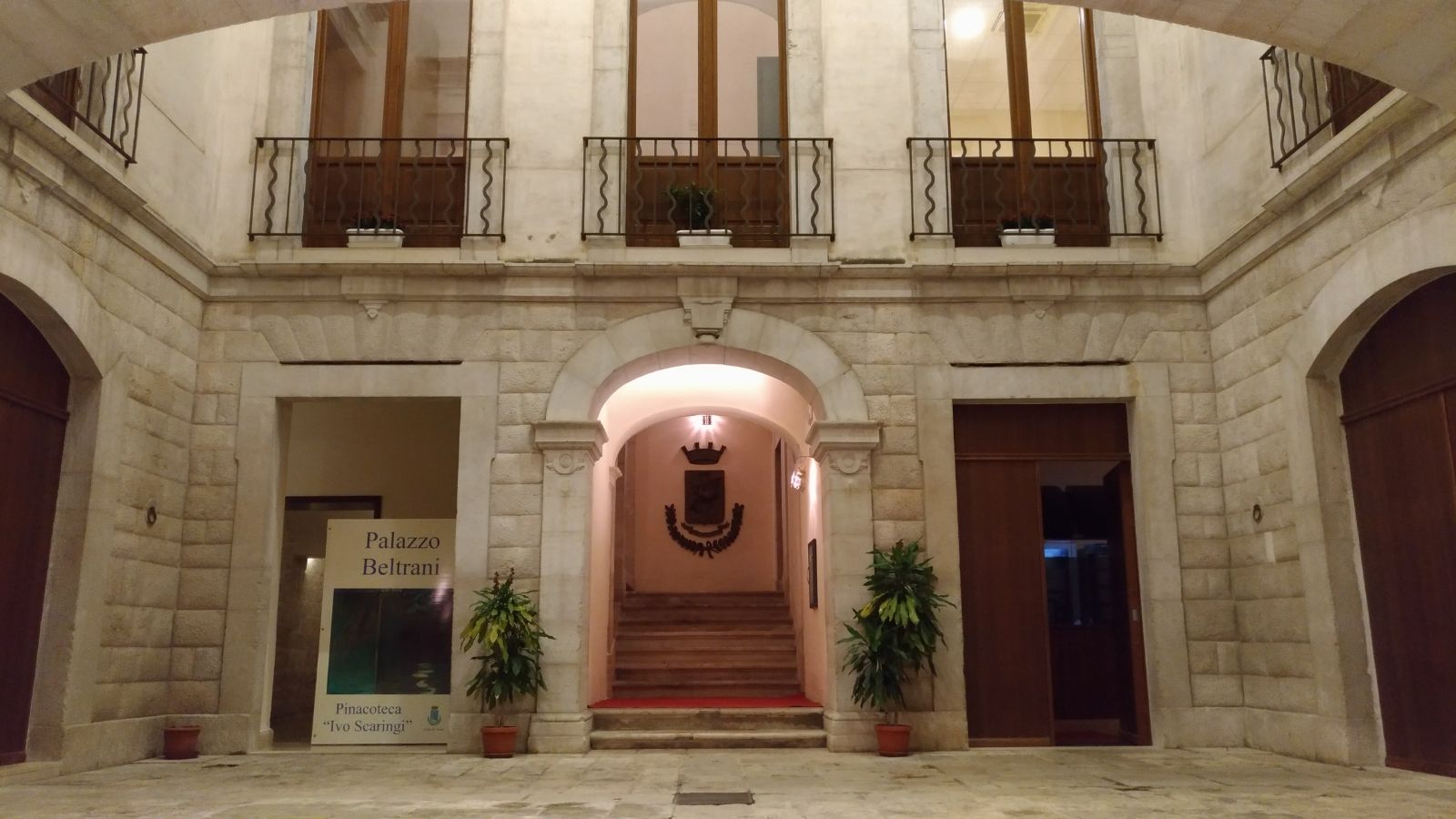
8 Palazzo delle Arti Beltrani
The Palazzo delle Arti Beltrani is a multifunctional museum and cultural center of reference in Trani. The museum hosts various collections related to the history of the city and its illustrious figures, which have significantly expanded over time.
Inside the palace, there is also a substantial collection of texts with historical and artistic content, specializing particularly in art history. These texts, acquired through legacies and donations, are available for consultation in the museum’s Consultation Center.

9 Where to eat in Trani
It is not difficult to find a good place to eat in Trani. Throughout Puglia and Trani is no exception, the food is truly a delight for the palate. The historic center of Trani is full of typical local cuisine trattorias but also in the streets overlooking the port, the offer is varied. Before deciding where to eat, consider your budget and your appetite. You can thus select inexpensive taverns or restaurants with gourmet cuisine. Ristorante Chef da Savino is one of these. Excellent service and tasty gourmet dishes just steps from the port. Recommended by Anna and Raffaele of FullTravel.it.

10 Where to sleep in Trani
Finding a hotel in Trani at a good price is not entirely difficult. The city offers good hospitality with accommodations for all budgets as well as many extra-hotel offers. It depends on your needs and, undoubtedly, on your budget.

Trani is a city that offers a perfect mix of history, culture, and natural beauty. Whether you decide to visit it for a day or dedicate an entire weekend, Trani will surprise you with its unique charm and rich cultural heritage. From the majestic Swabian Castle to the beautiful Cathedral by the sea, passing through the picturesque historic center and the characteristic Jewish quarter, Trani is a destination that will enchant every type of visitor.