


Edouard André came from a very wealthy family of bankers active in Paris in the 19th century. Around 1869 he decided to build his residence on a 5,700 square meter plot in the elegant Boulevard Haussmann, newly created with the urban revolution of the Grands Boulevards. The villa was inaugurated in 1876 with a lavish reception attended by all the high society and Parisian celebrities. Meanwhile, in 1872, Edouard commissioned his portrait from Nélie Jacquemart, a young painter who had gained a good reputation as a portraitist. In 1881, when Edouard was 48 years old, he decided to marry Nélie.
A Couple of Art Collectors
The marriage fueled the gossip of the time, since the two came from completely different families, both culturally (he was a Protestant Bonapartist and she a Catholic pro-monarchist) and economically. Furthermore, they did not have any children, which led to speculation that there was no particular romantic attachment between them. What actually made the marriage work and made it unique was their shared passion for art collecting. The couple regularly traveled to the Near East and Europe, especially Italy, to purchase artworks.
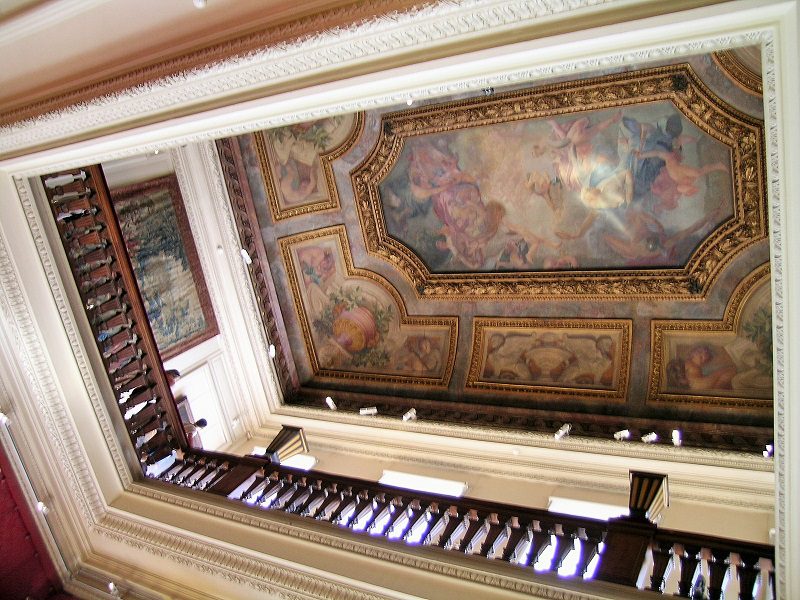
Together they collected 207 sculptures and 97 paintings. Among these, the acquisition of the Tiepolo frescoes from the Villa Contarini Pisani in Mira (near Venice), which adorn four rooms of the residence, was almost epic. The frescoes were discovered by the couple during a trip to Italy in 1893. The main scene, which decorates the staircase of the winter garden, depicts the stop of Henry III in Venice while he was on his way from Poland to Paris to become King of France, and his visit to the Doge Contarini right in the villa from where the paintings originate. The transport from Venice to Paris and reinstalling them in the Jacquemart-André residence took eight months, also because some architectural adjustments of the house were necessary. Additionally, the main painting was divided into two parts and the second part was relocated to the ceiling of the dining room.
Edouard was able to enjoy the view of the Tiepolo frescoes for only a few months as he died, just sixty, in July 1894. His family tried to seize the estate, but a prenuptial agreement had protected Nélie, who was thus the sole heir. Nélie arranged that upon her death, the house with all the works would pass to the state. She set the condition that the artworks remain exactly as she had arranged them. Therefore, the visit route faithfully follows her conception.

The representative rooms and the informal apartments
The first rooms you visit are the representative ones, where the couple’s social life took place. The stylistic theme is the art of the 18th century, well represented by the paintings and marble busts on display, but also recalled by the semicircular shape of the main room, the grand salon. Guests entered the painting gallery, which served as a waiting room, and were welcomed by paintings by Canaletto, Boucher, Chardin, and Nattier. The grand salon was the heart of this area; on the occasion of the most important receptions, it was connected to the adjacent painting gallery and music room thanks to a hydraulic system that allowed its partition walls to be opened. The single large environment thus created could accommodate up to a thousand people. The original dining room is today the museum restaurant and offers the unique opportunity to take a break surrounded by 18th-century Brussels tapestries and the ceiling frescoed by Tiepolo, with a view of the villa’s garden.
The informal apartments were the rooms where the spouses conducted their affairs. Although less emphatic than the representative rooms, they are equally a treasure trove of works of art, arranged consistently with the function and style of the various environments. Among the furniture, all from the finest manufactories of the 17th and 18th centuries, stands out an inlaid console commissioned directly by Louis XVI as a gift for Mademoiselle de Fontanges. The tapestry room was built entirely around the three tapestries from the Beauvais manufactory that Edouard already owned before building the house. And then, of course, there are the paintings: the study houses a collection of 19th-century French artists, while the library is decorated with works by Dutch and Flemish painters including Van Dyck and Rembrandt. One must not forget to look up to admire the ceilings, with frescoes by Tiepolo from Villa Contarini Pisani in the study and boudoir, and by Tintoretto in the smoking room.
At the extreme east side of the ground floor is the winter garden. Being adjacent to the music room, it allowed guests at receptions to relax in a bright environment decorated with Roman statues, plants, marble, and mirrors. The main element of the winter garden is the beautiful monumental double helix staircase, made light by a very fine wrought iron and bronze railing. The wall hosts the fresco from Villa Contarini depicting the visit of Henry III.
The Italian Museum
A good part of the first floor was originally intended to be Nélie‘s painting studio. However, she gave up practicing this art shortly after marriage. At the same time, the couple discovered they were passionate about Italian Renaissance art and adopted the custom of traveling to Italy once a year to purchase works from this period. This space therefore became the treasure trove of Renaissance collections, with a true museum-like setup. Unlike the reception rooms, only close friends had the privilege to visit this part of the house. Besides the sculpture gallery, which features a wonderful Donatello bronze plaque depicting the martyrdom of Saint Sebastian, the other two rooms that compose it are crucial to understanding the taste of the two spouses.
For Nélie, the best art was that coming from Florence. Thus, she set up a room whose central theme is Florentine religious art. This environment has the appearance of a chapel because it features some altarpieces, funerary monuments, and stalls. The paintings, although small, are among the most precious works of the entire collection. Indeed, there is a Saint George and the dragon, a symbolic and emblematic work by Paolo Uccello whom Nélie courted for years after seeing it in the Florentine home of an antique dealer, but she could only purchase it at an auction in London in 1899 because she would not have been allowed to take it out of Italy after the controversies erupted regarding the acquisition of the Tiepolo frescoes. Then there is a pair of Madonnas with Child, works respectively by Botticelli and Perugino. The composition type is similar, as the two painters came from the same school and both were inspired by Andrea Verrocchio, to the point that when Nélie bought the Botticelli, she initially thought it was actually a Verrocchio.
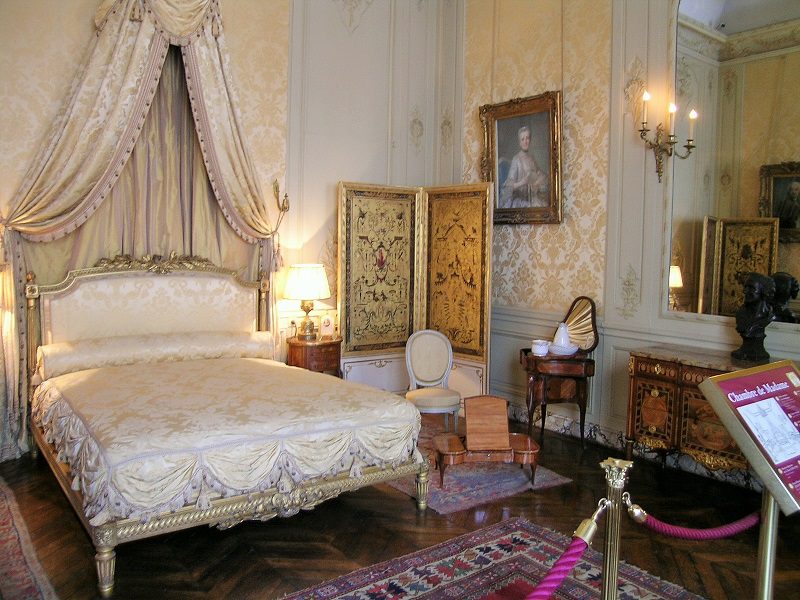
Edouard, instead, preferred Venetian and Northern Italian art, a less common choice among collectors of his time. His Venetian gallery combines religious subjects (including a Madonna with Child by Bellini and an Ecce Homo by Mantegna) with mythological subjects like the Visit of the Amazon Hippolyta to Theseus by Carpaccio. The visit concludes with the most intimate part of the house: the spouses’ bedrooms.
The Domaine de Chaalis
There is another place linked to the history of Nélie Jacquemart and it is the Domaine de Chaalis, an estate 40 kilometers from Paris, in the heart of the Valois. Widowed, after resolving the disputes related to her inheritance, Nélie undertook a world tour in 1901. Returning the following year, she purchased the Domaine and dedicated herself until her death to furnishing it and setting up a collection of marble busts and art objects that ideally tell the story of the royal abbey that is part of the complex.
In this arrangement, as well as in that of the house in Paris, Nélie reveals her desire to share over time her passion with those who, like her, love art and history.



