


Bari, capital of Apulia and lively Mediterranean port, always deserves a visit, a stroll among the elegant shops of via Sparano, a stop in the typical bars and restaurants, many of which nestle in the characteristic medieval old town, refurbished and relaunched on a grand scale for some years now. Residents of Bari can use the Bari Palese airport, located nearby. In the surroundings, a low-cost airport parking Bari for departures but also for those who want to leave the car and move on foot.
- 1 Old Bari
- 2 Norman Castle of Bari
- 3 The San Nicola Pier
- 4 Via Sparano
- 5 Crollalanza Seafront and Petruzzelli Theatre
- 6 Nicolaian Museum
- 7 Medieval and Modern Art Museum and Art Gallery
- 8 Cathedral Museum (Diocesan)
- 9 Bari Civic Museum
- 10 Romita Museum
- 11 Botanical Garden of Bari
- 12 Palazzo Simi
- 13 Earth Science Museum
- 14 Bari Zoology Museum
- 15 Palace of the Apulian Aqueduct
- 16 Ethnographic Museum Africa-Mozambique of Bari
- 17 Museum of the Overseas War Memorial
- 18 Other places to visit in Bari
- 19 Around Bari: Torre Pelosa
- 20 What to eat in Bari

1 Old Bari
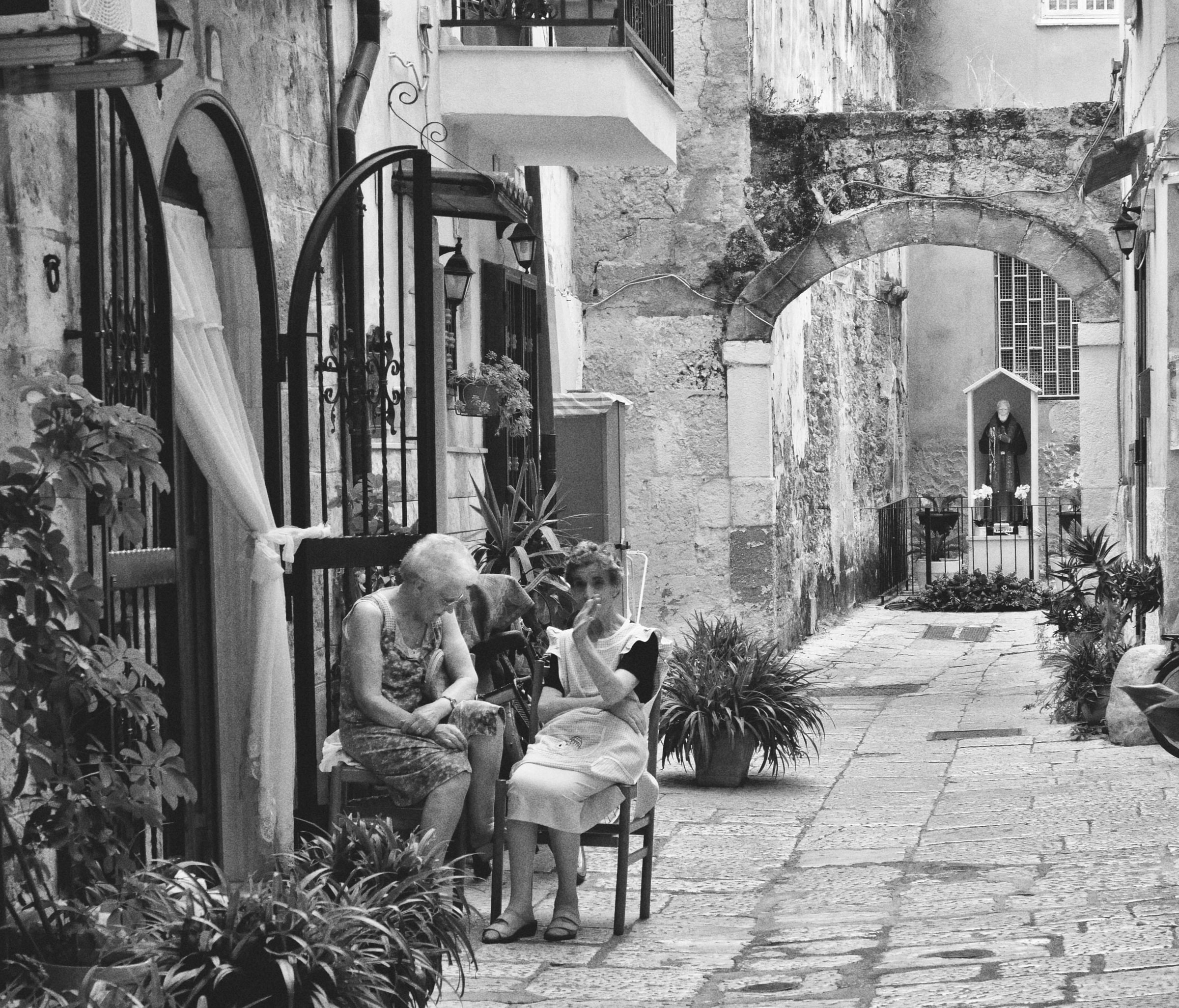
Around Old Bari nestle the most significant monuments, pride and joy of the entire city: the imposing Norman-Swabian-Aragonese castle and the Cathedral of San Sabino, located right at the gates of the old city which is presented with a picturesque tangle of alleys, small squares, courtyards, votive shrines, and symbols against the evil eye and slander. Sounds and voices of the local dialect echo in the alleys, becoming one with the surrounding environment. Here is the Basilica of San Nicola, patron saint of Bari. It is here that the saint’s relics arrived from the east in 1807 and have been preserved since then, even though the cathedral was consecrated only in 1197. The interior and exterior of the Basilica are the product of high-quality Apulian Romanesque architecture.

2 Norman Castle of Bari
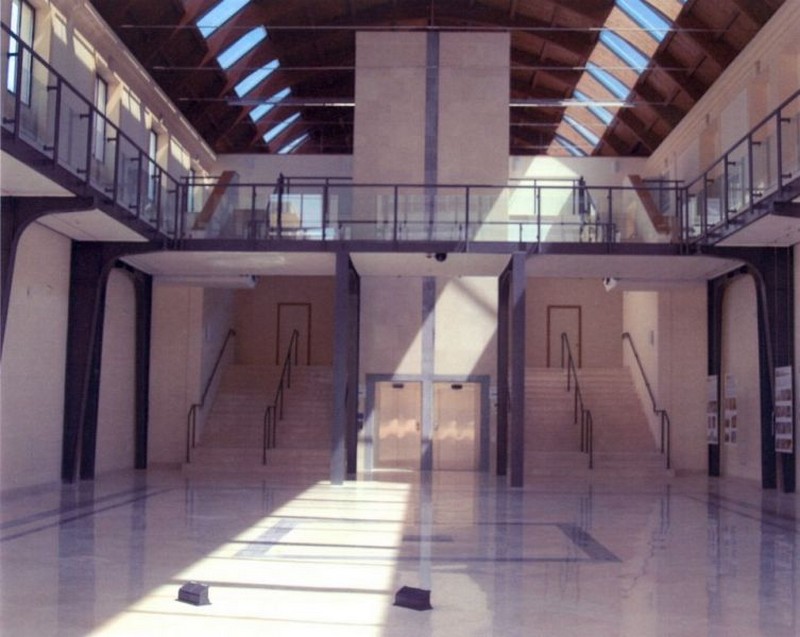
Il Castello di Bari, historically attributed to Roger the Norman, was erected in 1131; it stands on pre-existing residential structures from the Byzantine era. The restoration of the castle damaged by William the Bad (1156) is owed to Frederick II of Swabia between 1233 and 1240, using the previous layout and the surviving structure of the outer walls and towers. During the Angevin period, under Charles I, important restoration works were carried out by the protomagistri Pietro d’Angincourt and Giovanni di Toul. In the 1500s, under Isabella of Aragon and her daughter Bona Sforza, the bastioned wall and central courtyard with the double-ramp staircase were built. In the nineteenth century, the castle was used as a prison and later as a barracks.

3 The San Nicola Pier
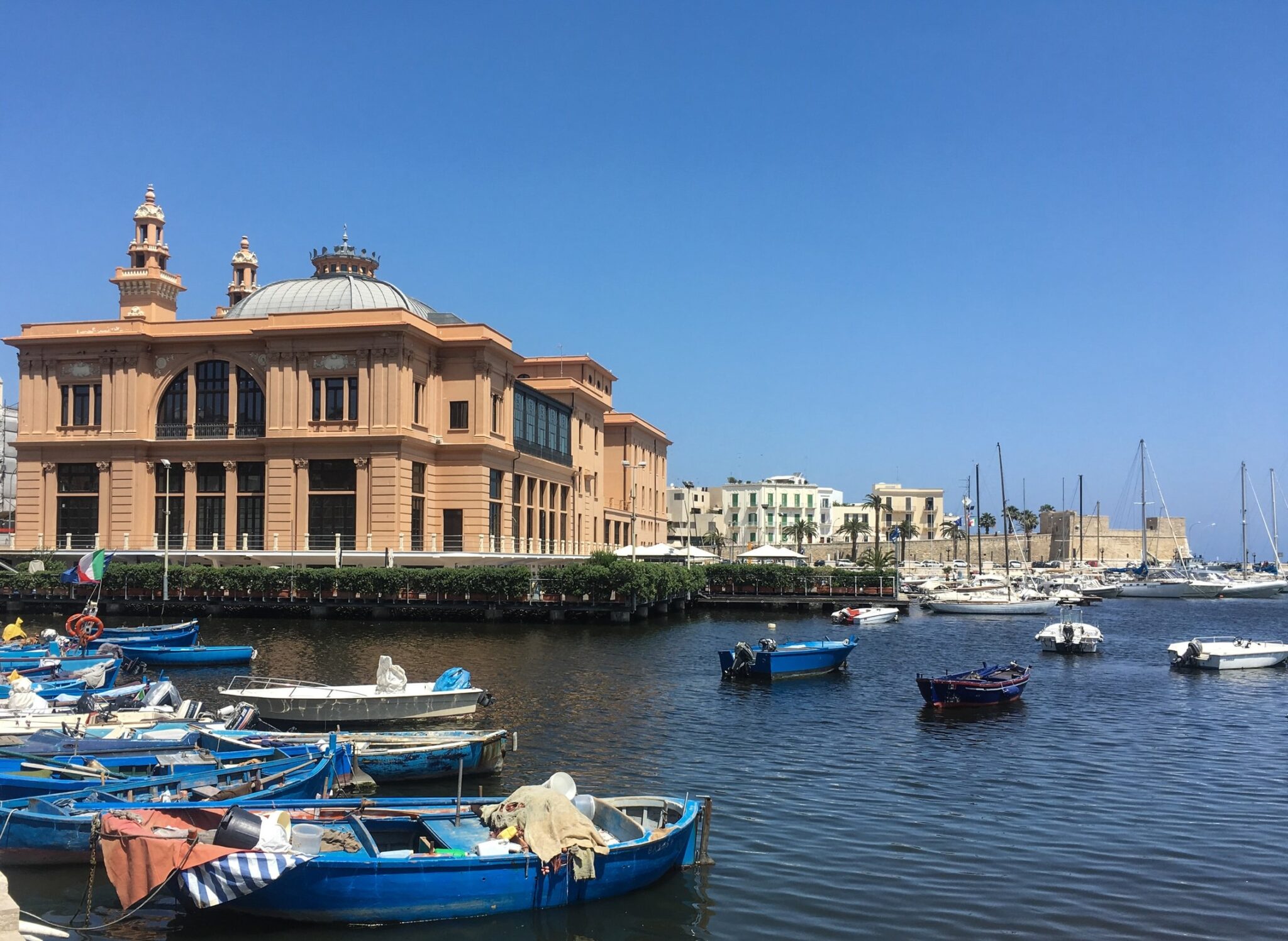
A few steps away, behind the ruins of the Teatro Margherita, the small harbor appears, a gathering place for old and new sea wolves, with the San Nicola Pier and the famous “nderr alle lanze,” the spot where fishing boats dock with their catch of seafood, which also supplies nearby restaurants and market stalls. One could spend hours watching fishermen “arricciano” the octopuses, beating them vigorously on the ground or with a sturdy wooden spatula to tenderize the meat before cooking.
4 Via Sparano
A few steps along the right-angled streets of the Murattiano district lead to the heart of the commercial city: via Sparano, Bari’s most elegant street, with sparkling shop windows full of refined goods, but also places rich in history and culture, such as the Laterza Bookstore, housed in the former premises of the glorious publishing house, with which Benedetto Croce also collaborated, as a plaque on the building recalls.
5 Crollalanza Seafront and Petruzzelli Theatre
The Adriatic is always there, just a stone’s throw away, witnessing the daily stroll on the Crollalanza Seafront, an architectural expression of the Fascist era. It is the meeting point for a chat before and after dinner; while for swimming and sunbathing, people rely on the golden and welcoming beaches of Giovinazzo, Polignano a Mare, and Monopoli. Not far away is the Petruzzelli Theatre, one of the largest in Italy, inaugurated in 1903. It was destroyed by a fire in 1991 and returned to the city in 2009, entirely rebuilt exactly as it was.

6 Nicolaian Museum
The Nicolaian Museum of Bari, inaugurated on February 6, 2010, houses important objects related to the Basilica of Saint Nicholas. Paintings and sacred vestments, inscriptions, parchments, and illuminated manuscripts coming from the Archive of the Basilica, as well as precious objects offered by pontiffs, pilgrims, and bishops such as enamels, coats of arms, reliquaries, chalices, and silverware from the Treasury. Of particular interest is the exhibition of two significant artifacts discovered during excavations carried out over the last decade in the Nicolaian Citadel under the scientific direction of the Superintendency for Archaeological Heritage of Puglia. These are the Roman-era entablature block and the medieval pilgrim badge (13th-14th century) depicting Saint Nicholas, recovered respectively from the subsoil beneath the Nicolaian Museum and the Library of the Nicolaian Studies Center. The Nicolaian Museum, which gathers the most valuable pieces related to the centuries-old history of the Basilica of Saint Nicholas, is a great attraction for anyone interested in the Saint as well as in the civil, artistic, and religious history of the city of Bari. Starting from antiquity, it covers the Byzantine (876-1071), Norman (1071-1194), Swabian (1194-1266), Angevin (1266-1442), Aragonese (1442-1501), Viceroyal (1551-1734), Bourbon (1734-1861), and post-unification periods. Inscriptions, parchments, and illuminated manuscripts (from the precious Archive of the Basilica), enamels, coats of arms, reliquaries, chalices, and silverware (from the Treasury), paintings, and sacred vestments allow the visitor to come into direct contact with masterpieces and documents that have made the history of the Saint, the Basilica, and the City.
7 Medieval and Modern Art Museum and Art Gallery
The Medieval and Modern Art Gallery of Bari was established on July 12, 1928. The collection was formed through the merging of the core of paintings already preserved in the Gallery annexed to the Provincial Archaeological Museum founded in 1875, other paintings deposited by Apulian churches and convents (the deposit from the Archiepiscopal Curia of Bari was particularly important), works obtained on deposit from the National Galleries of Naples and Rome, and others purchased by the Provincial Administration of Bari itself. From its founding until 1936, the Gallery was housed in the Government Palace. Starting from 1936, it was moved to the Province Palace, built based on a design by engineer Luigi Baffa, where it is still located. Since 2002, it has been named after the Apulian painter Corrado Giaquinto, born in Molfetta in 1703 and died in Naples in 1766, whose seven works are exhibited in the Museum.
8 Cathedral Museum (Diocesan)
On June 7, 1981, the Archbishop of Bari Mons. Mariano Magrassi established the Diocesan Museum of Bari. The intent was inspired by the directives of the Second Vatican Ecumenical Council, to ensure that “the sacred furnishings and precious works that adorn the house of God are not alienated or dispersed.” Initially, it served as a depot for works of art and sacred furnishings from churches in a state of abandonment in the old city of Bari and the entire diocese. The Museum was officially inaugurated on June 16, 1983. On September 12, 1996, the first exhibition of the Treasure Room, the Exultet Room I, and the art gallery was completed. On September 11, 1998, the second phase was inaugurated, consisting of the creation of the lapidary, the Benediction and Exultet Rooms II and III, and the room of sacred vestments. With the relocation of the Curia offices by Archbishop Francesco Cacucci, the remaining space on the first floor was also dedicated to the museum.

9 Bari Civic Museum
In 1913, to celebrate the centenary of the founding of the Murattiano district, the Civic Administration organized and set up a “Historical Exhibition of the 19th Century.” Following the great success of this initiative, the Municipality decided to create a “Historical Museum” which was inaugurated on January 26, 1919, in some rooms annexed to the Teatro Margherita. A “War Exhibition” was also organized, including the De Gemmis brothers’ library and some important collections of documents and weapons (including those of generals Bonomo and De Bernardis).
The Museum, appointed as a Moral Entity by Royal Decree on March 4, 1926, was increasingly enriched with interesting material, such as the Tanzi family archive and paintings. In the ’40s the premises were requisitioned by Anglo-American troops to be used as a recreational club for the soldiers, and much of the material was lost. Only after several years could the Museum reopen to visitors in new premises made available by the Municipal Administration. Since 1977 it has been housed in Strada Sagges, in an ancient palace, whose structure is peculiar to medieval palatial houses.
10 Romita Museum
Barese trained at the Royal Academy of Physical and Mathematical Sciences of Naples, de Romita was a professor of natural sciences at the Royal Technical and Nautical Institute of Bari. The museum represents the idea of redeveloping and restoring a naturalistic collection of historical-cultural and scientific importance kept for over a century at IISS Pitagora in Bari, where the same curator, the illustrious naturalist Prof. Vincenzo de Romita, created it at the end of the 1800s, earning the reputation as the father of ornithology and environmentalism in Puglia. It hosts several series of animals, including various species of birds not easy to find in southern Italy; reptiles, such as the variety Coluber leopardinus; fish with a fetus of a two-headed shark. Finally, among insects, the Ciccindela dilacerata appeared for the first time in the Fauna of the Neapolitan provinces.
11 Botanical Garden of Bari
The current Botanical Garden of Bari Institute was established in 1955, when a villa on the outskirts of the city with an adjoining agricultural land of 5,000 sqm was donated to the Faculty of Science. The first attempt to create a Botanical Garden in Bari dates back to August 1813; a decree by Gioacchino Murat mandated that every provincial capital have an Agricultural Society (later called Economic Society) with an attached Garden for the experimentation and production of agricultural and ornamental plants. This Botanical Garden had a very short life because the return of the Bourbons to the throne of Naples forced the newly formed Society to abandon the recently set up premises and move to makeshift locations. In 1858, after long disputes, the Municipality of Bari granted a land of 52 moggie near the coast, where the Economic Society building with an adjoining Garden was erected. This second attempt also failed due to the annexation of the Kingdom of the Two Sicilies to the Kingdom of Italy. Subsequently, by the decree of Vittorio Emanuele II on February 11, 1886, the Society was permanently dissolved. In 1964, after a few years from the founding of the Institute in 1955, the area of the Garden was doubled. The new area was organized giving priority to the regional flora.
12 Palazzo Simi
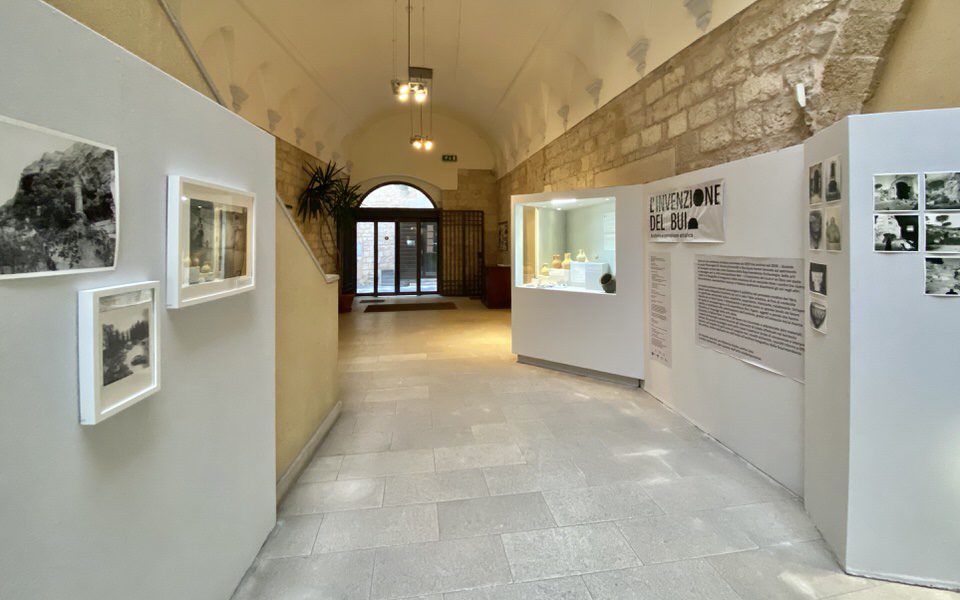
Palazzo Simi, current headquarters of the Operational Center for Archaeology of Bari, is a Renaissance-era house that seals a dense and tight archaeological layering both vertically and horizontally. The wall stratifications that can be visited in the palace’s underground chambers refer to the Early Middle Ages and the Romanesque period, built on the remains of the imperial era (1st century). The elegant spaces on the ground floor and upper floors are the result of expansions and transformations of the original medieval nucleus into a historic residence, carried out between the 16th and 17th centuries.
13 Earth Science Museum
The Earth Science Museum of the Department of Earth and Geoenvironmental Sciences at the University of Bari Aldo Moro is based on the historical collections acquired by our University in the second half of the 1950s. The collections were kept until 1985 in the Palazzo Ateneo, then they were transferred to the Department of Earth and Geoenvironmental Sciences at the Palazzo di Scienze della Terra of the University Campus in special rooms intended for museum exhibition. Currently, the Earth Science Museum includes a Geopaleontological sector and a Mineralogical-Petrographic sector and overall has an area of about 1000 sqm.
14 Bari Zoology Museum
The Museum of the ’’Lidia Liaci’’ Department of Biology at the University of Bari Aldo Moro was founded in 1925. After some changes of location, in 1992 the Museum rooms were transferred to the university Campus. Today, it is an exhibition facility of about 170 m2, divided into two rooms and houses just over a thousand zoological specimens. It conducts research, environmental conservation, educational and scientific dissemination activities. The educational activity is aimed at students of natural, biological and environmental sciences and consists of practical exercises in the recognition and surveying of specimens, film screenings, and seminars. The outreach activity, on the other hand, is carried out through guided tours for school groups of all levels, film screenings, the use of multimedia technologies, and lecture series on aspects of animal life and nature conservation. It is part of the Interdepartmental Service Center for Scientific Museology (CISMUS) and collaborates with numerous organizations for the study and protection of Apulian ecosystems.
15 Palace of the Apulian Aqueduct
The Palace of the Bari Aqueduct (Water Palace) was designed in 1924 by engineer Cesare Brunetti and completed in 1932. The style expressly referenced in the construction of the building is ‘900 Cambellotti. The furnishings and the creation of the decorations were commissioned from Duilio Cambellotti, who was inspired by the theme of water, using specialized companies for the production of furniture, stained glass, and marble, terracotta, and wrought iron decorations. In 2000, the building underwent some transformations, especially on the first floor, for the opening of a museum of the History of the AQP and a conference room.
16 Ethnographic Museum Africa-Mozambique of Bari
The Africa Mozambique Ethnographic Museum was inaugurated in 1980. Work on its creation began as early as the 1950s when the first Missionary Fathers arrived in Puglia. After 1950, at various intervals, the Missionaries continued to come to Italy for holidays and rest, bringing numerous and different local handcrafted objects from Africa. These artifacts, initially collected in a room of the Sanctuary of Santa Fara, later, with the creation of the museum, formed the core of the museum.
17 Museum of the Overseas War Memorial
The Overseas Military War Memorial, created by engineers from the Ministry of Defense, was inaugurated on December 10, 1967. It houses the mortal remains of over 75,000 fallen soldiers, of whom 45,000 are unknown, brought back to the homeland following the decommissioning of war cemeteries built in overseas territories where Italian units operated during the First and Second World Wars (Balkans, North and East Africa). The large surrounding area, arranged as a park, hosts the open-air Museum with monuments to the fallen and military memorabilia. This Memorial is responsible for the Polish Military Cemetery in Casamassima, which holds the remains of 431 Polish soldiers from the Second World War.
18 Other places to visit in Bari
19 Around Bari: Torre Pelosa
In the hamlet of Torre a Mare di Bari, around 1500, to defend the coast from raids by pirates and robbers who infested the Adriatic Sea, a watchtower was built, still existing in the center of the main square. Since then, the locality took the name “Torre Apellosa” or “Torre Lapillosa“, later transformed into “Torre Pelosa”, and became a small fishing village whose inhabitants mostly lived in trulli and natural caves and repaired their boats in the small harbor at the mouth of Lama Giotta.
20 What to eat in Bari
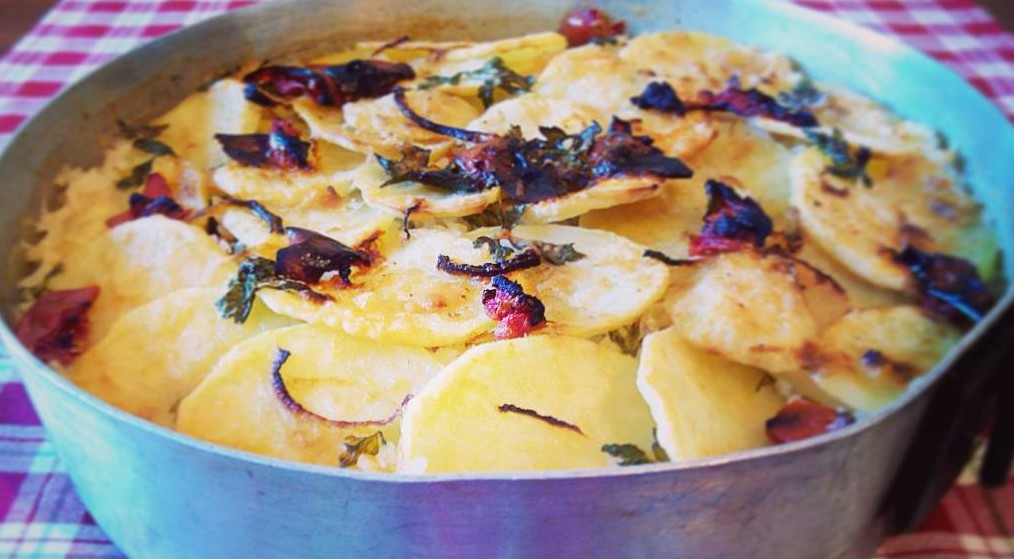
The dishes from Bari borrow from the Apulian cuisine although there are some that are purely local. Among these certainly the Bari tiella (rice, potatoes, and mussels) but there are also other dishes to enjoy. In this regard, we have written an article with some suggestions on what to eat and where in Bari.