

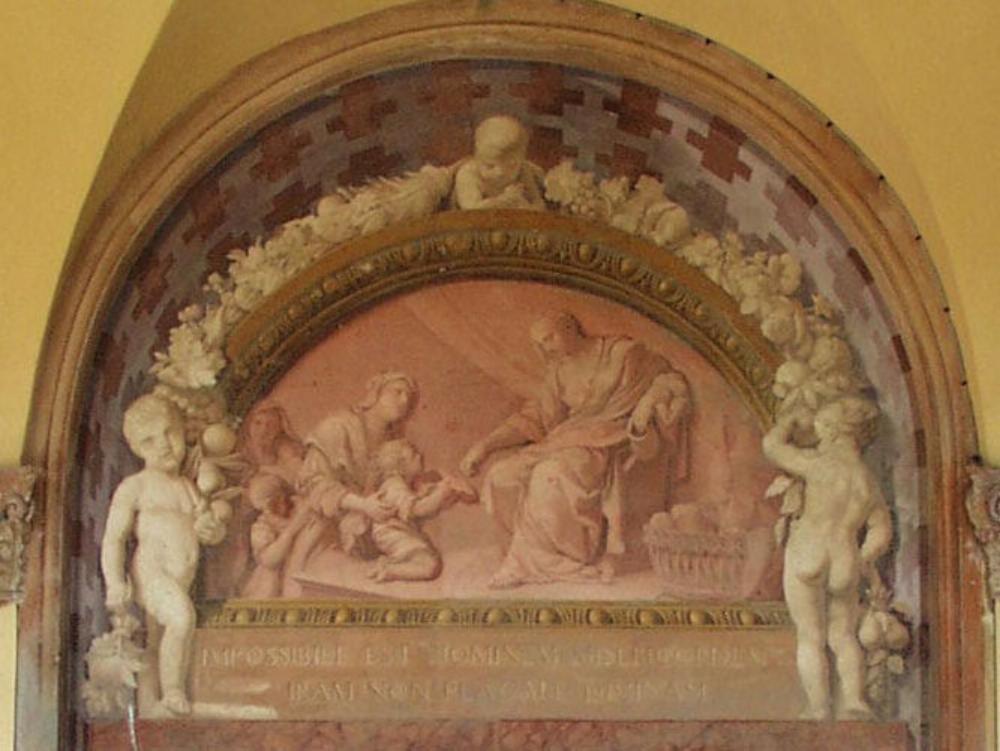


Il Cimitero della Certosa di Bologna, among the most significant monumental complexes in Europe, was established in 1801 at the monastery of the Certosa di san Gerolamo di Casara, suppressed in 1797. This building, outside the city walls and in a peripheral area as prescribed by the hermitic vocation of the order, was founded in 1334 thanks to a bequest from the jurist Giovanni d’Andrea; in 1359 the church was consecrated, enriched over time by the commissions of the Carthusians. Many and valuable were the works of art that decorated it, such as, for example, the polyptych by Antonio and Bartolomeo Vivarini dedicated to Blessed Nicolò Albergati, which was moved during the Napoleonic era to the National Art Gallery of Bologna along with paintings by Guercino and Ludovico and Agostino Carracci. Large altarpieces by Bartolomeo Cesi, Giovanni Andrea and Elisabetta Sirani, Lorenzo Pasinelli, Domenico Maria Canuti, Giovanni Maria Galli Bibiena, and the Neapolitan Nunzio Rossi remain in their original locations. The choir inlaid by Biagio de’ Marchi (1538) is precious. In the first decade of the 17th century, Tommaso Martelli designed the main bell tower, while in 1768 Gian Giacomo Dotti designed the monumental entrance to the monastery, the principal house of the entire Order since 1792. In 1869, a very important Etruscan necropolis was discovered on the same site and identified by Antonio Zannoni: 417 were the tombs from which materials were gathered and housed in the Etruscan section of the Civic Archaeological Museum of Bologna, a reference point for the study of a chronological period called the “Certosa phase.” The first phase of recovery of the monastery premises used as a cemetery according to the concepts of Enlightenment hygienism is testified by a series of drawings by the architect Angelo Venturoli, who, along with Luigi Marchesini, planned the reuse of the pre-existing spaces. In 1802 Ercole Gasparini conceived the monumental entrance from which the straight avenue leads to the Chapel of Suffrage (1811), and promoted the construction of a portico connected to that of San Luca. The use of spaces for burial purposes proceeded from the Third Cloister to the entrance Cloister and to the rooms of Pietà and Tombs. Among the most scenic places of this site, defined as a “Cemetery that can be called Museum” by Aleksandr Turgenev and visited by Byron and Leopardi, the Loggia of the Tombs (1833), reworked by Coriolano Monti, and the Aula Gemina, dominated at the center by the monument to the agronomist Giovanni Francesco Contri (Salvino Salvini, 1873), are particularly notable. Already from the first quarter of the 19th century, tombs commissioned by the Bolognese aristocracy to the most important sculptors of the time had been erected: notable monuments include Acquisti (Luigi Acquisti, 1823), Angelelli (Lorenzo Bartolini, 1827), Murat Pepoli (Vincenzo Vela, 1864), Baruzzi (Cincinnato Baruzzi, 1878), Bisteghi (Enrico Barberi, 1891). Many tombs were decorated with frescoes by prestigious painters such as Pietro Fancelli, Flaminio Minozzi, Filippo Pedrini, Antonio Basoli, Pelagio Palagi. Solid frescoes depicting the Virgin, coming from other religious buildings, were transferred to the “Madonnas” cloister. Among the monuments of the early 20th century is the monument to the Fallen of the First World War at the center of Cloister VI (Ercole Drei). Attached to the cemetery are spaces for Non-Catholics (1822), the Jewish cemetery (1869), the crematory altar, and the columbarium (1888). Among the famous burials are those of Carlo Broschi called Farinelli, Isabella Colbrtan, wife of Rossigni, Gioacchino Napoleone Pepoli, Giuseppe Grabinski, Giosuè Carducci, Marco Minghetti, Enrico Panzacchi, Riccardo Bacchelli, Ottorino Respighi, Giorgio Moranti, Giovanni Cappellini, and other famous figures. In 2008 the Pantheon at the Certosa, a space intended for secular rites, was enriched and renewed with the installation “Waiting Room” by the artist Flavio Favelli, who did not alter the pre-existing space but redesigned it through careful measures. The new black and white marble flooring rests on wooden panels so as not to damage the original; the walls are adorned with curtains that nevertheless leave the ivory-colored columns uncovered; opposite the entrance is a large mirror, and the room is illuminated by 25 crystal chandeliers. The whole is completed on the sides by wooden benches arranged in an amphitheater style and centrally there is a stage, made of a wooden floor, suitable for hosting the coffin.
Information on the Certosa Monumental Cemetery
Via della Certosa, 18,
40121 Bologna (Bologna)
051 204 640, 051 615 086 8
[email protected]
Source: MIBACT