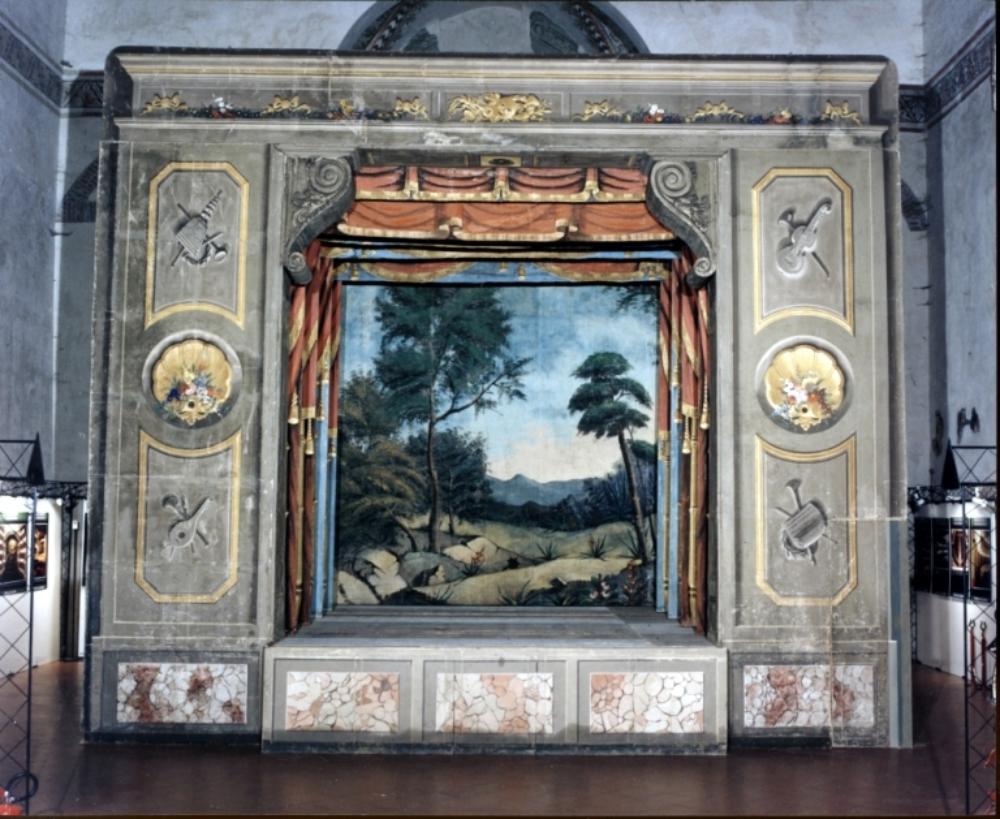


Testimonianza importante per far conoscere e approfondire gli studi di uno dei settori “popolari” del teatro italiani, The Puppet House of Ravenna brings together about sixty marionettes, 150 puppets, over a hundred scenic designs, as many handwritten scripts, and numerous paper tour materials (posters, letters, notices, permits), as well as scattered materials (wooden heads, puppet hands, costumes for puppets and marionettes). The marionettes come from the “Fantocci Lirici Yambo” company of Enrico Novelli (1875-1944), from the Picchi Family, and obviously from the family company.
Among the puppets, a series of traditional Emilian masks (Fagiolino, Sandrone, Doctor Balanzone) stand out; these belonged to the Burattineide company of Agostino Galliano Serra, found by a researcher in an ancient Bolognese church and added to the Collection in recent decades. Among the handwritten scripts, twelve are of significant value, as they were written in the first half of the nineteenth century by Ariodante Monticelli, the family founder; the others bear the signatures of other generations of the family: Vittorio Cesare Monticelli, Genoveffa Peli Monticelli, Otello Monticelli, Vasco Monticelli, William Monticelli; the rest are the work of well-known theatrical artists of marionettes and puppets: Enrico Novelli, the Picchi Brothers, Ettore Forni, Ciro Bertoni, Agostino Galliano Serra, just to name a few.
Particular exceptions are represented by some scripts by Mario Bellio. The scenic designs are all paper except for one in canvas, gifted to Otello by the famous Bolognese puppeteer Ciro Bertoni. Many of these were originally made for the marionette theater, with lengths reaching six to seven meters wide and three to four meters high, but largely have been resized to be used in the puppets’ “hut.”
The valuable scenic designs belonging to the Picchi Family and the founder Ariodante Monticelli date back to the first half of the nineteenth century, while those painted by Agostino Galliano Serra are from the early twentieth century, and those created by William Monticelli are from the immediate post-war period. An exhibition section (puppets, scenic designs, posters) is also dedicated to the last twenty-five years of work of the Teatro del Drago, founded in 1979 by Andrea and Mauro Monticelli.