


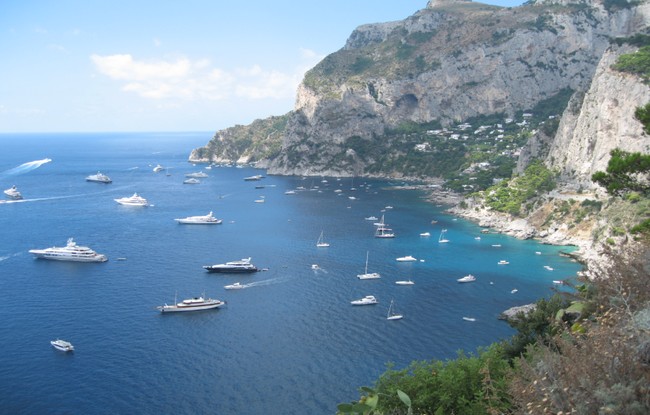


The writer Curzio Malaparte wanted to build Villa Malaparte in Capri, at Capo Massullo, between the blue sea and the green Mediterranean scrub.
Villa Malaparte Capri
“There was in Capri, in the wildest, most solitary, most dramatic part, in that part all facing south and east, where the Island becomes fierce from human, where nature expresses itself with an incomparable, cruel force, a promontory of extraordinary purity of lines, thrown into the sea like a claw of rock“, he wrote. And then. “no place in Italy has such a breadth of horizon, such depth of feeling. It is a place, certainly, only suitable for strong men, for free spirits“.
Curzio Malaparte
Histrionic, unpredictable, and contradictory, Curzio Malaparte was a fascist and a maoist, atheist in life and Christian on his deathbed, war correspondent, diplomat, director, poet, editor, and newspaper director. Above all, he was a writer of penetrating lucidity. And it is precisely that life, as extraordinary as ambiguous, that made the author of Kaputt one of the most debated figures of the twentieth century. Intellectuals loved and execrated him. Antonio Gramsci in his Prison Notebooks called him “a man of immense vanity and chameleon-like snobbery, capable of any villainy for glory.” For the publisher Piero Godetti, instead, he was “one of the finest signatures of fascism”.
In any case, Curzio Malaparte was a major protagonist in international culture.
In 1925, after reading a pamphlet from 1869 titled “The Malapartes and the Bonapartes,” the young writer Kurt Erich Suckert, son of a Saxon dyer who had moved to Tuscany, decided to change his name. He was undecided between Curzio Farnese, Curzio Borgia, Curzio Lambert, or Curzio Malaparte. He chose the last one because he found it more attractive than the others, and when Mussolini asked him why that name, the answer was “I chose Malaparte because Bonaparte ended badly, but I will certainly do better.” The writer was convinced that this new pseudonym would have a strong impact on his readers. Indeed, thanks to both his talent and his new identity, fame quickly arrived.
Although he was among the founders of the Fascist Party, Curzio Malaparte was an atypical fascist. On one hand, he considered Mussolini the best student of Lenin and Trotsky, and on the other, with the essay “Technique of a Coup d’État” published in Paris in 1931, he denounced Hitler’s tyranny. Following a series of defamatory letters sent to Italo Balbo, the Duce punished him and expelled him from the party, sentencing him to five years of confinement on the island of Lipari. The accusation was twofold: antifascist propaganda abroad for the book published in France and defamation of a minister in office for the letters to Balbo. After seven months in exile on Lipari, the writer was transferred to Ischia for health reasons, and then, thanks to his friendship with Count Galeazzo Ciano, Mussolini’s son-in-law, obtained a reduction of his sentence and transfer to Forte dei Marmi, where he served it.
During a period of surrealist searching, Malaparte describes his inner metamorphoses, and in his books he transforms into a woman, a dog, a tree, a saint. Then, with the article “City like me” published on February 14, 1937, the writer expresses his desire to become a building. He wants to turn into shutters, stairs, and plaster.
Casa Malaparte Capri
His literary fame no longer suffices him, and he writes: “I would like to build it all with my own hands, stone by stone, brick by brick, the city of my heart. I would be architect, mason, laborer, carpenter, plasterer; I would do all trades so the city would be mine, truly mine, from the cellars to the roofs, mine as I would want it. A city that would resemble me, that would be my portrait and at the same time my biography…And everyone, upon entering it, would feel that this city is me, that these streets are my open arms welcoming friends. The plaster of the walls, the shutters, the steps… I would want them to be the best part of me, the features of my face and spirit, the fundamental elements of the architecture and history of my life. That it would resemble me, and that everyone, living there, would feel they are inside me. House like me… my portrait of stone“. Curzio Malaparte thus feels the need to show the world his true face, his personality. He wants everyone to know who he really is. And to do so, he decides to build a “sad, hard, severe” house. Like him.
The grand-Italian, as he was called after publishing a poetry collection, throws down his challenge to the world of architecture and decides to build “House like me”, a self-portrait “essential, naked, without ornaments”, and at the same time a refuge and a place that reminds him of the period of exile in Lipari. The writer wants to create something that will make people talk about him.
Villa Malaparte in Capri, from 1938 to 1942
Between 1938 and 1942, Curzio Malaparte, developing a project by architect Adalberto Libera, builds at Capo Massullo in Capri a splendid Villa Malaparte of which he will claim full paternity. In “House like me” he writes: “Here, no house appeared. I was therefore the first to build a house in that nature. And it was with reverent fear that I undertook the effort, helped not by architects, or engineers (except for legal matters, for the legal form), but by a simple foreman.” Casa Malaparte is the only red house among the white houses of the island. Red like the houses of the Port Captains. The only one with a terrace roof instead of vaults. The only one without the traditional small external stairs.
The villa that director Jean-Luc Godard chose to set a scene from the film Le Mépris (Contempt) really seems the projection of Malaparte’s personality. Or at least it is for the writer, who would sign all his correspondence in big black letters, “House like me”. Even today, the inhabitants of Capri call this steep and wild corner of the island “Malaparte’s place”. Simply.
“House like me” is an austere, elegant, and modern construction that seems to arise directly from the rocks, supported towards the land by a trapezoidal staircase of pre-Columbian appearance, and extending the opposite way, toward the sea. The profile is slender, firm, essential. The lines are pure and symmetric, the references classical. There are “no Romanesque columns, no arches, no external staircase, no ogival windows, none of those hybrid blends of Moorish, Romanesque, Gothic, and Secessionist styles that some Germans, thirty or fifty years ago, brought to Capri, polluting the purity and simplicity of Capri houses.”
Casa Malaparte in Capri, the style
The house is far from the traditional style of the island, and at first glance looks more like a huge brick fallen on the rock than a dwelling. But then, on closer look, the structure is in absolute harmony with the surrounding nature and ends up seeming a natural elevation of the promontory.
The villa, representing a vigorous anticipation of Italian rationalism, immediately triggers reactions from architects and architectural historians. Some speak of “a rigid product angry with nature”, others “a wreck left on the rock after the waves receded”. Some associate the house with “an archaic and timeless boat balanced between Mediterranean architecture and abstraction games”. Others speak of it as an object in perfect fusion with the landscape.
Casa Malaparte seduces because it is the materialization of the personality of a disturbing and fascinating writer who still makes people talk. Because it is the result of literary quotes, political memories, bits of life. Because it is the autobiography of a great character, the place of his memories, the manifesto of his ideology.
The more passionate affirm the work is too personal to have been conceived by the creative spirit of a technician. So much so that after more than sixty years the debate among architects remains alive and questions recur. Was the house entirely made by architect Adalberto Libera, who was commissioned by the writer to design the villa? Or did Malaparte radically modify the structure during construction? And then, why does Libera never mention building a villa in Capri in his list of works?
Some confidently attribute the work to Libera. Others maintain that the house, as realized, is the sole fruit of Malaparte’s mind. Others speak of the villa as the perfect union of two great eclectic spirits. Meanwhile, after years of studies and research, the hypothesis that Malaparte progressively modified the architect’s initial project, adapting the plan to his intellectual needs, has become more credible. Helped by master mason Adolfo Amitrano from Capri, “the best, the most honest, the smartest, the most upright among those I have ever known”. But let’s start from the beginning. In 1936 Curzio Malaparte was guest in Capri of a friend, the Swedish doctor and writer Axel Munthe. After a walk to Capo Massullo he decided to buy the small promontory. The owner was a fisherman, Antonio Vuotto, and to convince him the writer told him he needed it to set up a rabbit farm. In 1938 Capo Massullo was his. A rock 70 meters long and 15 wide, inaccessible, sheer above the green and turquoise bay of Matromania, facing southeast toward the Sorrentine peninsula. To the south it faces the Faraglioni and the Monacone rock. All around only sea, rock, and wild nature. A unique place in the world.
“The house was already there, I drew the landscape!” Malaparte proudly said to Marshal Rimmel, in the book “La Pelle”.