

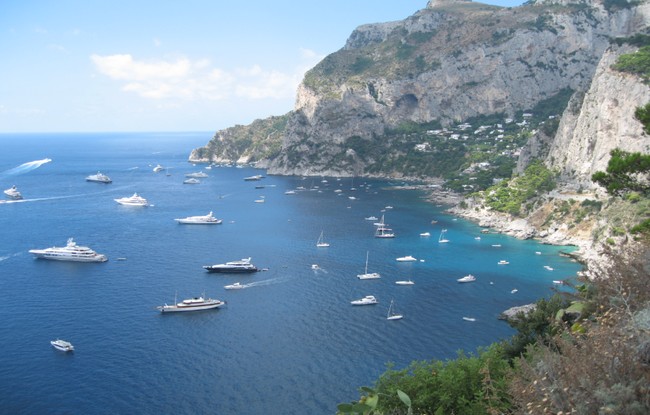


Lo escritore Curzio Malaparte quiso construir Villa Malaparte en Capri, en Capo Massullo, entre el azul del mar y el verde de la matorral mediterránea.
Villa Malaparte Capri
“It was in Capri, in the wildest, most solitary, most dramatic part, in that part all facing south and east, where the Island goes from human to fierce, where nature expresses itself with an incomparable and cruel force, a promontory of extraordinary purity of lines, thrown into the sea like a rock claw“, he wrote. And then. “no place in Italy has such a breadth of horizon, such depth of feeling. It is a place, certainly, only suitable for strong men, for free spirits“.
Curzio Malaparte
Istrionic, unvorhersehbar und widersprüchlich war Curzio Malaparte Faschist und Maoist, Atheist im Leben und Christ auf dem Sterbebett, Kriegsberichterstatter, Diplomat, Regisseur und Dichter, Verleger und Zeitungsredakteur. Und vor allem ein Schriftsteller von durchdringender Klarheit. Gerade dieses Leben, so außergewöhnlich wie ambivalent, machte den Autor von Kaputt zu einer der umstrittensten Persönlichkeiten des 20. Jahrhunderts. Intellektuelle liebten und verachteten ihn gleichermaßen. Antonio Gramsci bezeichnet ihn in seinen Gefängnisheften als „einen Mann von ungeheurer Eitelkeit und chameleonartigem Snobismus, der für Ruhm zu jeder Schandtat fähig ist“. Für den Verleger Piero Godetti hingegen war er „eine der schönsten Signaturen des Faschismus“.
In jedem Fall war Curzio Malaparte ein großer Protagonist der internationalen Kultur.
1925, nachdem er ein Pamphlet von 1869 mit dem Titel „I Malaparte e i Bonaparte“ gelesen hatte, beschloss der junge Schriftsteller Kurt Erich Suckert, Sohn eines sächsischen Färbers, der nach Toskana gezogen war, seinen Namen zu ändern. Er schwankte zwischen Curzio Farnese, Curzio Borgia, Curzio Lambert oder Curzio Malaparte. Er entschied sich für letzteres, weil er es für attraktiver hielt als die anderen, und als Mussolini ihn fragte, warum er diesen Namen gewählt habe, antwortete er: „Ich habe Malaparte gewählt, weil Bonaparte schlecht geendet hat, mir hingegen wird es sicher besser gehen.“ Der Schriftsteller war überzeugt, dass das neue Pseudonym großen Eindruck auf seine Leser machen würde. Tatsächlich, sowohl wegen seines Talents als auch wegen seiner neuen Identität, ließ der Ruhm nicht lange auf sich warten.
Obwohl er zu den Gründern der Faschistischen Partei gehörte, war Curzio Malaparte ein atypischer Faschist. Einerseits betrachtete er Mussolini als den besten Schüler Lenins und Trotzkis, andererseits prangerte er mit dem 1931 in Paris gedruckten Essay „Technik eines Staatsstreichs“ die Tyrannei Hitlers an. Nach einer Reihe verleumderischer Briefe an Italo Balbo bestrafte der Duce ihn und schloss ihn aus der Partei aus, indem er ihn zu fünf Jahren Verbannung auf der Insel Lipari verurteilte. Die Anklage war doppelt: antifaschistische Propaganda im Ausland wegen des in Frankreich veröffentlichten Buches und Verleumdung eines amtierenden Ministers durch die Briefe an Balbo. Nach sieben Monaten Verbannung in Lipari wurde der Schriftsteller aus gesundheitlichen Gründen nach Ischia verlegt, und dank der Freundschaft mit Graf Galeazzo Ciano, Mussolinis Schwiegersohn, erhielt er eine Strafmilderung und wurde nach Forte dei Marmi verlegt, wo er seine Strafe verbüßen sollte.
Während einer surrealistischen Suchphase erzählt Malaparte von seinen inneren Metamorphosen und verwandelt sich in seinen Büchern in eine Frau, einen Hund, einen Baum, einen Heiligen. Dann äußert der Schriftsteller mit dem am 14. Februar 1937 veröffentlichten Artikel „Städte wie ich“ den Wunsch, selbst zu einem Gebäude zu werden. Er will sich in Fensterläden, Treppen, Putz verwandeln.
Casa Malaparte Capri
The literary fame is no longer enough for him and he writes: “I would like to build it all with my own hands, stone by stone, brick by brick, the city of my heart. I would be an architect, bricklayer, laborer, carpenter, plasterer, I would do all the jobs so that the city was mine, truly mine, from the cellars to the roofs, mine as I would want it. A city that resembles me, that is my portrait and at the same time my biography… And everyone, upon entering it, would feel that that city is me, that those streets are my arms open to welcome friends. The plaster on the walls, the shutters, the steps…, I would want them to be the best part of me, the features of my face and my spirit, the fundamental elements of the architecture and the history of my life. That it would resemble me, and that everyone living in it would feel like they are inside of me. A house like me… my portrait in stone“. Curzio Malaparte therefore feels the need to show the world his true face, his personality. He wants everyone to know who he really is. And to do so he decides to build a “sad, hard, severe” house. Like him.
The arch-Italian, as he was called after the publication of a collection of poems, throws his challenge to the world of architecture and decides to build “House like me,” a self-portrait “essential, naked, without ornaments,” and at the same time a refuge and a place that reminds him of the period of exile in Lipari. The writer wants to create something that speaks about him.
Villa Malaparte in Capri, from 1938 to 1942
Between 1938 and 1942 Curzio Malaparte, developing a project by the architect Adalberto Libera, built at Capo Massullo in Capri a splendid Villa Malaparte of which he would entirely claim the authorship. In “House like me” he writes: “Here, no house appeared. I was therefore the first to build a house in that nature. And it was with reverent fear that I undertook the work, helped not by architects, or engineers (except for legal matters, for the legal form), but by a simple foreman.” Casa Malaparte is the only red house among the white houses on the island. Red like the houses of the Harbor Captains. The only one with a rooftop solarium terrace and not with vaults. The only one without the traditional small external stairs.
The villa that director Jean-Luc Godard chose to set a scene of the film Le Mépris really seems the projection of the personality of Malaparte. Or at least it is for the writer, who will address all his correspondence in large black letters, “House like me”. And even today the inhabitants of Capri call this wild and rugged corner of the island, “Malaparte’s”. Simply.
“House like me” is a stern, elegant, and modern construction, which seems to emerge directly from the rocks, supported toward the land by a trapezoidal staircase of pre-Columbian appearance, and which stretches in the opposite direction, towards the sea. The profile is slender, decisive, essential. The lines are pure and symmetrical, the references classical. There is “no Romanesque column, no arch, no external staircase, no pointed window, none of those hybrid blends between Moorish, Romanesque, Gothic, and Secessionist styles that some Germans, thirty or fifty years ago, brought to Capri, polluting the purity and simplicity of Capri houses.”
Casa Malaparte in Capri, the style
The house is very far from the island’s traditional style, and at first glance it looks more like a huge brick fallen onto the rock than a dwelling. But then, on closer look, the structure is in absolute harmony with the surrounding nature, and it ends up seeming like a natural elevation of the promontory.
The villa, which represents a vigorous anticipation of Italian rationalism, immediately triggers reactions from architects and architectural historians. Some speak of “a rigid product angry with nature,” others of “a wreck left on the rock after the wave’s ebb.” Some associate the house with “an archaic and timeless boat balancing between Mediterranean architecture and abstraction games.” And some talk of it, instead, as an object in perfect fusion with the landscape.
Casa Malaparte seduces because it is the materialization of the personality of a disturbing and fascinating writer who still makes people talk about himself today. Because it is the result of literary quotations, political memories, fragments of life. Because it is the autobiography of a great character, the place of his memories, the manifesto of his ideology.
The most passionate affirm that the work is too personal to have been conceived by the creative spirit of a technician. So much so that after more than sixty years the debate among architects is still alive and the questions recur. Was the house entirely built by architect Adalberto Libera, who received from the writer the commission to design the villa? Or did Malaparte radically modify its structure during construction? And then, why in the list of his works does Libera never mention the construction of a villa in Capri?
There are those who definitely attribute the work to Libera. Others, instead, maintain that the house, as it was built, is the product of Malaparte’s sole mind. Then there are those who speak of the villa as the perfect union of two great eclectic spirits. Meanwhile, after years of study and research, the hypothesis that Malaparte progressively modified the architect’s initial project, adapting the floor plan to his intellectual needs, has become increasingly credible. Assisted by the master mason Adolfo Amitrano from Capri, “the best, the most honest, the most intelligent, the most upright, among those I have ever known.” But let’s start from the beginning. In 1936 Curzio Malaparte is a guest in Capri of a friend, the Swedish doctor and writer Axel Munthe. After a walk to Capo Massullo he decides to purchase the small promontory. The owner is a fisherman, Antonio Vuotto, and to convince him the writer will tell him he needs it to establish a rabbit farm. In 1938 Capo Massullo is his. A rock 70 meters long and 15 meters wide, inaccessible, steep on the green and turquoise bay of Matromania, and oriented southeast toward the Sorrentine Peninsula. To the south it overlooks the Faraglioni and the rock of Monacone. All around only the sea, the rock, and the wild nature. A unique place in the world.
“The house was already there, I drew the landscape!” Malaparte proudly said to Marshal Rimmel, in the book “La Pelle.”