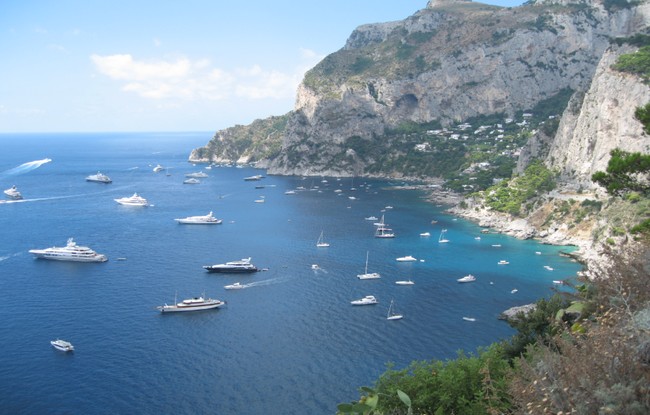

Lo scrittore Curzio Malaparte wanted to build Villa Malaparte in Capri, at Capo Massullo, between the blue of the sea and the green of the Mediterranean scrub.
Villa Malaparte Capri
“It was in Capri, in the wildest, most solitary, most dramatic part, in that part facing south and east, where the island turns from human to fierce, where nature expresses itself with an incomparable, cruel force, a promontory of extraordinary purity of lines, ventured into the sea like a claw of rock“, he wrote. And then. “no place in Italy has such a vast horizon, such depth of feeling. It is a place, certainly, only suitable for strong men, for free spirits“.
Curzio Malaparte
Istrionic, unberechenbar und widersprüchlich war Curzio Malaparte Faschist und Maoist, Atheist zu Lebzeiten und Christ auf dem Sterbebett, Kriegsberichterstatter, Diplomat, Regisseur und Dichter, Verleger und Zeitungsleiter. Und vor allem ein Schriftsteller von durchdringender Klarheit. Gerade dieses Leben, so außergewöhnlich wie zwiespältig, machte den Autor von Kaputt zu einer der umstrittensten Persönlichkeiten des 20. Jahrhunderts. Intellektuelle liebten und verabscheuten ihn. Antonio Gramsci bezeichnet ihn in seinen Gefängnistagebüchern als „einen Mann von ungeheurer Eitelkeit und chamäleonhaftem Snobismus, fähig zu jedem Verbrechen um der Ruhm willen“. Für den Verleger Piero Godetti hingegen war er „eine der schönsten Unterschriften des Faschismus“.
Auf jeden Fall war Curzio Malaparte ein großer Protagonist der internationalen Kultur.
1925, nachdem er ein Pamphlet mit dem Titel „I Malaparte e i Bonaparte“ aus dem Jahr 1869 gelesen hatte, beschloss der junge Schriftsteller Kurt Erich Suckert, Sohn eines sächsischen Färbers, der in die Toskana gezogen war, seinen Namen zu ändern. Er schwankte zwischen Curzio Farnese, Curzio Borgia, Curzio Lambert oder Curzio Malaparte. Er wählte Letzteres, weil es ihm attraktiver erschien als die anderen, und als Mussolini ihn nach dem Grund für diesen Namen fragte, antwortete er: „Ich habe Malaparte gewählt, weil Bonaparte schlecht geendet hat, ich hingegen werde bestimmt besser dastehen.“ Der Schriftsteller war überzeugt, dass das neue Pseudonym bei seinen Lesern großen Eindruck machen würde. Tatsächlich, sei es wegen seines Talents oder seiner neuen Identität, kam der Ruhm nicht lange.
Auch wenn er zu den Gründern der Faschistischen Partei gehörte, war Curzio Malaparte ein untypischer Faschist. Einerseits betrachtete er Mussolini als den besten Schüler von Lenin und Trotzki, andererseits prangerte er mit dem 1931 in Paris gedruckten Essay „Technik eines Staatsstreichs“ Hitlers Tyrannei an. Nach einer Reihe verleumderischer Briefe an Italo Balbo bestrafte der Duce ihn und schloss ihn aus der Partei aus, verurteilte ihn zu fünf Jahren Internierung auf der Insel Lipari. Die Anklage war zweifach: antfaschistische Propaganda im Ausland wegen seines in Frankreich veröffentlichten Buches und Verleumdung eines amtierenden Ministers wegen der Briefe an Balbo. Nach sieben Monaten Verbannung auf Lipari wurde der Schriftsteller aus gesundheitlichen Gründen nach Ischia verlegt und dann dank der Freundschaft mit dem Grafen Galeazzo Ciano, Mussolinis Schwiegersohn, erhielt er eine Strafverkürzung und wurde nach Forte dei Marmi verlegt, wo er seine Strafe absitzen sollte.
Während einer surrealistischen Suchphase erzählt Malaparte von seinen inneren Metamorphosen und verwandelt sich in seinen Büchern in eine Frau, einen Hund, einen Baum, einen Heiligen. Dann drückt der Schriftsteller mit dem am 14. Februar 1937 veröffentlichten Artikel „Städte wie ich“ seinen Wunsch aus, selbst ein Gebäude zu werden. Er will sich in Fensterläden, Treppen, Putz verwandeln.
Casa Malaparte Capri
Literary fame is no longer enough for him and he writes: “I would like to build it all with my own hands, stone by stone, brick by brick, the city of my heart. I would become an architect, bricklayer, laborer, carpenter, plasterer, I would do all the trades so that the city would be mine, truly mine, from the cellars to the roofs, mine as I would like it. A city that resembles me, that is my portrait and at the same time my biography… And everyone, as soon as they enter it, would feel that this city is me, that these streets are my arms open to welcome friends. The plaster on the walls, the shutters, the steps…, I would like them to be the best part of me, the features of my face and my spirit, the fundamental elements of the architecture and history of my life. That it resembles me, and that everyone feels, living in it, to be inside me. A house like me… my stone portrait“. Curzio Malaparte therefore feels the need to show the world his true face, his personality. He wants everyone to know who he really is. And to do so he decides to build a “sad, hard, severe” house. Like him.
The arch-Italian, as he was called after the publication of a poetry collection, throws down his challenge to the world of architecture and decides to build “Casa like me,” an “essential, naked, without ornaments” self-portrait, and at the same time a refuge and a place that reminds him of the period of exile in Lipari. The writer wants to create something that makes people talk about him.
Villa Malaparte en Capri, de 1938 a 1942
Entre 1938 y 1942 Curzio Malaparte, desarrollando un proyecto del arquitecto Adalberto Libera, construye en Capo Massullo de Capri una espléndida Villa Malaparte de la cual se atribuirá totalmente la paternidad. En “Casa como yo” escribe: “Aquí, ninguna casa aparecía. Yo era, por tanto, el primero en construir una casa en esa naturaleza. Y fue con temor reverente que me dispuse al trabajo, ayudado no por arquitectos, ni por ingenieros (excepto por cuestiones legales, por la forma legal), sino por un simple maestro de obra.” Casa Malaparte es la única casa roja entre las casas blancas de la isla. Roja como las casas de los Capitanes de puerto. La única con un techo-solarium en losa y no con bóvedas. La única sin las tradicionales pequeñas escaleras exteriores.
La villa que el director Jean-Luc Godard eligió para ambientar un episodio de la película Il Disprezzo, parece realmente la proyección de la personalidad de Malaparte. O al menos lo es para el escritor, que inscribirá toda su correspondencia con grandes letras negras, “Casa como yo”. Y todavía hoy los habitantes de Capri llaman a este rincón escarpado y salvaje de la isla, “de Malaparte”. Simplemente.
“Casa como yo” es una construcción austera, elegante y moderna, que parece emerger directamente de las rocas, apuntalada hacia tierra por una escalera trapezoidal de aspecto precolombino, y que se extiende en la dirección opuesta, hacia el mar. El perfil es esbelto, decidido, esencial. Las líneas son puras y simétricas, las referencias clásicas. No hay “ninguna columnita románica, ningún arco, ninguna escalerita exterior, ninguna ventana ojival, ninguno de esos híbridos enlaces entre estilo morisco, románico, gótico y modernista, que ciertos alemanes, hace treinta o cincuenta años, llevaron a Capri, contaminando la pureza y simplicidad de las casas capriotas.”
Casa Malaparte in Capri, the style
The house is very far from the traditional style of the island, and at first glance it looks more like a huge brick fallen on the rock than a dwelling. But then, on closer inspection, the structure is in absolute harmony with the nature that surrounds it, and ends up appearing as a natural elevation of the promontory.
The villa, which represents a vigorous anticipation of Italian rationalism, immediately triggers the reaction of architects and architectural historians. Some speak of “a rigid product angry with nature,” others of “a wreck left on the rock after the waves receded.” Some associate the house with “an archaic and timeless boat balanced between Mediterranean architecture and abstraction games.” And there are those who talk about it, instead, as an object in perfect fusion with the landscape.
Casa Malaparte seduces because it is the materialization of the personality of a disturbing and fascinating writer who still today causes people to talk about him. Because it is the result of literary quotations, political memories, fragments of life. Because it is the autobiography of a great character, the place of his memories, the manifesto of his ideology.
The most passionate affirm that the work is too personal to have been conceived by the creative spirit of a technician. So much so that after more than sixty years the debate among architects is still alive, and the questions recur. Was the house entirely realized by the architect Adalberto Libera, who was commissioned by the writer to design the villa? Or did Malaparte radically modify its structure during construction? And then, why does Libera never mention the construction of a villa in Capri in his list of works?
There are those who certainly attribute the work to Libera. Others instead claim that the house, as it was realized, is the fruit of Malaparte’s sole mind. Then there are those who speak of the villa as the perfect union of two great eclectic spirits. Meanwhile, after years of studies and research, the hypothesis that Malaparte progressively modified the architect’s initial project, adapting the floor plan to his intellectual needs, has become increasingly credible. Assisted by the master mason Adolfo Amitrano of Capri, “the best, the most honest, the most intelligent, the most upright, among those I have ever known.” But let’s start at the beginning. In 1936 Curzio Malaparte is a guest in Capri of a friend, the Swedish doctor and writer Axel Munthe. After a walk at Capo Massullo, he decides to purchase the small promontory. The owner is a fisherman, Antonio Vuotto, and to convince him the writer tells him he needs it to establish a rabbit farm. In 1938 Capo Massullo is his. A rock 70 meters long and 15 wide, inaccessible, overlooking the green and turquoise bay of Matromania, and oriented southeast toward the Sorrento peninsula. To the south it faces the Faraglioni and the Monacone rock. All around only the sea, the rock, and wild nature. A unique place in the world.
“The house was already there, I drew the landscape!” Malaparte said proudly to Marshal Rimmel, in the book “The Skin”.