




The Prehistoric Ethnographic Museum of Rome was inaugurated on March 14, 1876 by Luigi Pigorini (1842-1925) in the city center, in a wing of the Palazzo del Collegio Romano built at the end of the sixteenth century by the Society of Jesus. Since the 17th century, the Jesuit College had housed the collection of antiques and various curiosities gathered by Father Athanasius Kircher.
The Superintendence to the National Prehistoric Ethnographic Museum “Luigi Pigorini” of Rome has been, since its foundation, a center of excellence in research and promotion of the palethnological and ethno-anthropological heritage preserved in our country. Its origin, as a scientific and protection institution, dates back to 1875, the year in which the “Royal National Prehistoric Ethnographic Museum of Rome” was founded in the Palazzo del Collegio Romano.
According to the intentions of the founder, Luigi Pigorini, the new institution was born not only to collect in a “central” museum, in the new capital of the Kingdom, the documentation of Italian, European, and extra-European prehistoric cultures as well as the cultures of the so-called “primitive” contemporary populations, but especially to give a unified scientific approach to palethnological studies and research in Italy.
Since its foundation, the “Royal National Prehistoric Ethnographic Museum of Rome” has therefore fulfilled a fundamental role in promoting and coordinating excavations of Italian prehistoric sites, alongside an intense and innovative high-level training activity with the conducting, at the Museum, of courses of the first university chair of Palethnology established in Italy, as well as a constant and extraordinary activity of scientific dissemination with the creation, in the same founding year of the Museum, of one of the first European journals dedicated to prehistoric disciplines, the Bullettino di Paletnologia Italiana. In 1940, the Museum became the seat of the Superintendence (Superintendence to the Antiquities of Rome V).
On the occasion of the VI International Congress of Prehistoric and Protohistoric Sciences, held in Rome in 1962, the “Museum of Prehistory and Protohistory of Lazio” was inaugurated in the Palazzo delle Scienze, at EUR, established as a permanent section of the National Prehistoric Ethnographic Museum “L. Pigorini”, still in the historic seat of the Collegio Romano.
In 1968, by decree of Minister Gui (D.M. March 4, 1968, art. 1, paragraph 5), the Superintendence of Rome V was renamed Superintendence of Prehistory and Ethnography.
Between 1975 and 1977, the entire National Prehistoric Ethnographic Museum was transferred to the Palazzo delle Scienze at EUR, to vacate the premises of the Collegio Romano for the new Ministry for Cultural and Environmental Heritage. With the organization of the new Ministry, the Museum remained part of the Special Institute renamed Special Superintendence to the National Prehistoric Ethnographic Museum “L. Pigorini”.
Within the framework of the establishing Law of the Ministry for Cultural and Environmental Heritage, the Special Superintendence was confirmed the status of a technical body for conservation, protection, museal and monumental enhancement and research both in the field of Prehistory and Protohistory and in the field of Ethnography.
In the new Ministry organization, the Superintendence is no longer “Special,” but its institutional duties remain unchanged.


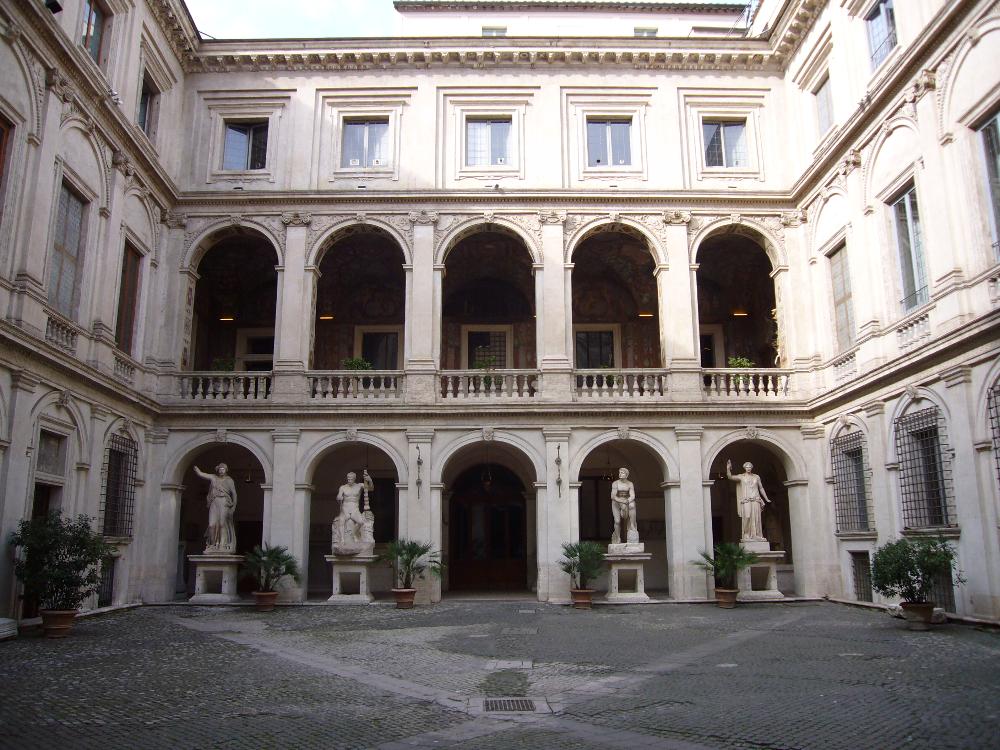


 in the city center, in a wing of the Palazzo del Collegio Romano built at the end of the sixteenth century by the Society of Jesus.)