

The imperial city of Augsburg, in the early 16th century, built a formidable ring of walls and bastions that surrounded the city, further protected by moats and historic canals where water still flows today. Eleven gates were originally constructed within the walls, five of which you can still admire.
What to See in Augsburg
Much of the historic city wall was demolished in the 19th century, but remains of Augsburg’s old fortifications can still be visited in several places. The fully preserved section stretches for about four kilometers. Restoration works are currently ongoing in some parts of the old city walls.
Wertachbrucker Tor
At the edge of Augsburg’s old town stands Wertachbrucker Tor, originally built in Gothic style around 1370. In 1605, the master city architect Elias Holl redesigned and restored it in Renaissance style. In 1805, Napoleon himself passed through this very gate. Just a year later, Augsburg became part of Bavaria, which had sided with Napoleon in the historic campaigns that led to the French Emperor’s victories at Ulm and Austerlitz.
Fischertor Gate
In the northwest of Augsburg’s old town you’ll find the Fischertor Gate. From here, a narrow staircase leads up to the city walls, passing by the Witches’ Fountain—a wooden sculpture steeped in legend as the spot where witches would take their last drink before their sentence. Continuing, you’ll reach the former Luginsland bastion, now listed as a Bavarian monument. From its summit, you can enjoy an impressive view over the city.
Descending a few steps from the old watchtower takes you to a moat; following the path along the city walls, you’ll come across the Schwedenstiege, a stone stairway. Here stands one of Augsburg’s most curious symbols: the Stoinernen Ma, a life-sized stone figure commemorating the Thirty Years’ War.

Venetian Fountain
At the foot of these steps, you’ll find the Venetian Fountain, so named for its distinctive Venetian style. Operated by Stadtwerke Augsburg (the city’s utility company), it offers free drinking water renowned for its quality. Throughout Augsburg, there are 22 public fountains where you can refill your bottle—an especially welcome refreshment during the summer for both locals and visitors.
Augsburger Kahnfahrt: Food and Boat Rentals
Across the street along Bert-Brecht-Straße, you’ll reach the Augsburger Kahnfahrt, a traditional restaurant with a beer garden that also offers boat rentals. For over a hundred years, a stretch of the outer canal here has been open for boating. Immediately beyond is Oblatterwall, another well-known former city bastion. These spots are also beloved for their connection to Bertolt Brecht, the celebrated writer and native son of Augsburg, born here in 1898.
Jakobertor Gate
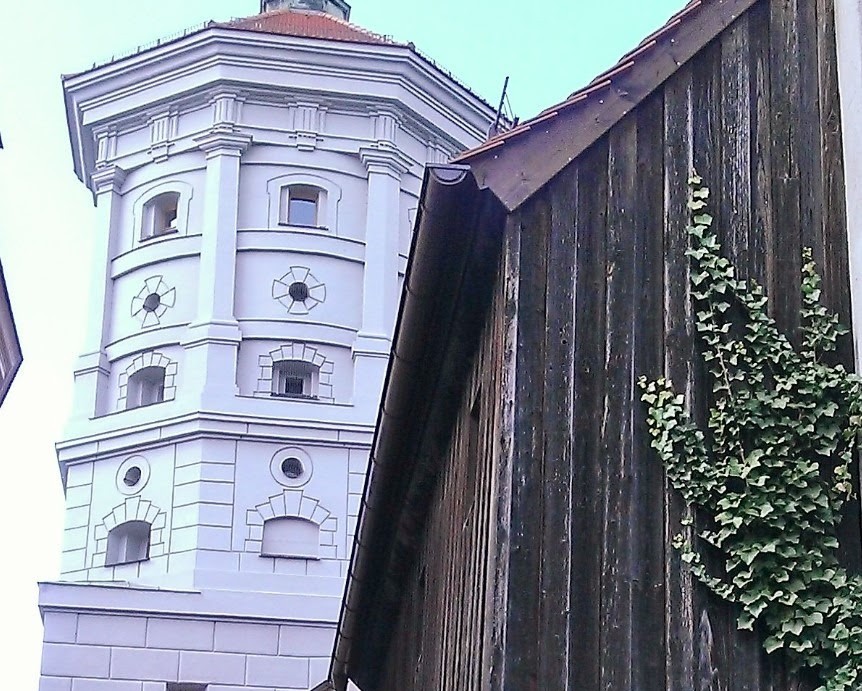
Continuing your walk, you’ll come to the Jakobertor Gate. A bit further, along the Obere Jakobermauer and Vogelmauer walls, you’ll arrive at Vogeltor. Following the old moat, the path climbs back toward the upper town and the Red Gate. In front of the Red Gate, on your right, is the Handwerkerhof (Craftsmen’s Courtyard), where you can discover the historic and intricate water technology of the Red Gate Water Towers.
This architectural complex, recognized as a UNESCO World Heritage Site since 2019, includes the Large Water Tower, the Small Water Tower, and a third tower originally used to supply Augsburg’s fountains.

Handwerkerhof (Craftsmen’s Courtyard), Augsburg