

It was in July 1997 that the Borden company tried to save the historic Prince spaghetti factory based in Lowell, in Massachusetts.
Prince was an economic resource that provided jobs to many town residents, after moving its headquarters from Boston’s Little Italy – the North End – in 1939. The factory in Lowell occupied the terminal area of Prince Avenue and Prince Court. At the time, people identified the narrow old streets of the Italian neighborhood in Boston with the boy Anthony used in pasta advertising as he ran home because “Wednesday is Prince Spaghetti Day.”
Employees and investors of Borden unsuccessfully tried to buy the spaghetti manufacturing plant which represented the largest in the United States in Lowell and consisted of six factories selling spaghetti in 38 US states. Lowell was the Spaghettiville of America.
The History of Pasta in Boston
The history of pasta is closely linked to the story of Italians at the end of the 20th century, when the North End of Boston inevitably became Little Italy. Twenty-five years earlier this neighborhood was full of Irish people, followed by Jewish families, especially those from Eastern Europe.
These two ethnic groups prospered to the point of settling in other less crowded urban areas. In 1930 over 44,000 Italians lived densely packed in the North End, so much so that its density was considered higher than Calcutta! Italian immigrants living in the neighborhood worked in markets, bakeries, tailor shops, shoe stores, or were fishermen.
In 1912 three Sicilians joined forces to open a macaroni and spaghetti production business. Gaetano LaMarca was the manager, Giuseppe Seminara the salesman, and Michele Cantella the pasta maker. These entrepreneurs could not imagine that the small company would become the largest pasta manufacturer in the United States. They named their company after the address it was located at, 92 Prince Street. Prince pasta was so successful that in 1917 the owners built a seven-story building near Commercial Street in Boston’s North End, complete with a rail freight unloading system at the rear, delivering semolina flour directly to the factory.

Despite the Great Depression, Prince pasta boomed and within twenty years needed more space. It was then moved to Lowell in 1939. The year after, another immigrant arrived from Sicily in Massachusetts intending to buy a pasta factory: 34-year-old Giuseppe Pellegrino was so impressed by the new Prince factory in Lowell that he settled there, working as an assistant to the founders.
Within just one year, he made so much money that he could afford to buy the factory. Pellegrino had an extraordinary work ethic, limitless energy, and a talent for advertising. He started with a promotional campaign. Since macaroni and spaghetti were considered ethnic food, he focused especially on Italian newspapers.
Prince Pasta Became a Brand
In Boston’s North End, Wednesday is Prince Spaghetti Day
At that time, spaghetti was seen as the meal of poor immigrants and working-class families on tight budgets. But in the early 1950s Pellegrino decided it was time to launch the pasta to non-Italians and hired a Boston advertising agency to produce a radio commercial that would make Prince Pasta a household name. This gave birth to the memorable slogan: “In the North End of Boston, Wednesday is Prince Spaghetti Day.”
In reality, in Italy, pasta was an almost daily meal, but in America, Italian immigrant families cooked pasta only on Sundays and ate the leftovers the next day. The advertising creatives at the time believed that Catholic families ate fish on Fridays. This is why they chose a midweek day. But the advertisement was not aimed at North End residents, rather at all those Americans who did not eat much pasta and were encouraged to eat more.
In 1969, there was another successful advertisement. The twelve-year-old boy from Boston’s North End – Anthony Martignetti – was approached by a TV crew while standing at the corner of his home. He agreed to be filmed running through the narrow streets and sidewalks of the North End to get home and join the table. When the advertisement aired, the chant of “Anthony!” called by his mother from the window to come back for lunch immediately became part of New England’s popular culture. The TV commercial ran for 13 years from fall 1969. It was instrumental in placing Boston’s Italian Americans at the center of American life, and this simple idea radically changed Americans’ perception of Italian food.
When the factory was moved to Lowell, the town sign proclaimed: “Welcome to Spaghettiville.” Many factory workers were immigrants from Portugal or Laos. Joseph Pellegrino Jr. was considered by most to be a good employer and a good citizen, son of a Sicilian immigrant from Mistretta who arrived in America in 1905.
Former mayor Brenden Fleming compared him to Aaron Feuerstein, owner of Malden Mills, who saved his workers from a devastating fire at his Lawrence factory. “If it had happened to Pellegrino, he would have done the same.” But despite good intentions in 1987 Pellegrino sold his factory to the food industry giant Borden, Inc.. Ten years later, the company, in serious trouble, announced the closure. Over 400 workers opposed losing their jobs and Lowell the loss of an institution on Moore Street.
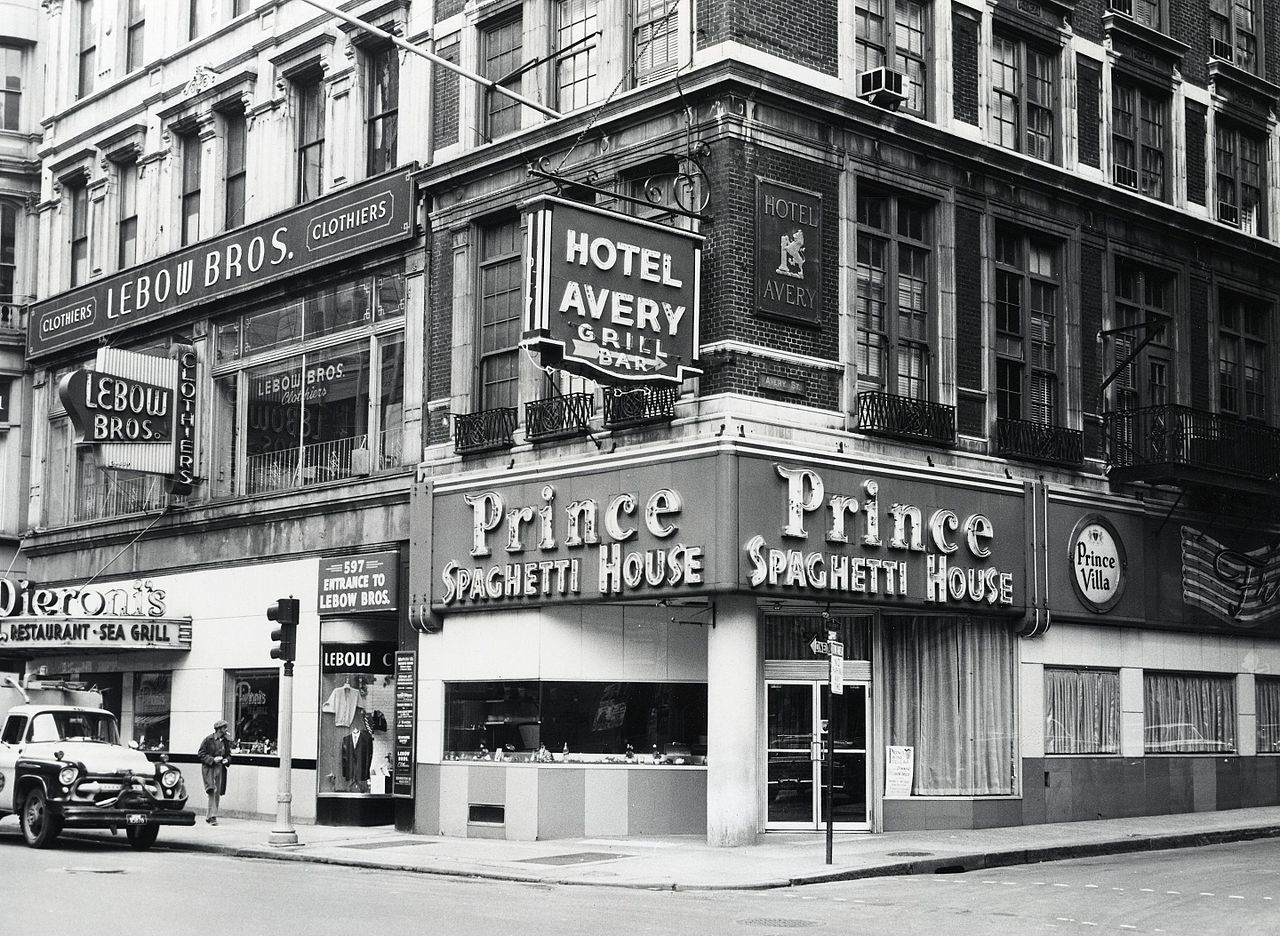
Prince Spaghetti was a staple of New England and a true institution in Massachusetts, as well as a valued longtime customer of the Boston & Maine Railroad. Protests and petitions surged demanding Borden put the factory up for sale rather than close it. A group of workers, former factory managers, and investors created a new company, Boston Macaroni, and made an offer to buy the Lowell plant.
On July 11, 1997, however, the Prince Pasta Company ceased production. Five days later, a celebrating town learned that a deal to acquire the facilities by Boston Macaroni had been reached, thanks also to the intervention of Ted Kennedy. But the joy was short-lived: Borden refused the rights to use the name “Prince Pasta” and – additionally – Boston Macaroni discovered the factory building needed repairs costing millions of dollars. In autumn the deal fell through. When Borden closed the plant, Senator Ted Kennedy said it was “a sad day in Spaghettiville.” A year later, a textile company bought the plant, ironically fitting for a city like Lowell that played a key role in the development of the textile industry in the United States.
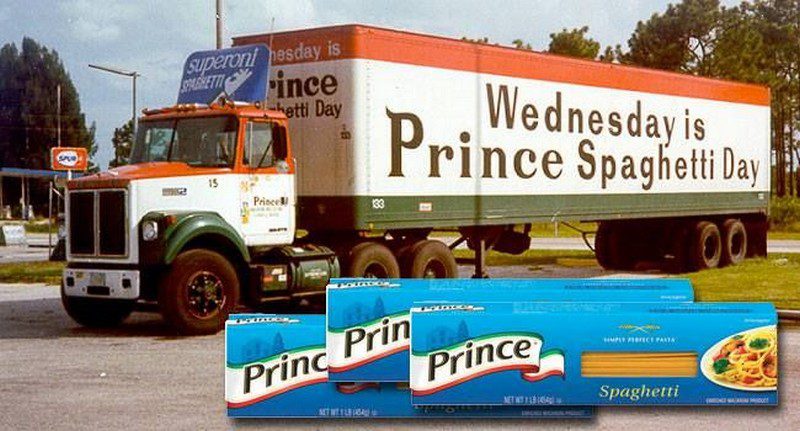
In 2015 the building was again sold, bought, and converted into one of the most important data centers throughout New England: it became an Internet hub while, in 1974, the old 1917 Prince building in Boston’s North End was converted into residential condominiums. In Lowell, there is still an iron overpass on Gorham Street – the Prince Spaghettiville Bridge – bearing the historic sign, and next to it stands the historic diner Trolley Restaurant Pizzaria, a true landmark. Today Prince is a brand of New World Pasta, a company based in Pennsylvania with manufacturing plants in St. Louis.
©by Thema Srl – Milan – www.Themasrl.it