Es是在1997年7月,公司Borden试图拯救位于马萨诸塞州劳威尔的历史悠久的Prince意大利面厂。
Prince是一个经济资源,为许多城镇居民提供了工作机会,自1939年将其总部从波士顿的小意大利 – 北端搬迁后。劳威尔的工厂占据了Prince大街和Prince庭院的终点区域。那时,人们将波士顿意大利社区的狭窄古老街道与广告中跑回家的男孩Anthony联系在一起,因为“星期三是Prince意大利面日。”
Borden的雇员和投资者徒劳地试图收购劳威尔的意大利面制造厂,该工厂是美国最大的工厂之一,由六个工厂组成,销售意大利面到38个美国州。劳威尔是美国的意大利面之城。
The history of pasta in Boston
The history of pasta is closely linked to the experiences of Italians at the end of the 20th century, when the North End of Boston inevitably became the Little Italy. Twenty-five years earlier this neighborhood was teeming with Irish people, followed by Jews, particularly families from Eastern Europe.
These two ethnic groups prospered to the point of settling in other urban areas, less congested. In 1930, over 44,000 Italians lived crowded in the North End so much that its density was considered higher than Calcutta! The Italian immigrants living in the neighborhood worked in markets, bakeries, tailor shops, shoe stores, or were fishermen.
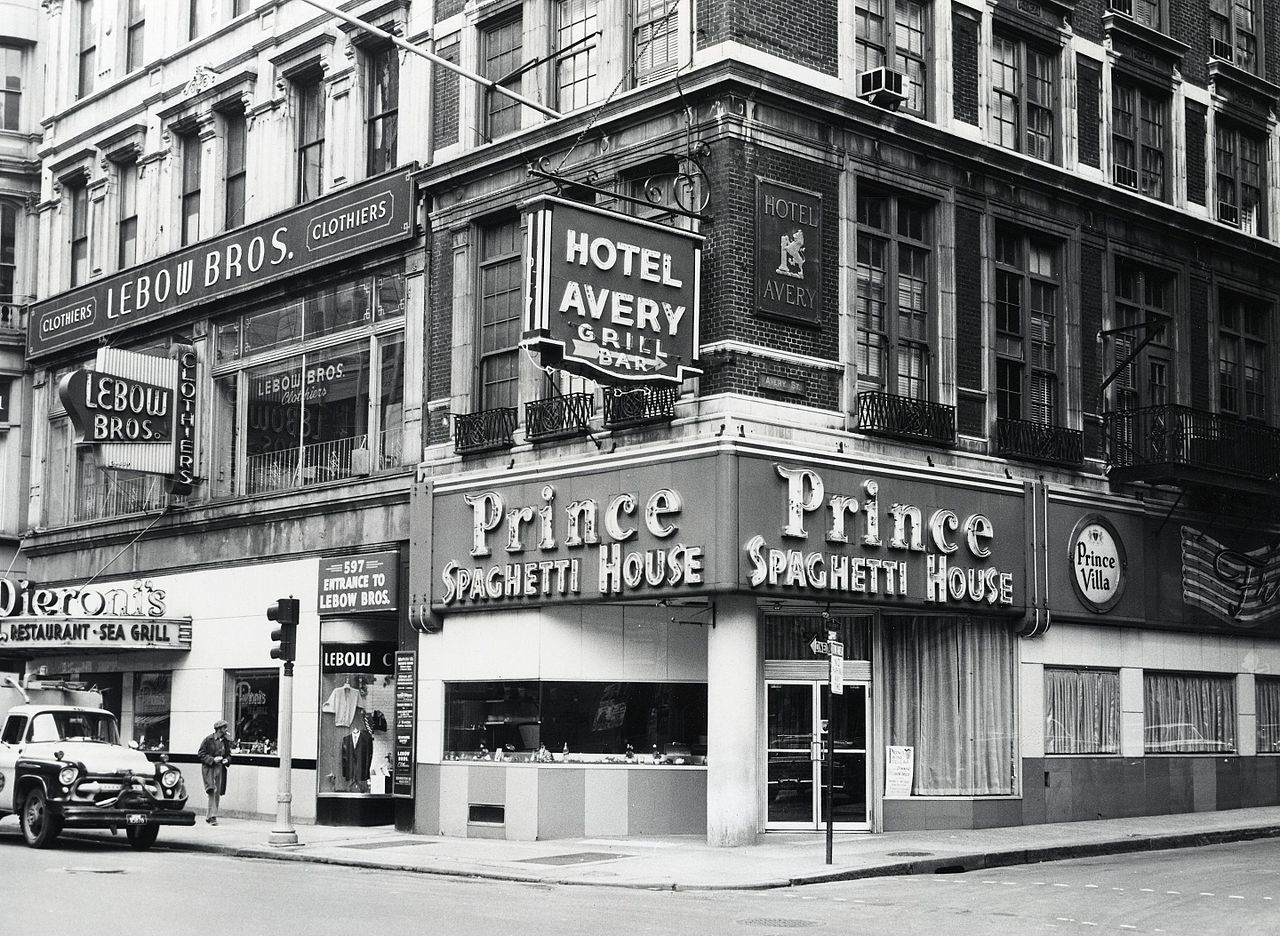
In 1912 three Sicilians joined forces to open a macaroni and spaghetti production business. Gaetano LaMarca was the manager, Giuseppe Seminara was the salesperson, and Michele Cantella was the pasta maker. These entrepreneurs could not imagine that the small company would become the largest pasta manufacturer in the United States. They named their company after the address where it was located, 92 Prince Street. The Prince pasta was such a success that in 1917 the owners built a seven-story building near Commercial Street in Boston’s North End, complete with a rail loading dock at the back, delivering semolina flour directly to the factory.

Despite the Great Depression, Prince pasta had its boom and within twenty years needed more space. So it was moved to Lowell in 1939. The following year, another immigrant arrived from Sicily to Massachusetts with the intention of buying a pasta factory: 34-year-old Giuseppe Pellegrino was so impressed by the new Prince factory in Lowell that he settled there, working as an assistant to the founders.
Within just one year he made so much money that he could afford to buy the factory. Pellegrino had an extraordinary work ethic, unlimited energy, and a talent for advertising. He began with a promotional campaign. Since macaroni and spaghetti were considered ethnic food, he focused particularly on Italian newspapers.
The Pasta Prince Became a Brand
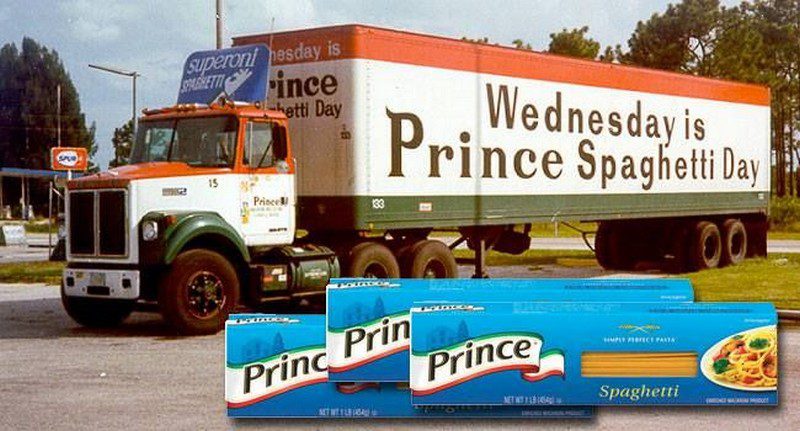
In Boston’s North End, Wednesday is Spaghetti Prince Day
At that time, spaghetti was considered a dish for poor immigrants and working-class people with limited budgets. But in the early 1950s, Pellegrino decided it was time to launch the pasta to non-Italians and hired a Boston advertising agency to produce a radio commercial that would make Prince Pasta a household brand. Thus was born the slogan that resonated: “In the North End of Boston, Wednesday is Prince Spaghetti Day.” (in Boston’s North End, Wednesday is Spaghetti Prince Day).
In reality, in Italy, pasta was an almost daily meal, but in America, Italian immigrant families only cooked pasta on Sundays and ate the leftovers the next day. The ad creatives of the time believed that Catholic families ate fish on Fridays. That’s why they chose a random midweek day. But the advertisement was not aimed at the North End people, but at all those Americans who did not eat much pasta and were encouraged to eat more.
In 1969, it was the turn of another successful advertisement. The twelve-year-old boy from Boston’s North End – Anthony Martignetti – was approached by a television crew while standing at the corner of his house. He agreed to be filmed running through the narrow streets and sidewalks of the North End to get home and join the table. When the commercial aired, the nursery rhyme of “Anthony!” being called by his mother at the window to come home for lunch immediately became part of New England’s popular culture. The television commercial aired for 13 years starting in the fall of 1969. It was instrumental in putting Boston’s Italian-Americans at the center of American life, and this simple idea radically changed Americans’ perception of Italian food.
When the factory was moved to Lowell, the city sign proclaimed: “Welcome to Spaghettiville.” Many of the factory employees were immigrants from Portugal or Laos. Joseph Pellegrino Jr. was considered by many a good employer and a good citizen, son of a Sicilian immigrant from Mistretta who arrived in America in 1905.
Former mayor Brenden Fleming compared him to Aaron Feuerstein, the owner of Malden Mills, who saved his workers from a devastating fire at his Lawrence factory. “If it had happened to Pellegrino, he would have done the same“. But despite good intentions, in 1987 Pellegrino sold his factory to the food industry giant Borden, Inc., and ten years later, the company, in serious trouble, announced its closure. Over 400 workers opposed losing their jobs and Lowell objected to losing an institution on Moore Street.
Prince Spaghetti was a fixture of New England and a true institution in Massachusetts, as well as having been a valued client for many years of the Boston & Maine Railroad. Protests and petitions poured in asking Borden to put the factory up for sale rather than close it. A group of workers, former managers of the factory, and investors created a new company, Boston Macaroni, and made an offer to purchase the Lowell plant.
However, on July 11, 1997, the Prince Pasta Company ceased production. Five days later, a city celebrating learned that an acquisition agreement of the facilities had been reached by Boston Macaroni, also thanks to the intervention of Ted Kennedy. But the cheer was short-lived: Borden refused the rights to use the name “Prince Pasta” and – furthermore – Boston Macaroni discovered that the factory building required millions of dollars in repairs. In the fall, the deal fell through. When Borden closed the plant, Senator Ted Kennedy said it was “a sad day in Spaghettiville.” A year later, a yarn manufacturing company bought the plant, ironically apt for a city like Lowell which played a fundamental role in the development of the textile industry in the United States.
In 2015, the building was sold again and purchased and converted into one of the most important data centers in all of New England: it became an Internet hub while in 1974, the old Prince building in Boston, dating from 1917 in the North End, was converted into a residential condominium. In Lowell, there is still an iron overpass on Gorham Street – Prince Spaghettiville Bridge – which bears the historic sign, and nearby stands the historic diner Trolley Restaurant Pizzaria, a true landmark. Today Prince is a brand of New World Pasta, a company based in Pennsylvania with production plants in St. Louis.
©by Thema Srl – Milan – www.Themasrl.it