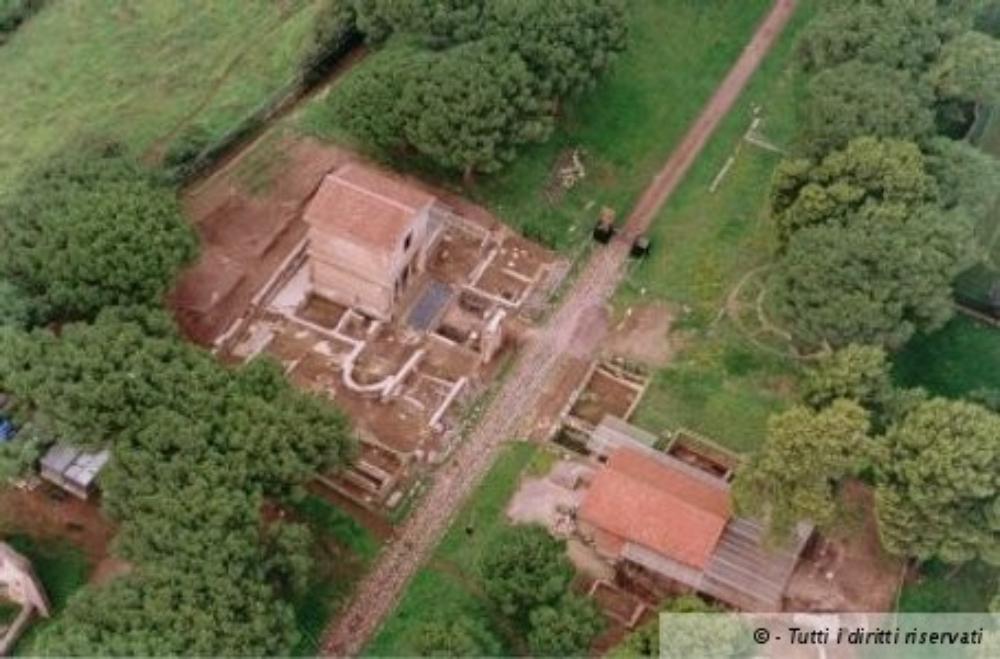


Around Rome there are several attractions to visit in a day. It is ideal to rent a car in Rome Fiumicino or at dedicated points in the capital to head towards the locations in the wide area surrounding the “eternal city.” Among these points of interest are: the remains of ancient Ostia; the Port of Claudius, the Port of Trajan, the Necropolis of Porto, the Basilica of Saint Hippolytus and the Ship Museum in Fiumicino.
The remains of ancient Ostia
The remains of ancient Ostia are set in a very different geographic and territorial context than in ancient times: in fact, during the Roman era the Tiber bordered the northern side of the settlement, while now it only touches a small part of the western sector, as its riverbed was carried downstream by a devastating and famous flood in 1557; furthermore, the coastline, originally close to the city, is currently about 4 km away due to the advancement of the mainland caused by debris left by the river over the last 2,000 years.
Ostia was thus a city that arose, with its own river port, on the sea and river, and this particular position determined its importance through the centuries both strategically-militarily and economically. An ancient tradition attributed its foundation to the fourth king of Rome, Anco Marzio, around 620 BC, for the exploitation of salt pans at the mouth of the Tiber (from which the name Ostia comes, from ostium = mouth).
In any case, the oldest remains are represented by a fortification (castrum) made of tuff blocks built by Roman colonists in the second half of the 4th century BC, exclusively for military purposes, to control the Tiber mouth and the Lazio coast. Later, especially after the 2nd century BC (when Rome had already dominated the entire Mediterranean), the military function of the city began to decline, destined to become shortly the main commercial emporium of the capital.
It is open every day except Monday, December 25, January 1, and May 1. Opening hours: from the last Sunday in October to February 15: 8:30 am–4:30 pm; from February 16 to March 15: 8:30 am–5:00 pm; from March 16 to the last Saturday in March: 8:30 am–5:30 pm; from the last Sunday in March to August 31: 8:30 am–7:15 pm; from September 1 to September 30: 8:30 am–7:00 pm; from October 1 to the last Sunday in October: 8:30 am–6:30 pm.

Port of Claudius
The emperor Claudius, in 42 AD, began the construction of a large maritime port (Port of Claudius), located 3 km north of the mouth of the Tiber, completed in 64 AD under the principate of Nero. The new port complemented those of Ostia and Pozzuoli, which since the early 2nd century BC had been the cornerstone of Rome’s port organization.
The imposing infrastructure ensured a calm basin where goods could be safely unloaded from large cargo ships arriving here from all over the Mediterranean and transferred onto river boats (naves caudicariae) suitable for ascending the Tiber to Rome.
The port basin, approximately 150 hectares, was partly excavated on land and partly enclosed towards the sea by two converging curved piers leading to the entrance. On an artificial island stood a gigantic lighthouse, similar to the famous lighthouse of Alexandria in Egypt, which signaled to sailors the entrance to the basin. At least two artificial channels (the fossae mentioned by an inscription from 46 AD) ensured connection between the sea, the Port of Claudius, and the Tiber.
The foundations of the right (or northern) pier are still visible behind the Ship Museum extending about a kilometer westward. On the quay delimiting the port basin towards land, some functional structures pertaining to the port are visitable (the so-called Captaincy, a cistern, and thermal buildings) all built, however, in a later period (2nd century AD) than Claudius’s layout.
Poor safety and the progressive silting to which the port was subjected prompted Emperor Trajan to build, just 40 years later (100 to 112 AD), a new more internal basin (Port of Trajan); nevertheless, the Port of Claudius continued to be used as a sheltered anchorage.

– Photo Ostia Antica BeniCulturali
Port of Trajan
After the construction of the Port of Claudius, inaugurated in 64 AD, growing supply needs of Rome required the creation of a new port basin built by Emperor Trajan. The new Port of Trajan, hexagonal in shape, was connected by a new canal to the Tiber to facilitate the transfer of goods to Rome.
Today the coast is about 3 km from the ancient Portus complex, which is squeezed amid the infrastructures of the Fiumicino Airport, road and highway networks, and urban expansion. In this setting, the archaeological area is an unexpected oasis also from a naturalistic perspective, thanks to the presence of wetlands and rich vegetation.
The extent of the ancient city can be estimated at about 65 hectares for the period after the construction of the defensive circuit, that is for the 5th century. The state-owned area (32 hectares) only includes part of the ancient city of Portus, with the hexagon and all the suburb still in private ownership.
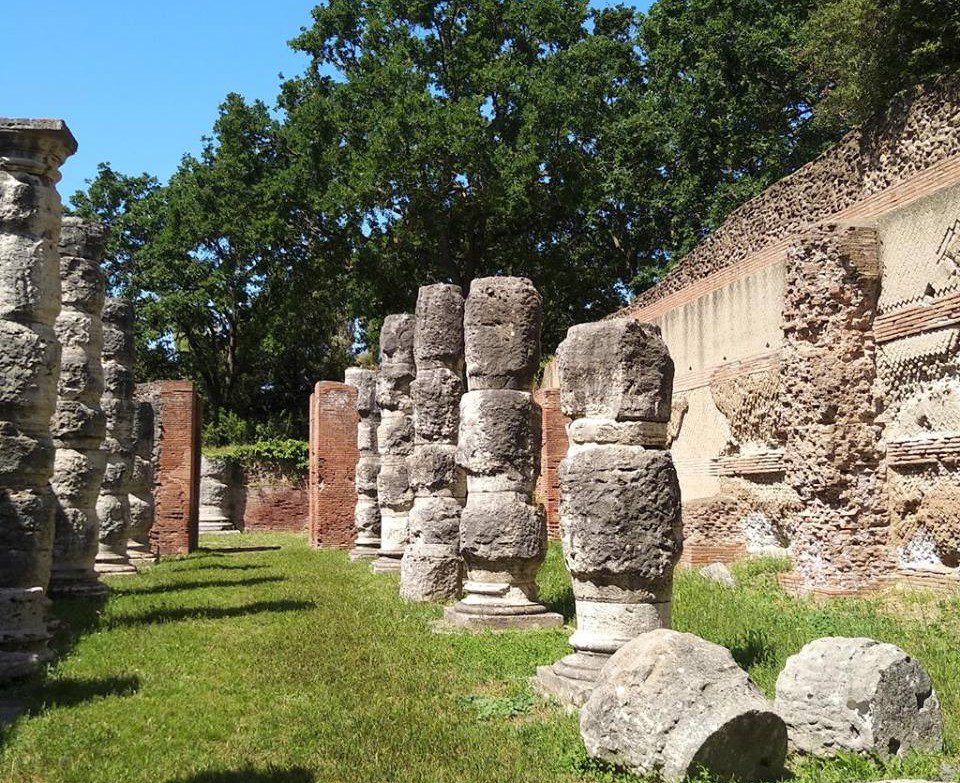
Necropolis of Porto, Isola Sacra
The complex that currently allows viewing over 200 funerary buildings, known as the state-owned area of the Necropolis of Porto, represents the southernmost limit of the burial settlement developed along the Via Flavia Severiana from the end of the 1st century AD until the 4th century AD. The occupation dynamics confirm the importance of the elevated road axis towards which the tombs converge, initially isolated, progressively forming the first road front by adjacency. Subsequent expansions engulfed the road pavement and the construction of buildings along a second, more limited set-back front. The last construction phase filled the remaining space in the first front which resulted in continuous building.
The architectural tombs visible in the necropolis show a homogeneous typology: the burial chamber, sometimes two-story, is generally square-shaped, often accompanied by a contemporary or later enclosure. The roofs were barrel-vaulted or flat terraces with a triangular pediment on the facade, decorated with plinths, pilasters, columns, and capitals that outline the precise brick curtain wall with small windows and doors framed by thresholds, jambs, and travertine lintels. The representational value of the facade is confirmed by inscriptions (in Latin, more rarely in Greek) placed above the door within pumice and brick frames.
The inscriptions report the name of the owner, the dimensions of the tomb, the testamentary provisions, and the rules for the use of the sepulcher, providing valuable data on the social composition of the population of Portus, mainly made up of merchants, freedmen, and small entrepreneurs. The scenes of professions — reflecting a lively “popular” art — depicted on the bricks beside the inscriptions refer to these activities and thus the earthly identity of the deceased (the midwife assisting birth, the surgeon operating, the hardware maker and seller, the grain merchant, etc.).
The external appearance of the tomb is not determined by the chosen funeral rite, cremation or inhumation, which rather strongly conditions the internal arrangement by dividing the wall into two registers: niches containing urns for cremated remains above, and arcosolia for inhumations below; subfloor levels were reserved for inhumation deposits (formae, arranged on several levels).

Basilica of Saint Hippolytus and Antiquarium
The Basilica of Saint Hippolytus was uncovered in the early 1970s near the Fiumicino canal (ancient Trajan’s ditch) on Isola Sacra. Built between the late 4th and early 5th centuries, it is the most important early Christian basilica in the port suburb. It stands on a Roman thermal bath complex of which some rooms and especially water cisterns remain.
The three-nave basilica with apse preserves traces of the bishop’s throne and the baptistery constructed in a later phase. It was used during the Middle Ages and was likely abandoned in the 15th century following the depopulation of the diocese. Inside the basilica, inscriptions and valuable sculptural finds were discovered, now kept in the nearby Antiquarium, where the Carolingian ciborium made during the pontificate of Leo III (795–816) prominently stands out.

Ship Museum in Fiumicino
Inside the Ship Museum of Fiumicino are exhibited the remains of five vessels (plus fragments of two others) datable from the 2nd to the 5th century AD. The wrecks were unearthed between 1958 and 1965 during the construction of the “Leonardo da Vinci” international airport. Only the hull structures survive; they resisted destructive action of water, flora, and marine fauna because they were covered by marine sediments.
The ships were located inside the port built by Emperor Claudius in the 1st century AD, in an area between the museum site and the remains of the northern pier of the port basin. This area, marginal and prone to silting, formed a real “naval cemetery” where vessels too damaged to continue service were abandoned.
Of the five best-preserved vessels, two (Fiumicino 1 and 2) are identifiable with the naves caudicariae known from ancient sources. The caudicariae, a type of large river barge, were used to transport goods from the maritime port to the river ports of Rome. These barges had no sails and were towed by ropes pulled by men (the helciarii mentioned in classical sources) or oxen walking along the Tiber bank. This propulsion system, called hauling, was used until the end of the 19th century.
Fiumicino 3 is also a river boat but smaller than the previous ones. Fiumicino 4, originally equipped with a square sail, was suitable for coastal maritime navigation or fishing activities. The small “Fisherman’s Boat” (Fiumicino 5), equipped with a central live well for transporting fish, was used for fishing. The hull bottom was perforated at the live well to allow water circulation and thus keep the catch alive.
Numerous objects related to onboard life, equipment, and types of materials transported by sea to the port of Rome (amphorae, marbles, etc.) are also exhibited inside the museum.