


What to do for free in Seville is a much more interesting question than it may seem. The Andalusian capital, famous for its Cathedral, the Giralda, the Royal Alcázar, flamenco, and its lively neighborhoods, is not a city to be visited only by purchasing tickets. Many of its best experiences are free: strolling in Plaza de España, crossing the bridge to Triana, getting lost in the Barrio de Santa Cruz, entering markets, enjoying the sunset along the Guadalquivir, or visiting museums and monuments on dedicated days or at specific times. With a bit of planning, Seville becomes a perfect destination even for those who want to keep their budget in check without giving up on the beauty of the journey.
- The 12 best free experiences in Seville
- Visiting Seville for free: what to know before you go
- Plaza de España: the most spectacular free wonder of Seville
- Parque de María Luisa: shade, gardens, and walks without a ticket
- Barrio de Santa Cruz: getting lost in the most romantic neighborhood
- Archivo General de Indias: a free UNESCO heritage site
- Triana: the neighborhood to experience with no agenda
- Mercado de Triana: get a free taste of the city’s daily life
- Eating in Seville without spending too much
- Guadalquivir riverfront: the best sunset stroll
- Plaza del Cabildo: a little surprise near the Cathedral
- Alameda de Hércules: Seville’s most alternative side
- Basilica of La Macarena and historic walls
- Metropol Parasol: seeing Las Setas without going up to the viewpoint
- Museo de Bellas Artes: free for European Union citizens
- Real Alcázar for free: possible, but with reservation and limited spots
- Cathedral and Giralda for free: pay attention to time slots and availability
- Palacio de las Dueñas free on Mondays: an opportunity to book
- Torre del Oro: free or pay-what-you-want on some visit types
- Centro Cerámica Triana: free only in some cases
- What to do for free in Seville in one day
- What to do for free in Seville on a weekend
- Seville for free in winter and during events
- Where to stay to visit Seville on a budget
- Is it worth visiting Seville for free?
- Frequently asked questions about free things to do in Seville
- What are the best free things to do in Seville?
- Is it possible to visit the Real Alcázar for free?
- Can you visit the Seville Cathedral for free?
- Which museums are free in Seville?
- What free things can you do in Seville with children?
- What is the best time to visit Seville on a budget?
- Can you visit Seville on a low-cost weekend?
If you’re in a hurry. The must-see free things to do in Seville are Plaza de España, Parque de María Luisa, a walk in the Barrio de Santa Cruz, the Triana neighborhood, the Mercado de Triana, the Archivo General de Indias, and sunset on the Guadalquivir. With more time, you can add free museums, free entrance during special time slots, and itineraries in less touristy neighborhoods. In any case, we also recommend considering a guided city tour, so you can make the most of your time.
The 12 best free experiences in Seville
If it’s your first time in the city and you want to get your bearings right away, these are the most useful free experiences for building a balanced itinerary among the historic center, neighborhoods, parks, and panoramic spots.
Visiting Seville for free: what to know before you go
Seville is a generous city, but it’s important to distinguish between attractions that are always free and those that are only free at certain times, for some categories of visitors, or with mandatory reservation. Squares, neighborhoods, markets, parks, and many churches can be visited freely. Some museums are free for European Union citizens, while important monuments like the Real Alcázar, the Cathedral, or some historic palaces may offer free admission during limited periods and with restricted spaces.
The advice is simple: build your trip starting with experiences that are always free and use the free time slots for monuments as an extra opportunity, not as the sole basis of your itinerary. If you want to see the major attractions without risking being left out, also check the dedicated guides on how to buy tickets for the Cathedral and the Giralda of Seville and on how to buy tickets for the Royal Alcázar of Seville.
Plaza de España: the most spectacular free wonder of Seville
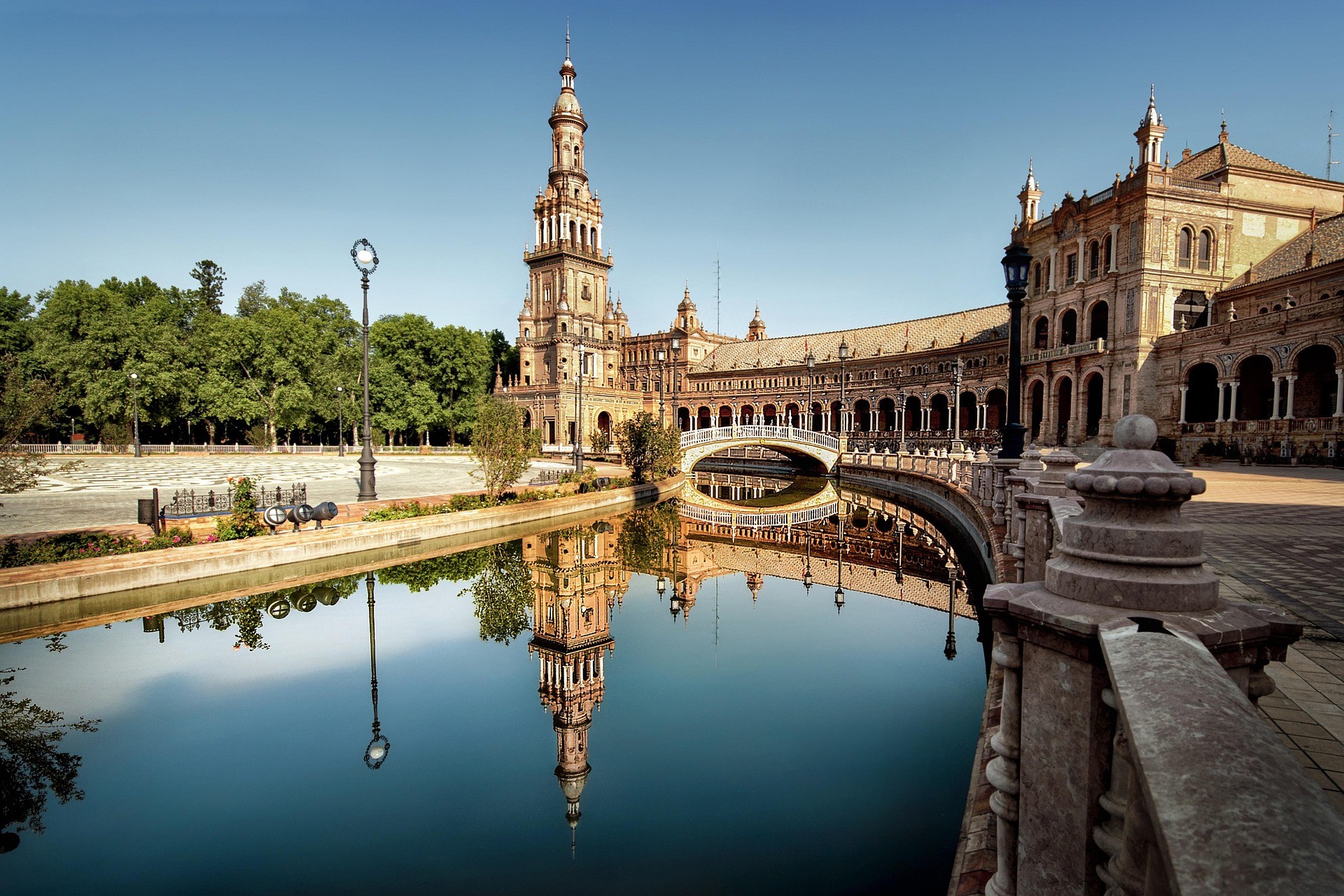
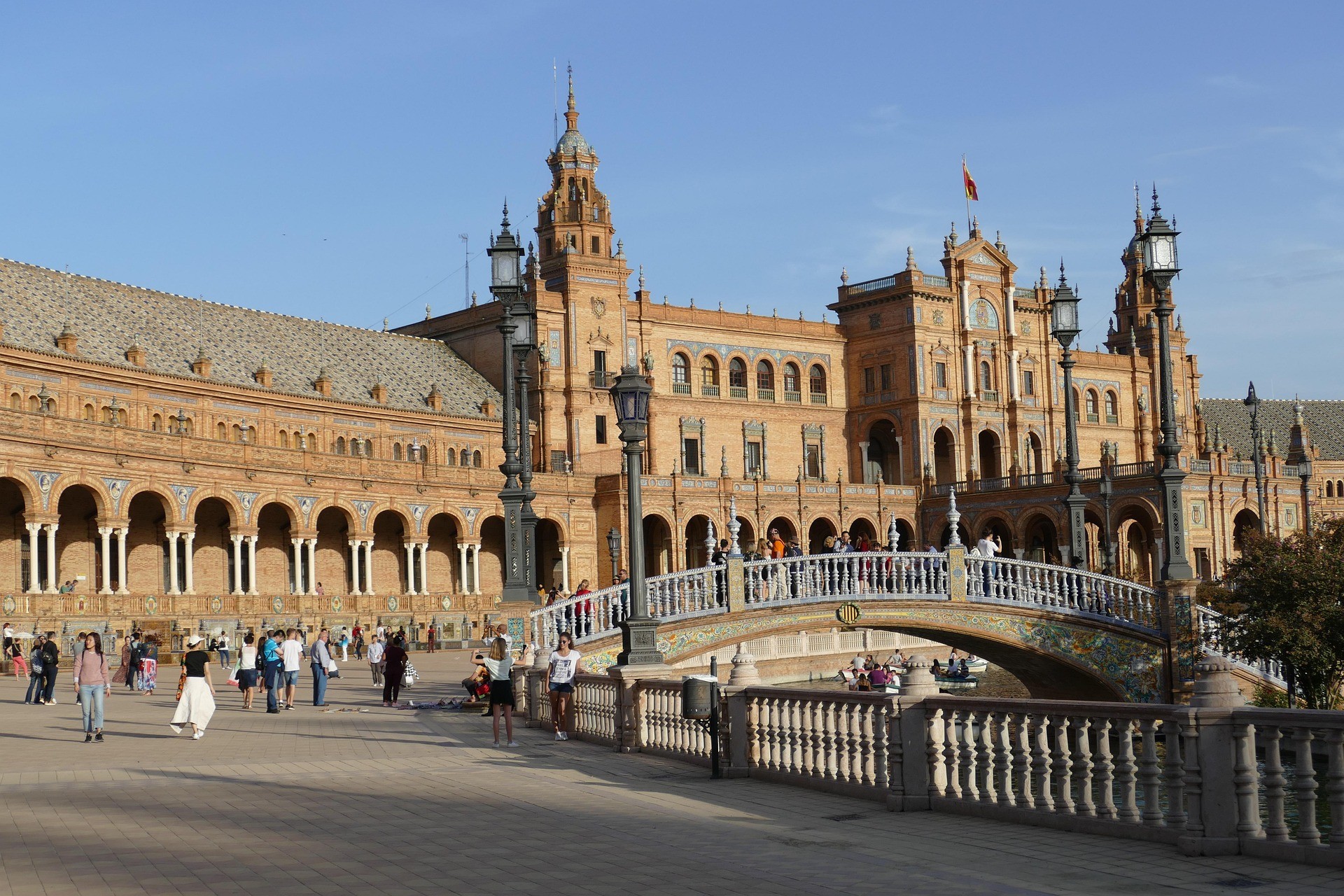
Among the free things to do in Seville, Plaza de España is the first to put on your list. It’s one of those squares that needs no introduction: spacious, theatrical, bright, crossed by little bridges and decorated with colorful ceramics dedicated to the Spanish provinces. It was built for the Ibero-American Exposition of 1929 and still today has a powerful scenic effect, especially in the early morning or late afternoon when the light is warmer and the crowds thin out.
The visit is completely free and can last just a few minutes or much longer, depending on how much time you want to spend there. You can walk along the portico, admire the details of the azulejos, look for the bench dedicated to the Spanish city that intrigues you most, or simply stop to admire the square from the center. It is also one of the most photographed places in Seville, but remains an authentic experience because locals use it as an urban space, not just as a tourist attraction.

Parque de María Luisa: shade, gardens, and walks without a ticket
Next to Plaza de España you’ll find Parque de María Luisa, the city’s great green lung. It’s the perfect place to slow down, especially during the hottest hours when the Andalusian sun makes visiting the center tiring. Tree-lined paths, fountains, ponds, historic pavilions, and small shady corners make the park a precious stop for those who want to discover Seville without spending money.
The park is also ideal for those traveling with children or for anyone who wants to break up a very monumental itinerary with a more relaxed break. As you stroll, you’ll find elegant views, decorated benches, inner squares, and areas where you can stop and take your time. If you’re planning a short stay, you can include it on the same route as Plaza de España, maybe before continuing toward the historic center or the Guadalquivir.
Barrio de Santa Cruz: getting lost in the most romantic neighborhood
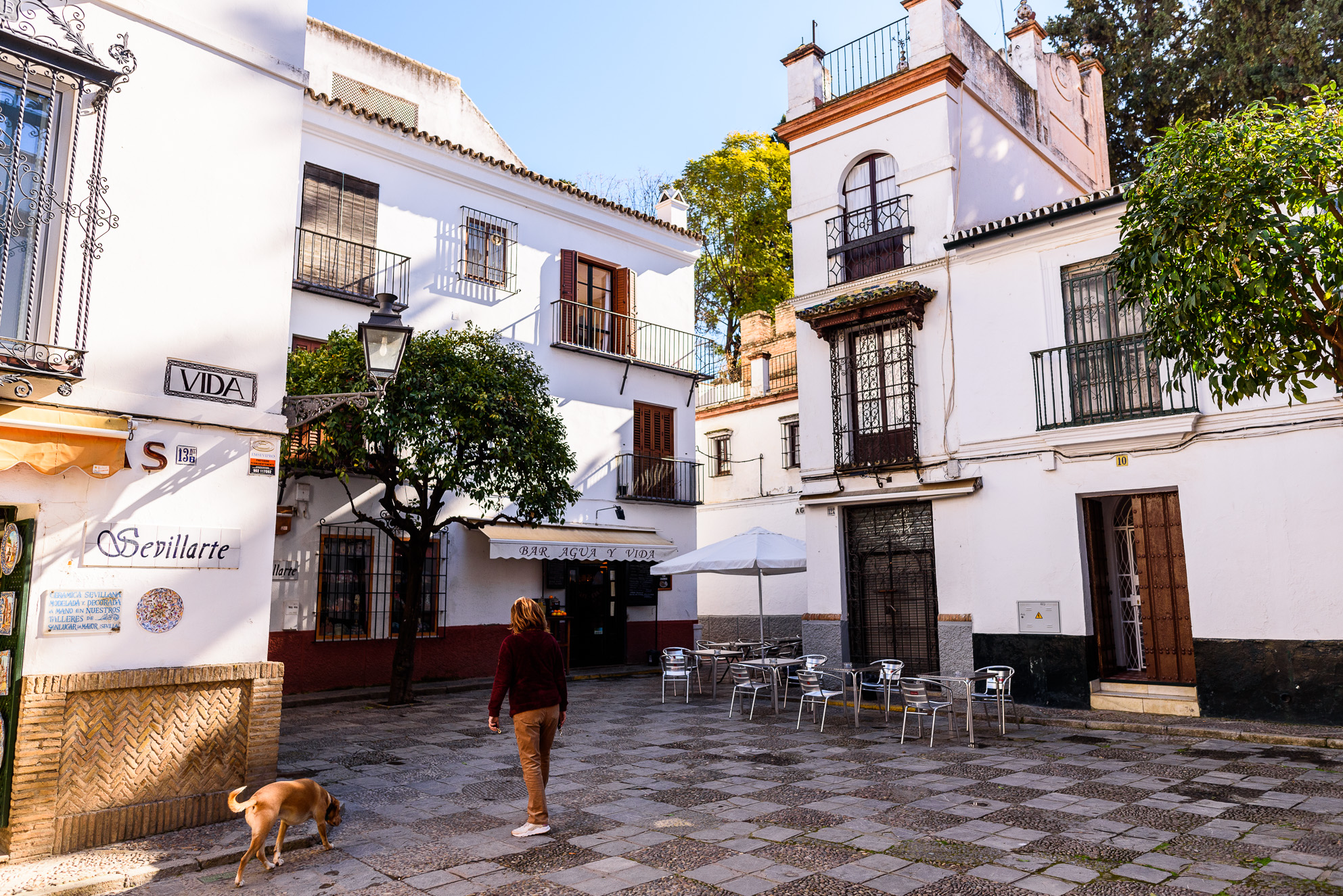
The Barrio de Santa Cruz is one of the most enchanting places in Seville and it costs nothing to walk through it. It is the city’s old Jewish quarter, a labyrinth of narrow alleys, white houses, flowered balconies, quiet little squares, and sudden glimpses. Here the advice is not to be in a hurry: rather than looking for a specific monument, you should let yourself be guided by the atmosphere.
Santa Cruz is perfect early in the morning, when the groups have not yet arrived, but also in the evening, when the lights make the streets more intimate. It is certainly one of the most touristic neighborhoods, but it still retains an undeniable scenic charm. Walking here lets you see why Seville is such a beloved city: not just for its main monuments, but for the way beauty appears suddenly, around a corner, in a small square, or in a courtyard glimpsed through an open doorway.
Archivo General de Indias: a free UNESCO heritage site
The Archivo General de Indias is one of the most important free attractions in Seville. It is located between the Cathedral and the Real Alcázar, right in the historic center, and is part of the UNESCO heritage along with the other two major landmarks in the area. Entry to the accessible rooms and exhibitions is free, so it’s a perfect stop if you want to add cultural value to your itinerary without increasing your budget.
The building houses fundamental documents related to the history of the Spanish Empire and its relationships with the Americas. Even without going into specialized archival matters, the visit is interesting for its architecture, location, and the historic significance of the place. It’s also an ideal solution if the weather is very hot, or if you want to alternate between open-air spaces and cultural interiors.
Triana: the neighborhood to experience with no agenda
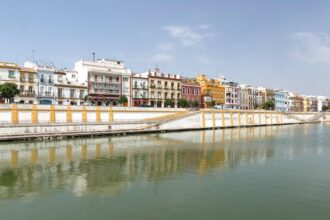
Crossing the Guadalquivir and reaching Triana is one of the most beautiful free experiences you can have in Seville. The neighborhood has a strong identity, different from the monumental center—more popular, more closely tied to ceramics, flamenco, the river, and daily life. Just walk along Calle Betis, wander into the inner streets, and look at the colors of the façades to realize that Triana isn’t just “the other side,” but a fundamental part of Seville’s soul.
If you want to explore the neighborhood further, you can connect this section to the guide dedicated to what to see in Triana in Seville. Even without buying tickets, Triana has much to offer: river views, shops, markets, churches, squares, and a less formal atmosphere compared to the center. It’s an area to enjoy slowly, preferably in the late afternoon when the sun sets and the city starts to change its rhythm.

Mercado de Triana: get a free taste of the city’s daily life
Visiting the Mercado de Triana is free and it’s one of the best places to observe local life. Of course, food and drinks are charged, but entering, looking at the stalls, listening to the sounds of the market, and soaking in the neighborhood’s atmosphere is already an interesting experience. Fruit, fish, cured meats, cheeses, spices, and small eateries keep the market lively at all morning hours.
It’s also a great starting point to understand the local gastronomy before sitting down at the table. If you’re interested in the subject, you can learn more with the guide on what to eat in Seville, which is helpful for recognizing typical dishes, tapas, and Andalusian flavors. Even on a low-cost trip, knowing the local food helps you spend better and avoid overly touristy places.
Eating in Seville without spending too much
Visiting Seville for free doesn’t mean missing out on the gastronomic side of your trip. The city is perfect for tasting tapas, Andalusian dishes, and local specialties without spending a lot, especially if you choose markets, traditional bars, and places frequented by locals. To better find your way among typical dishes, local flavors, and useful addresses, you can also read the guide dedicated to what to eat in Seville.

Guadalquivir riverfront: the best sunset stroll
The Guadalquivir is one of Seville’s main highlights. Walking along the river is free and lets you see the city from a different perspective. On one side you have the historic center, on the other Triana; in between, bridges, reflections, boats, and an urban skyline that changes with the light. The best time is at sunset, when the façades light up in color and the temperature becomes more pleasant.
You can start from the area near the Torre del Oro, continue towards the Triana Bridge, then cross the bridge to continue your walk on the other bank. You don’t need a specific route: the beauty is simply in walking, stopping, taking photos, and letting the city guide you. It’s one of the simplest—but also most memorable—free experiences.

Plaza del Cabildo: a little surprise near the Cathedral
Just a few steps from the Cathedral, Plaza del Cabildo is one of those places many visitors stumble upon by chance. It’s a semicircular, cozy, very elegant plaza, hidden from the main flow. Entering costs nothing and offers a quiet break in the heart of one of the city’s busiest areas.
It’s worth stopping by if you’re already near the Cathedral or the Archivo General de Indias. It doesn’t require much time, but it adds a more intimate and less predictable note to your sightseeing route. It’s also perfect for those who enjoy photographing architectural details, arcades, and orderly perspectives.

Alameda de Hércules: Seville’s most alternative side
The Alameda de Hércules is a large pedestrian area in the northern part of the center—less monumental but very interesting for understanding contemporary Seville. It’s an area lived in by students, families, creatives, and residents, with eateries, open spaces, trees, and daily life that feels different from the main tourist routes.
It’s not the first stop for those staying only a few hours, but it becomes very interesting if you’ve already visited the most famous landmarks or want to discover a less classic side of the city. In the evening it comes alive, but it’s also pleasant for a daytime walk. In a free itinerary, the Alameda helps balance monumental Seville with its more urban and contemporary side.
Basilica of La Macarena and historic walls
The Macarena district lets you step off the most immediate paths and discover an important area of the city. The Basilica of the Macarena is linked to Seville’s popular devotion and Holy Week, while a short distance away you’ll find stretches of the ancient Almohad walls. Entry to the basilica is generally free, while museum spaces may require a ticket.
The visit is especially interesting for those who want to understand the deep relationship between Seville, popular religiosity, and urban identity. The walls, instead, tell the story of an older, defensive, and layered city. It’s a zone to include if you have more than one day or if you want an itinerary that isn’t only focused on the Cathedral, Alcázar, and Plaza de España.

Metropol Parasol: seeing Las Setas without going up to the viewpoint
The Metropol Parasol, known as Las Setas, is one of Seville’s most recognizable contemporary structures. Access to the viewpoint is paid, but you can admire the structure from below, walk through the square, and appreciate the contrast with the surrounding historical context completely for free.
It’s worth stopping by, especially if you’re interested in contemporary Seville or want to see how the city has tried to incorporate new architectural forms into the historic center. The Encarnación area is also a convenient spot to take a break, have a drink, or head towards the Alameda. It’s a short stop, but it’s useful to make your route more varied.
Museo de Bellas Artes: free for European Union citizens
The Museo de Bellas Artes of Seville is one of the best free cultural opportunities for European visitors. For European Union citizens, entry is free, while for other visitors the cost is still very low. The museum is located in a former convent and houses an important collection of Spanish art, with particular emphasis on Seville’s Baroque painting.
It’s a recommended visit especially for those who want to add a high-quality museum stop without affecting their budget. The building itself, with its cloisters and historic spaces, is worth attention. It can be included during a quiet morning or on a very hot afternoon, when alternating between walks and indoor visits becomes essential.

Real Alcázar for free: possible, but with reservation and limited spots
The Real Alcázar is one of Seville’s most important monuments and usually requires a ticket. However, there are free admission slots, especially at certain times on Mondays, with mandatory reservations and limited availability. It’s a very interesting possibility, but it shouldn’t be taken for granted: spots can run out quickly and conditions might change.
If the Real Alcázar is a priority for your trip, the advice is to consider carefully. You can try to book the free entry if available, but if you travel in high season or have little time it might be wiser to buy the ticket. To avoid mistakes, also read the guide on how to buy tickets for the Real Alcázar of Seville.

Cathedral and Giralda for free: pay attention to time slots and availability
There are also free or reduced admission options for Seville Cathedral and the Giralda for certain categories, and in specific cases, free slots with very limited availability. However, this is one of the city’s most sought-after attractions, so it’s not a good idea to base your entire itinerary on the hope of snagging a last-minute free spot.
If you want to visit the Cathedral calmly, especially during a weekend or busier periods, it’s best to plan ahead. The visit remains one of the most important experiences in the city, but in an article about free things to do, it must be addressed realistically: free is possible, but not always simple. For more details, you can check out the guide on how to buy tickets for the Cathedral and the Giralda of Seville.

Palacio de las Dueñas free on Mondays: an opportunity to book
The Palacio de las Dueñas is one of Seville’s most fascinating historic palaces. Normally entry is paid, but the palace offers free tickets for non-holiday Mondays, which must be booked online and are subject to availability. Even in this case, it’s not always available for free, but an opportunity to seize with a bit of advance planning.
If you find availability, it can be one of the most beautiful free visits to add to your trip. The palace allows you to experience a more aristocratic side of Seville, made up of courtyards, gardens, decorated rooms, and family memories. It’s an ideal stop for those who’ve already seen the main highlights and want to enrich their itinerary without increasing their budget.
Torre del Oro: free or pay-what-you-want on some visit types
The Torre del Oro, overlooking the Guadalquivir, is one of the city’s most recognizable symbols. The exterior can naturally be admired for free, while interior visits may be free or pay-what-you-want on certain days, according to the latest museum policies. Because conditions can change, it’s always smart to check before you go.
Even without going inside, it’s still a worthwhile stop on any free itinerary. From here, you can start a walk along the river, reach the Puente de Triana, and continue towards Calle Betis. It’s a very pleasant area especially at sunset, when the river offers one of Seville’s most beautiful scenes.

Centro Cerámica Triana: free only in some cases
The Cerámica Triana Centeris not always free for everyone, but offers free entry for some categories and in certain cases linked to specific visiting conditions. Still, it’s a stop worth considering because it showcases one of the most iconic aspects of the neighborhood: the ceramic tradition, the workshops, the colors, and the relationship between craftsmanship and urban life.
If your budget is strictly zero, you can simply enjoy observing the workshops and decorated facades in the area. But if you already have a ticket to the Real Alcázar or fall into a free entry category, the center can be a very interesting addition to your Triana itinerary.
What to do for free in Seville in one day
If you only have one day and want to spend as little as possible, plan a walking itinerary. Start from Plaza de España and Parque de María Luisa, then head to the historic center passing through the Cathedral area. From here, you can visit Plaza del Cabildo, the Archivo General de Indias, and get lost in the Barrio de Santa Cruz. In the afternoon, cross the bridge to Triana, enter the market, and finish the day along the Guadalquivir River.
This route doesn’t require tickets and still lets you see some of the city’s most representative places. Of course, it’s not a substitute for visiting the inside of the Cathedral or the Real Alcázar, but it shows you a rich and spectacular side of Seville. If you have an extra day, you can also follow the complete itinerary for Seville in 2 days.
What to do for free in Seville on a weekend
On a weekend, you can spread out the free experiences better. Dedicate the first day to monumental Seville: Plaza de España, Parque de María Luisa, the historic center, Archivo General de Indias, Barrio de Santa Cruz, and sunset on the Guadalquivir. The second day can focus on Triana, Mercado de Triana, Macarena, Alameda de Hércules, and Las Setas from the outside.
If you want to save even more, plan your accommodation and meals well. The guide on a weekend in Seville for less than 200 euroscan help you organize an economical yet sensible trip, while the article on where to sleep in Seville without spending too muchis useful for choosing a convenient area without increasing your budget too much.

Seville for free in winter and during events
Visiting Seville off-season can be a very smart choice. In winter, temperatures are often milder than in other European cities, walks are more pleasant, and many free experiences are even more enjoyable due to fewer crowds. Plaza de España, Parque de María Luisa, Triana, and the riverfront can be experienced at a slower and more authentic pace.
If you’re considering a trip during the colder months, you can learn more with the guide to a winter weekend in Seville for tourists seeking mild climates. During the Feria de Abril, on the other hand, the city completely changes: many atmospheric experiences are free, even though you need to plan the theme carefully. To understand how it works, read the guide to the Feria de Abril in Seville.
Where to stay to visit Seville on a budget
To enjoy Seville’s free experiences without wasting time and money on transport, picking the right area is key. Staying too far from the center might seem cheaper, but it can complicate your itinerary, especially if you have only two or three days. The most practical areas are the historic center, Santa Cruz, El Arenal, Triana, and well-connected areas like Macarena.
Those who want to save should look for a balance between price and location. Triana can be a good choice if you want to stay close to the center but in a neighborhood with a strong identity; Macarena may offer better rates; and the center is unbeaten for convenience. For a more comprehensive evaluation, you can read the guide on where to sleep in Seville without spending too much.

Is it worth visiting Seville for free?
Yes, it is absolutely worth it. Seville is a city that gives a lot even without a ticket: squares, neighborhoods, parks, markets, walks along the river, and monumental views are an essential part of the experience. Of course, some attractions like the Real Alcázar and the Cathedral are worth the ticket if they fit within your budget, but they are not the only way to understand the city.
Visiting Seville for free mainly means walking, observing, and choosing the right moments of the day. The city has a natural theatricality that does not always depend on paid entrances. For this reason, a low-cost itinerary can not only be possible but also beautiful: simply mix always-accessible places, free entry times when available, and good planning.
Frequently asked questions about free things to do in Seville
What are the best free things to do in Seville?
The best free things to do in Seville are visiting Plaza de España, strolling in Parque de María Luisa, exploring the Barrio de Santa Cruz, crossing the Guadalquivir to Triana, entering the Mercado de Triana, visiting the Archivo General de Indias, and enjoying the sunset along the river.
Is it possible to visit the Real Alcázar for free?
Yes, the Real Alcázar sometimes offers free entry during certain Monday time slots, with mandatory reservation and limited spots. However, this is not guaranteed every day, so it’s a good idea to check availability in advance and consider buying a ticket if your visit is a priority.
Can you visit the Seville Cathedral for free?
The Cathedral and the Giralda may offer free entry or discounts under certain conditions, but spots are limited and the terms may change. If you want to be sure to visit, especially during peak season, it’s best to plan ahead and check official availability.
Which museums are free in Seville?
Among the free museums or those with free entry for certain categories is the Museo de Bellas Artes, which is free for citizens of the European Union. The Archivo General de Indias is also a very interesting cultural visit that’s completely free. Other places may only be free for residents, minors, or during specific times.
What free things can you do in Seville with children?
With children, the best free experiences are Plaza de España, Parque de María Luisa, walks along the Guadalquivir, Triana, and the markets. These are spacious, scenic places and less demanding than museums, perfect for alternating discovery and rest breaks.
What is the best time to visit Seville on a budget?
The best times to visit Seville on a budget are winter (excluding holidays and long weekends), and some weeks during the low season between autumn and early spring. During these months, it’s easier to find cheaper accommodations and free experiences are even more enjoyable since the city is less crowded.
Can you visit Seville on a low-cost weekend?
Yes, Seville is great for a low-cost weekend. By choosing a well-located accommodation, walking a lot, and including free experiences like Plaza de España, Triana, Santa Cruz, the Guadalquivir, and the Archivo General de Indias, you can enjoy a rich trip without spending too much.