


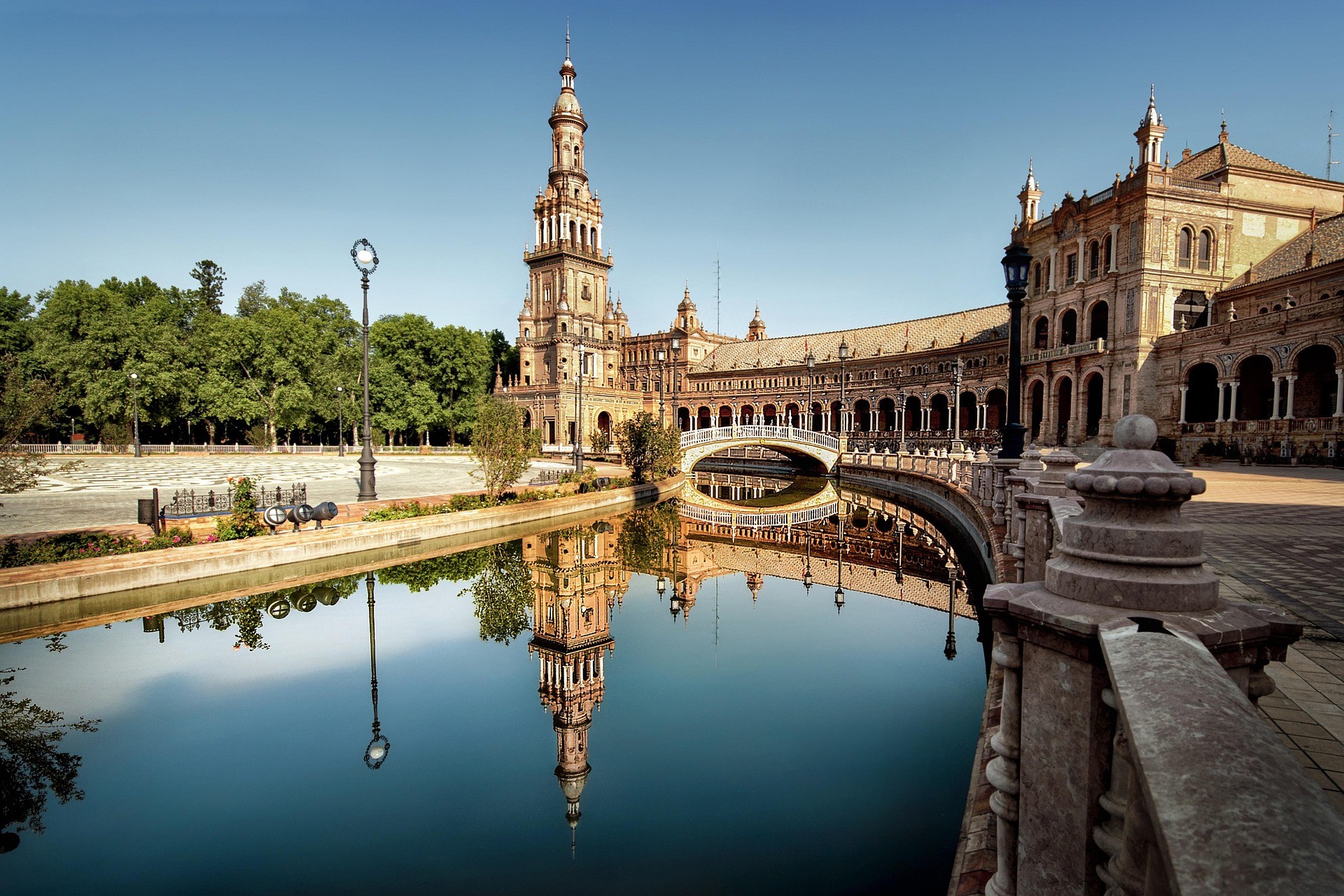

Seville is a city perfect for a short trip, but it is not a “simple” city. It is compact and walkable, yes, but also intense: monuments among the most important in Spain, neighborhoods with a very strong personality, an evening life that shifts the day’s axis, and a climate (especially in late spring and summer) that forces you to think in terms of shade and breaks, not just stages.
- 1. Book Alcázar and Cathedral in advance: it saves your trip
- 2. Do not underestimate the heat: shift “heavy” visits to the morning
- 3. Walk, but wisely: Seville is best explored on foot if you choose the right base
- 4. Seville is also alive at night: don’t end your day too early
- 5. Eat wisely: tapas yes, but the right ones
- Seville itinerary in 2 days: how to use it
- Seville itinerary in 2 days: how to use it
- Day 1: monumental Seville (Alcázar, Cathedral, Santa Cruz, Plaza de España)
- 08:30–11:30 | Real Alcázar of Seville
- 11:45–13:30 | Seville Cathedral and Giralda
- 13:30–15:30 | Real lunch break (tapas with purpose)
- 15:30–17:00 | Barrio Santa Cruz: alleys, shade, and small squares
- 17:30–20:00 | Plaza de España and María Luisa Park
- 20:30–late | Evening in Seville: atmosphere, tapas, flamenco (if you want)
- Day 2: Setas, the “real” center, river and Triana
- 09:00–10:30 | Metropol Parasol (Las Setas): the city from above
- 10:30–12:30 | Off-the-beaten-path historic center: streets, small churches, daily life
- 12:30–14:00 | Arenal and Guadalquivir: Seville on the river
- 14:00–15:30 | Lunch break: market or tapas (smart choice)
- 16:00–19:30 | Triana: the soul of Seville (market, ceramics, sunset)
- 8:00 PM–late | Last night: choose the “ending” that suits you
- Where to stay in Seville to optimize the itinerary
- When to go: the best period and the events that change the city
- Mistakes to avoid (that waste time in 48 hours)
- Quick FAQ (SEO): common questions about Seville in 2 days
- Is two days enough to see Seville?
- What is the best order of visits?
- Is it worth booking tickets online?
- Where is it best to stay to get around on foot?
- What shouldn’t I miss besides the monuments?
- Conclusion: the best way to remember Seville
This itinerary for 2 days in Seville is designed to let you experience the best of the city in a realistic way, without rushing and without getting trapped in avoidable queues. You will find a detailed route, concrete visiting times, suggestions on when to see each place at the best time of day, and practical tips to organize the 48 hours smoothly.
1. Book Alcázar and Cathedral in advance: it saves your trip
The two visits that determine the outcome of your weekend are the Real Alcázar e and the Cathedral with Giralda. They are very close and often visited on the same day, but without a reserved ticket you risk losing hours (or having to give up). To organize yourself better, you can find more information here:
- How to buy tickets for the Real Alcázar of Seville
- How to buy tickets for the Cathedral and the Giralda

2. Do not underestimate the heat: shift “heavy” visits to the morning
If you travel between May and September (but often also in late April), the heat is not just a variable: it’s the rhythm. The longer and more demanding visits (Alcázar, Cathedral, Plaza de España) are better done in the morning or late afternoon. The central hours are perfect for shaded alleys (Santa Cruz), museums, markets, or a long break.

3. Walk, but wisely: Seville is best explored on foot if you choose the right base
The historic center is large but continuous: distances are manageable if you stay between Santa Cruz, Arenal, or the central area. The difference between “very comfortable” and “tiring” lies entirely in the accommodation area. If you want a targeted, updated selection designed to save without sacrificing location, you can consult this guide: where to stay in Seville without spending too much.
4. Seville is also alive at night: don’t end your day too early
One of the most common mistakes is to “consume” Seville only during the day. The city changes face in the evening: more humane temperatures, crowded streets, warm lights on the buildings, tapas and flamenco becoming part of the landscape. In our itinerary, you will always find a sensible idea for after dinner.

5. Eat wisely: tapas yes, but the right ones
If you sit in the first “convenient” place near the monuments, you risk a tourist version of Andalusian cuisine. Better to enter the city with a compass: typical dishes, what to really order, what to try at least once. To orient yourself among flavors and local specialties you can read what to eat in Seville.
Seville itinerary in 2 days: how to use it
You can follow this itinerary linearly (recommended) or adapt it to your needs. To help you, you will find:
- Realistic visiting times
- Tips to avoid queues
- Alternatives if you are traveling with children or in case of intense heat
Seville itinerary in 2 days: how to use it
You can follow this itinerary linearly (recommended) or adapt it. To help you, I have included:
- Realistic visiting times (not from an “ideal” guide)
- Tips to avoid queues (when to go and what to avoid)
- “Smart” alternatives if you are tired, if it rains or if you travel with children
Technical note for WordPress: I deliberately avoid inserting the link to your cornerstone “Seville” here because you told me the auto-SEO plugin adds it as soon as it sees the destination. So I avoid duplication or uncontrolled choices.
Day 1: monumental Seville (Alcázar, Cathedral, Santa Cruz, Plaza de España)
08:30–11:30 | Real Alcázar of Seville
If you have to choose only one place that represents Seville, it is this one. The Real Alcázar is not “just” beautiful: it is a living manual of cultural layering. Here you understand why Seville has been a frontier and a bridge between worlds. Mudejar architecture, courtyards that seem embroidered, azulejos that never end, gardens that change atmosphere at every turn.
How much time do you really need? The minimum visit is 2 hours, but if you want to enjoy it without rushing, count 2 and a half to 3 hours, including the gardens. Many visitors make the mistake of “leaving” as soon as they see the palace: instead, the gardens are half the experience. If it’s hot, they also become your refuge: trees, fountains, shade.
Practical tip: choose the first available slot and arrive early. For all the ticketing and access parts, use your guide: how to buy tickets for the Real Alcázar.

11:45–13:30 | Seville Cathedral and Giralda
The Seville Cathedral is a powerful visual impact: huge spaces, naves that seem endless, filtered light. Here you don’t need to “know everything”: just let yourself be impressed. Then comes the part that sticks with you: the Giralda. The ascent is unusual: there are no classic stairs, but ramps. It’s a detail that changes the effort and makes everything smoother. Once at the top, the city is a mosaic of light roofs and clean lines. If you’re looking for the photo to take home, it’s often here.
Queue-avoidance tip: book this visit as well. Here’s your guide: tickets for Cathedral and Giralda.
13:30–15:30 | Real lunch break (tapas with purpose)
After Alcázar and Cathedral you need a long break. Seville is not the city of grab-and-go sandwiches: it’s the city of tapear done right. It is also the time when the city slows down, especially on hot days. If you want to choose what to order wisely (and avoid getting a “standard” menu), you should consult what to eat in Seville. It’s also perfect for giving depth to this itinerary: typical dishes, local flavors, and smart choices.
Mini-checklist for a typical order: if you feel like it, include at least one “creamy” dish (salmorejo), one “land” dish (carrillada), and one “sea” dish (pescaíto frito). It’s a simple way to taste Andalusia without complicating your life.

15:30–17:00 | Barrio Santa Cruz: alleys, shade, and small squares
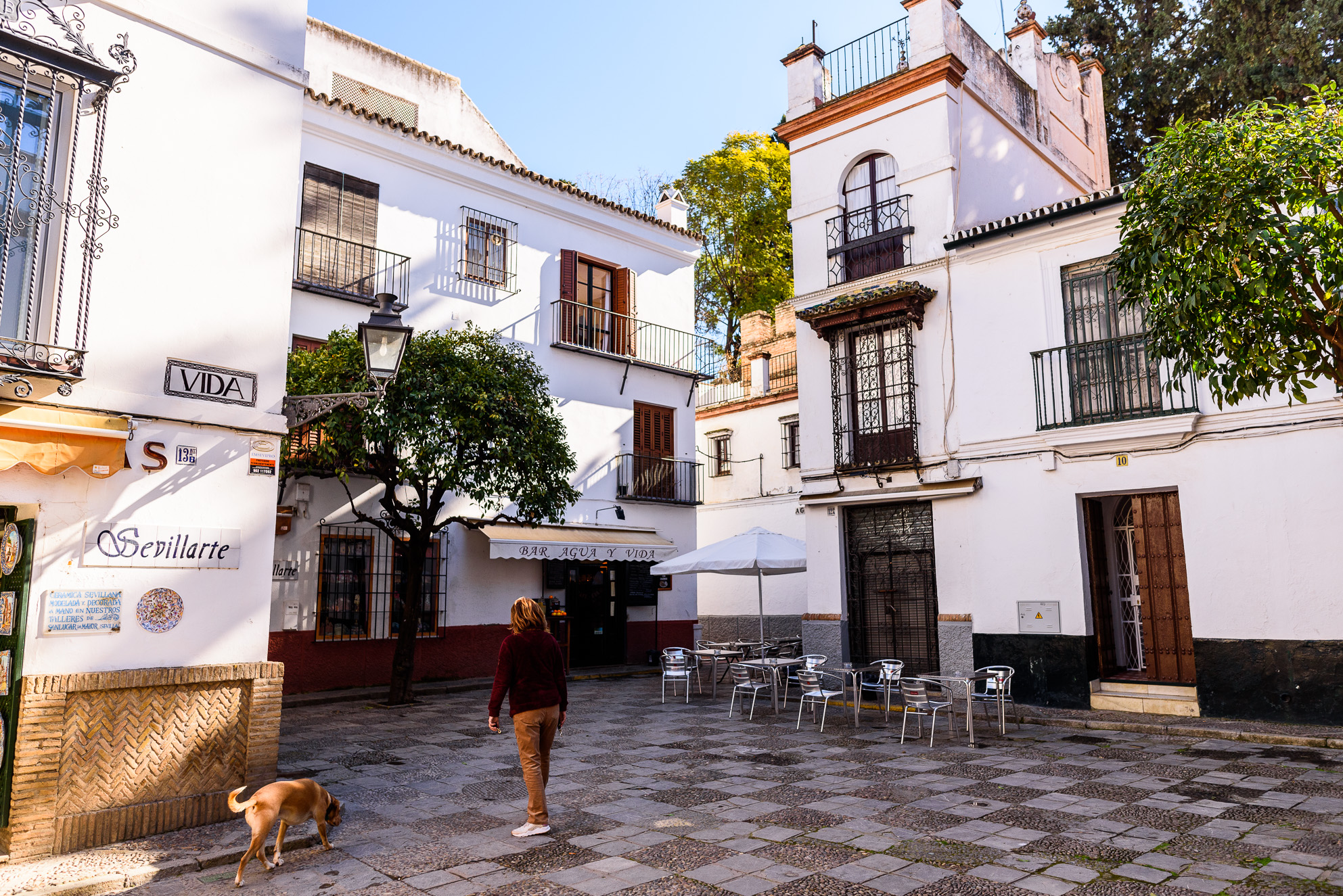
After lunch, the smartest choice is to enter the Barrio Santa Cruz. It’s a network of narrow shaded alleys, hidden courtyards, sudden silences. This is the most “narrative” Seville, the one that seems built to make you get lost (in a good way).
What to do here? Walk without hurry. If you want to make the experience more tangible, look for three things: a tiny square with orange trees, a door open onto a courtyard, a sudden perspective of the Giralda peeking through the rooftops. Santa Cruz works like this: it doesn’t hit you all at once, but in small flashes.
17:30–20:00 | Plaza de España and María Luisa Park
Late afternoon is the perfect time for Plaza de España. Don’t go there at noon: you risk experiencing it as “tiring.” Instead, towards evening, the square becomes scenic, almost cinematic. The ceramics dedicated to Spanish provinces are a little journey within the journey (and often become the favorite game: “find your province”).
Then enter María Luisa Park: there’s no need to “see everything.” You need to breathe. It’s one of the few things many itineraries overlook: the break as part of the visit, not as an interruption.
20:30–late | Evening in Seville: atmosphere, tapas, flamenco (if you want)
The evening is when you really understand Seville. You can choose a second tapas session, or go for a more cultural experience. If you love flamenco, this is the right city, but with one rule: avoid the “tourist show” effect if you can. Even just a well-chosen venue can make a difference.

If you have a limited budget and want a practical approach (like organizing a weekend on a budget), it makes sense to also cross-reference this guide: weekend in Seville with less than 200 euros.
Day 2: Setas, the “real” center, river and Triana
09:00–10:30 | Metropol Parasol (Las Setas): the city from above
Start with a different point of view: Metropol Parasol, called by everyone Las Setas. It is contemporary, divisive, but very useful to orient yourself. The walk up high gives you a mental map of the city: you understand how extensive the historic center is, where the points you have already passed are, and where you are heading.
When is it best? In the morning, when the air is cooler and the light is clear. Alternatively at sunset, but in two days you risk overlapping it with other better stops (Triana at sunset, for example).
10:30–12:30 | Off-the-beaten-path historic center: streets, small churches, daily life
Here I don’t give you a “checklist of things to tick off”. I give you a logic: today is the day when Seville must stop being just a monument and become a city. Walk through the inner streets, enter a church if you find the door open, stop where you smell bread or coffee. It is in these hours that the trip becomes personal.
If you are traveling with children or with someone who “can’t handle” too many visits, this time slot is perfect: no queues, no large spaces to face, just strolling and stops.
12:30–14:00 | Arenal and Guadalquivir: Seville on the river
Head down to the river: the Guadalquivir is a narrative line. Here the city changes pace. The Torre del Oro is an iconic landmark and a good excuse to walk along the riverbank calmly.
Practical advice: if it’s hot, this is one of the areas where the air moves a bit more. If it rains, it is a “transitory” area that you can reduce without regrets to dedicate more time to Triana.
14:00–15:30 | Lunch break: market or tapas (smart choice)
You have two sensible options: a light and quick lunch to leave time for the afternoon in Triana, or a longer break if you’re tired and want to “recharge” your energy.
In both cases, use the guide what to eat in Seville: it helps you choose dishes that make sense in the context (and avoid lazy choices that then leave you feeling like you ate “just anything”).

16:00–19:30 | Triana: the soul of Seville (market, ceramics, sunset)
Triana is not a “neighborhood for a quick visit”. It is a neighborhood to live in. Cross the bridge (Isabel II) and immediately feel the difference: more popular, more everyday, more real. Here Seville becomes less postcard and more story.
Don’t miss:Mercado de Triana for the atmosphere (even just to pass through), the ceramic shops, the streets where life flows without putting on a show.
For a complete and ready-made guide as a cluster, integrate this one: what to see in Triana. In this itinerary, Triana is the perfect finale because it leaves you with the most authentic Seville.
The best moment: sunset. No need to look for the “perfect view”: just be there, with the light fading and the city warming up with voices.
8:00 PM–late | Last night: choose the “ending” that suits you
Here you decide how to close. Three possible endings, all sensible:
- Tapas finale: choose 2–3 places and make a small route (without sitting for hours in the same place). It’s the most Sevillian way to say goodbye to the city.
- Romantic finale: slow walk, night photos, illuminated squares. Seville in the evening is gentle.
- Cultural finale: carefully chosen flamenco, without looking for the “wow effect” of tourist packages.

Where to stay in Seville to optimize the itinerary
The right base is worth more than a thousand micro-optimizations. If you want to move by foot and reduce taxis/public transport, aim for:
- Santa Cruz (beautiful, central, perfect for Alcázar and Cathedral)
- Arenal (great for the river and evenings)
- Central historic district (balance of everything)
If the goal is to spend well without overpaying, here you find the most suitable guide: where to stay in Seville without spending too much. You will find recommended areas, types of accommodation, and practical tips to optimize location and budget. If instead you prefer to compare availability and prices directly based on your dates, you can also use FullTravel’s dedicated hotel search engine to search hotels in Seville, so you can filter by area, price range, and services. And if you are working with a tighter budget (for example, a really low-cost weekend), this practical guide can also be useful: weekend in Seville with less than 200 euros.
When to go: the best period and the events that change the city
Seville is a destination that changes completely depending on the calendar. The most balanced period is often between late winter and spring (or in autumn). Two special scenarios deserve a dedicated link:
- Feria de Abril: if you really want to understand how it works and how to experience it without stress, use this guide: Feria de Abril in Seville.
- Mild winter: if your goal is a weekend without cold, here is your perfect insight: winter weekend in Seville.

Mistakes to avoid (that waste time in 48 hours)
- Arriving without reservations for Alcázar and Cathedral: you risk wasting half a day.
- Visiting Plaza de España at noon during the hot seasons: it becomes exhausting, not beautiful.
- Staying only between Alcázar and Cathedral: it’s wonderful, but it’s not the whole of Seville. Triana is essential to truly “understand” the city.
- Eating randomly in the most touristy areas: with two days, every meal counts for the experience. Use what to eat in Seville as your compass.
- Planning too much: Seville doesn’t reward rushing. It rewards well-made pauses.
Quick FAQ (SEO): common questions about Seville in 2 days
Is two days enough to see Seville?
Yes, if you organize your priorities. In 48 hours you can visit Alcázar, Cathedral and Giralda, stroll in Santa Cruz, see Plaza de España, and experience Triana. If you want to add museums or day trips, you need more days, but for a first visit two days are perfect.
What is the best order of visits?
The first day is ideal for Alcázar and Cathedral (they are close) and for Plaza de España in the late afternoon. The second day works very well with Setas in the morning and Triana in the afternoon, finishing with sunset and evening.
Is it worth booking tickets online?
Yes. To save time (and often to guarantee entry), it’s worth booking especially for Alcázar and Cathedral/Giralda. Use the dedicated guides: Alcázar e Cathedral/Giralda.
Where is it best to stay to get around on foot?
Santa Cruz and Arenal are the most convenient areas. If you want to save money without giving up location, check out where to stay in Seville without spending too much.
What shouldn’t I miss besides the monuments?
Triana. It’s the neighborhood that lets you understand the soul of the city. Here you find the complete guide: what to see in Triana.
Conclusion: the best way to remember Seville
Seville in 2 days is not a list of stops: it’s a sequence of atmospheres. The decorated silence of the Alcázar, the dizziness of the Giralda, the theatrical light of Plaza de España, and then Triana, which is not visited: it is crossed. If you follow this itinerary with some flexibility (without trying to control everything), you will return home with a rare feeling: not that of having seen “a lot”, but that of having seen well.