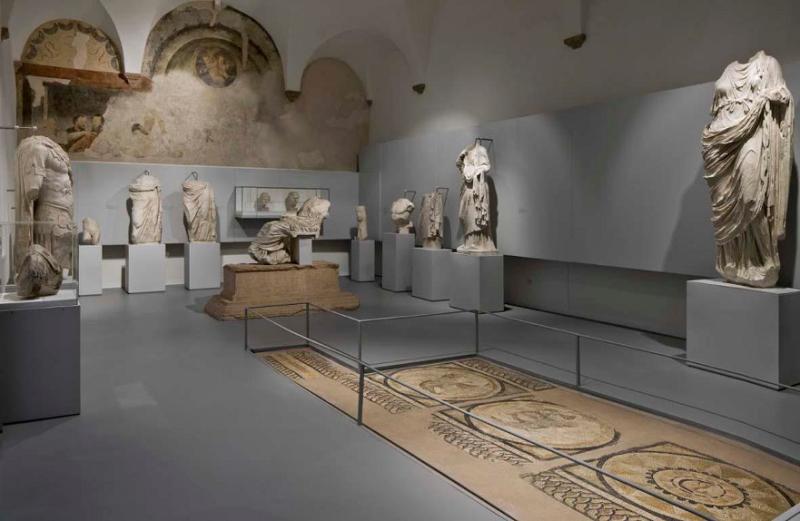


Commissioned by the wealthy Lavezzola family between 1530 and 1550 to the brilliant architect Michele Sanmicheli, it later became the property of the Pompei family, and in 1833 Count Alessandro Pompei donated it to the Municipality of Verona to host exhibitions, art collections, and scientific collections of notable prestige and importance to the city. The original core of the palace was expanded, starting in 1858, by progressively annexing adjacent spaces and houses.
In the spacious rooms of the Palace there are now fourteen exhibition halls, the library, laboratories, collection storage, and the offices of the Museum.
The Civic Museum of Natural History of Verona houses scientific sections dedicated to the study of minerals and rocks, paleontology, and zoology. The prehistoric and botanical sections are hosted in the Command Pavilion of the Austrian Arsenal of Verona.
The scientific material gathered by the Museum’s researchers and numerous naturalists over nearly five centuries is now meticulously prepared and cataloged, studied, and thus preserved in the collections or displayed to the public in the halls.
The Museum therefore plays a central and decisive role in scientific research and in publishing essays and educational texts. The educational and communication section is also very active, aimed at spreading naturalistic culture among various public groups (schools, adults, families, associations, etc.).
A section of the Civic Museum of Natural History of Verona is dedicated to the fossils of Bolca: the most extraordinary testimony of the Earth’s evolution imprinted in rock as if on the pages of a book. From the Bolca area in the Lessini Mountains, 50 km from Verona, come fossil specimens of over 250 animal species and 200 plant species, a fascinating snapshot of life on Earth 50 million years ago.