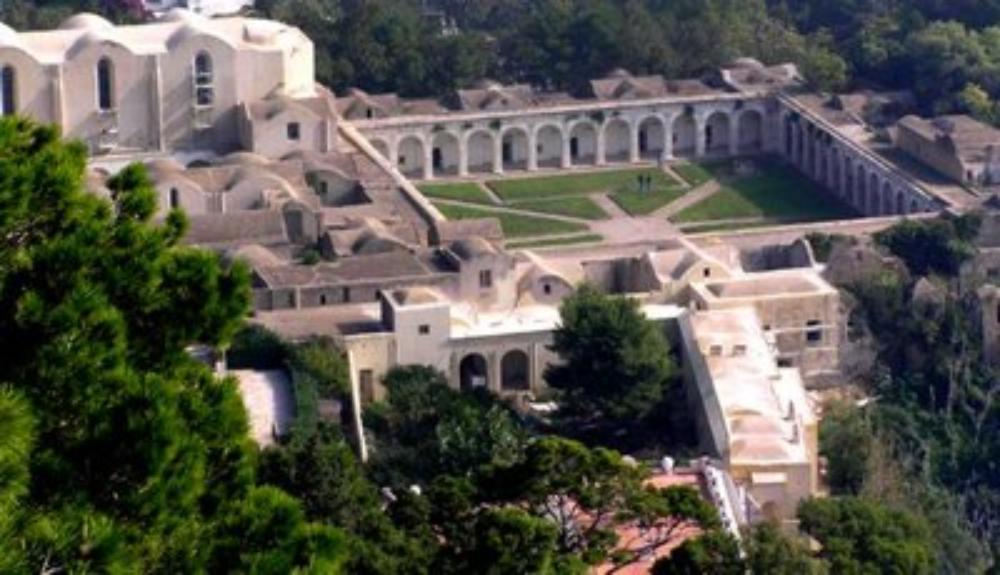


The complex dates back to the second half of the 14th century, by the will of Count Giacomo Arcucci, Grand Chamberlain of Queen Joanna I of Anjou, as evidenced by the valuable fresco above the entrance portal to the church, dating to around 1371 and executed by the Florentine painter Niccolò di Tommaso. The fresco depicts the Virgin on the throne with Child together with Count Giacomo Arcucci and Queen Joanna I, and the saints James and John the Baptist. The monastery’s layout follows precise canonical rules: the “upper house” or cloistered convent and the “lower house” with service rooms. Today the Charterhouse presents a layering of interventions that often overlapped, also transforming the preexisting structure. The Charterhouse of San Giacomo is distinguished by its generous volumes, marked by clear formal simplicity, free of stucco, and characterized by the plasticity of the masonry structures and its vault structures, formed by extradosed vaults. Following pirate raids, the Charterhouse suffered serious damage and from 1563 onwards underwent significant restoration work, as evidenced by the late-Renaissance great cloister. In the 17th century, the Prior’s Quarters and the Apothecary were built. In 1808 the Charterhouse was suppressed and its assets confiscated. In 1815 it was turned into a barracks, then became a hospice for invalids, and after 1860 until 1898 was the seat of the 5th Disciplinary Company, composed of anarchists and soldiers of bad conduct. The last act, which greatly influenced the future decay of the complex, was with the Unification of Italy when the assets and revenues of the Carthusian monks of Capri were transferred to the church of Ischia. A comprehensive restoration project began in 1927, led by Superintendent Gino Chierici, who brought to light the original 14th-century structures. Recently the Charterhouse underwent restoration and plant adaptation under the supervision of the Superintendent for Architectural and Landscape Heritage of Naples and Province. Dedicated to Saint James, the church is the tallest building and thus dominates the entire structure of the Charterhouse, belonging to the original 14th-century layout. From the low porch with an arch, you enter the interior of the church which has a single nave, divided into three bays, made up of half pillars and ribbed arched ribs, concluded by the evocative sequence of ribbed vaults with sharp ribs, ending in a semicircular apse from a later period at the back of the hall. In the inner corner of the ogival arch, a dove, painted directly on marble, symbolizes the Holy Spirit. The naves and the ceiling feature fragments of frescoes from the early 1700s. The great cloister forms the central part of the so-called “upper house,” that is, the space reserved for the cloister, around which are arranged the twelve monks’ cells, designed by Giovanni Antonio Dosio, featuring round arches resting on sturdy pillars. Along one of the three sides of the gallery is the entrance to the small cloister, a 14th-century testimony of the Charterhouse of San Giacomo. Here the arches rest on slender small pillars with capitals made from Roman and Byzantine spolia, uncovered during the restoration by Superintendent Gino Chierici. Above the surrounding gallery appears the baroque mass of the “clock tower,” with a square base topped by a triangular spire. Located to the right of the great cloister, the Prior’s Quarters, built in the first half of the 17th century, is the residence of the spiritual guide of the Carthusian community. Around the great cloister are arranged the twelve Fathers’ dwellings, each a small two-level building with an extradosed rib vault symbolizing the cross, divided into: Ave Maria, a room containing a statue of the Virgin, and cubiculum, where most of the simple cloistered life took place. Each house also had a small garden enclosed by high walls. Inside the prestigious Charterhouse, the museum was inaugurated in 1974 thanks to the care of then Superintendent Raffaello Causa. Named after the symbolist painter K. W. Diefenbach (1851–1913) – whose paintings, left in some rooms of the charterhouse after his death, it hosts – the museum is the tribute Capri wanted to pay to the artist who stayed here from 1900 until his death. The museum displays large paintings with diverse subjects, whose visionary symbolism strongly marks the space, making it a place of great emotional impact for visitors. Of the three hundred works created during the thirteen years spent in Capri, until his death, part was generously donated to the State by his heirs. Today it is possible to visit the collection including 31 canvases, 5 plaster sculptures, and a portrait of the painter painted by Ettore Ximenes. The museum also houses Roman-era statues depicting marine deities discovered in the Blue Grotto.
Information about the Charterhouse of San Giacomo
Via Certosa
80073 Capri (Naples)
0818376218
[email protected]
https://www.polomusealencampania.beniculturali.it
Source: MIBACT