

The Naples State Archives was established as the “General Archive of the Kingdom” by royal decree on December 22, 1808, with the goal of bringing together in one location the historic archives of institutions that existed prior to the arrival of Joseph Bonaparte in Naples in 1806.
The archives grouped documents from the Regia Camera della Sommaria—which held land registry volumes for all the municipalities of the kingdom—the Chancellery, the State Secretariats from the viceregal period, and the State’s top advisory and judicial bodies (Consiglio Collaterale, Real Camera di S. Chiara, Cappellano Maggiore, Sacro Regio Consiglio, Gran Corte della Vicaria), as well as records from other important governmental organizations.
After the Bourbon Restoration in 1815, the archive was renamed the “Great Archive of the Kingdom” and it was established that both past and present government records would be periodically deposited. From 1860 onwards, there was a significant increase in its document holdings, thanks to acquisitions from the Bourbon ministries and other central bodies such as the Consulta di Stato and the Gran Corte dei Conti.
The first director after Italian Unification was economist and journalist Francesco Trinchera, who published the first comprehensive guide to the Naples archives in 1872, drawing on earlier work by archivist Michele Baffi. Distinguished scholars such as Camillo Minieri Riccio (1874-1882), Bartolomeo Capasso (1882-1900), and Eugenio Casanova (1907-1915) succeeded him. Casanova authored a renowned manual on archiving and an extensive report covering the decade 1899-1909, published in 1910.
The tenure of Riccardo Filangieri di Candida (1934-1956), who oversaw the collection of private archives, unfortunately coincided with one of the darkest periods in Italian archival history. During WWII, the Naples State Archives suffered, more than any other Italian archive, the loss of a vast amount of irreplaceable documents stored in a depot near Nola for safekeeping, which were destroyed by retreating German troops in September 1943.
Throughout the 20th century, having lost its status as a capital city archive, the institution received records from provincial and local bodies such as the Prefecture, Police Headquarters, and the District Tax Office, including documents on Naples’ provisional land cadaster established by Murat in 1809 and valid until 1914. The first floor of the Monastery of Santi Severino e Sossio, which houses the Naples State Archives, functions as the archive museum.
At the heart of the Institute’s life—the Main Reading Room, the Inventory Room, and the Reception Room are all housed here—this floor was also historically the centre of monastic community life. The four splendid cloisters defined its rhythms; the Chapter Room, decorated by Belisario Corenzio in the early 1600s with a remarkable Christological fresco cycle, was a venue for debate; and the imposing Refectory was the centre of daily monastic routine.
Multiple historical layers and functions coexist here: the monastery, the 19th-century archive, and the modern cultural institute. Visits to the Naples State Archives today are limited to the first-floor areas. The virtual tour, however, opens the doors to the “Secret Archive“: usually off-limits spaces, occupied by offices or document storage, which—despite their function—hide treasures of significant artistic and archival value.
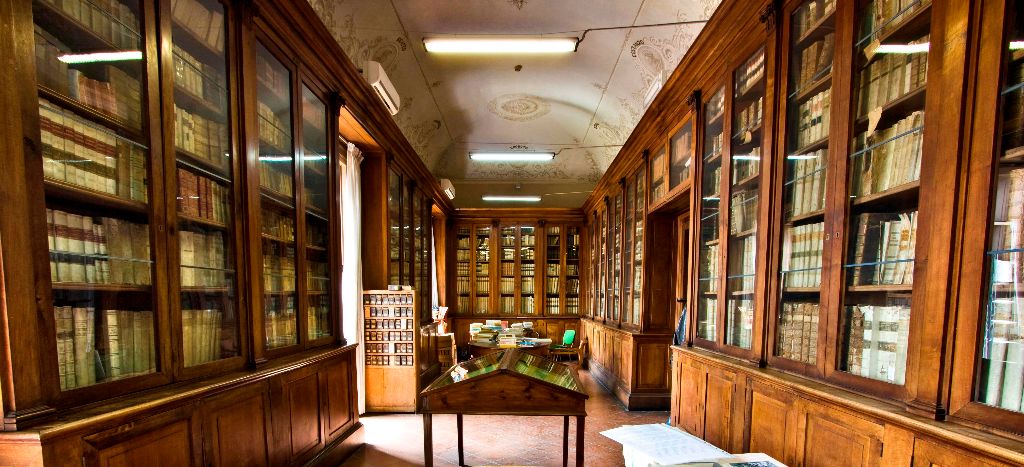
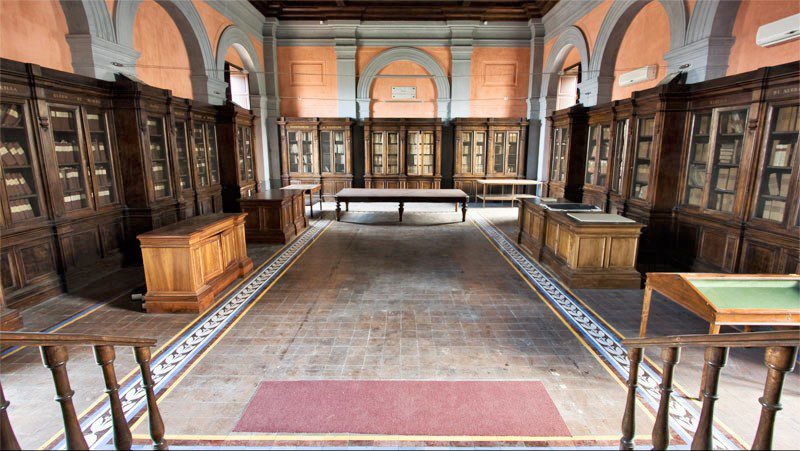
The third floor features relics from the Roman era, 19th-century precision instruments, and the Archive’s oldest piece, the Carta lapidaria, showing the distinctive blend of documents and monuments that defines the Santi Severino and Sossio complex. On the Institute’s fourth floor, monumental document storage halls were built in the early 19th century. These halls, not included in standard tours, are noteworthy both for the value of the documents preserved and for their varied and innovative shelving solutions.