


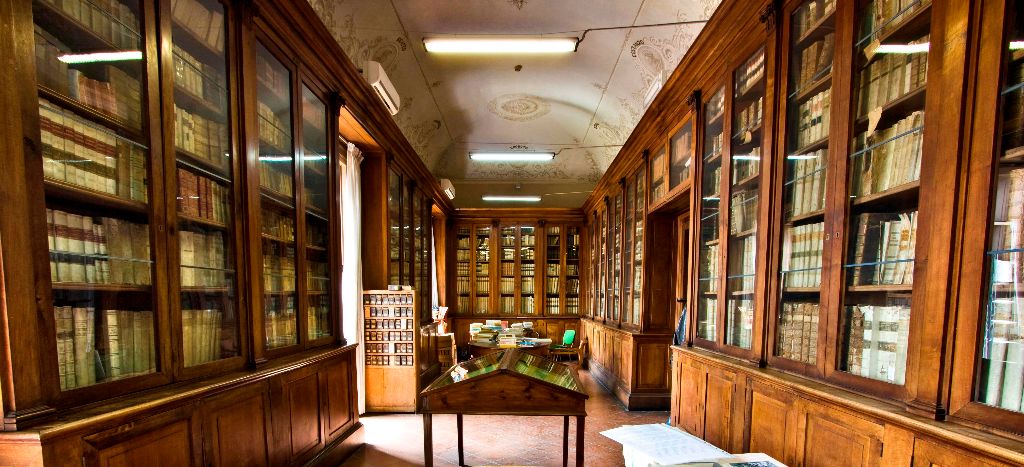

L’State Archive of Naples was established as the “General Archive of the Kingdom” by the royal decree of December 22, 1808, with the purpose of bringing together in one location the ancient archives of the institutions existing until the arrival of Joseph Bonaparte in Naples in 1806.
Thus, the archives of the Royal Chamber of the Sommaria, which included volumes of the “onciari” cadastres relating to all the municipalities of the kingdom, the Chancellery, the State Secretariats of the viceregal era, the supreme advisory bodies of the State (Collateral Council, Royal Chamber of S. Chiara), the Major Chaplain, and the highest judicial bodies of the State (Sacred Royal Council, Grand Court of the Vicaria) were concentrated, along with the records of many other state bodies.
After the Bourbon restoration of 1815, the name changed to “Great Archive of the Kingdom” and the principle was established that not only the records of ceased administrations but also those of current administrations had to be periodically deposited there. From 1860 onward, the archive saw a significant increase in its documentary holdings, thanks to the acquisition of the acts of the Bourbon ministries and other central bodies, such as the State Council and the Grand Court of Accounts.
The first director after the Unification was the economist and journalist Francesco Trinchera, who, relying on a previous valuable work by the archivist Michele Baffi, edited the Report on the Neapolitan Archives (1872), the first and in many respects still a valuable systematic guide to the sources of the State Archive of Naples. He was succeeded by authoritative scholars such as Camillo Minieri Riccio (1874-1882) and especially Bartolomeo Capasso (1882-1900) and Eugenio Casanova (1907-1915), the latter author of a famous archival manual and a comprehensive report on the State Archive of Naples for the decade 1899-1909, published in 1910.
The tenure of Riccardo Filangieri di Candida (1934-1956), during which the acquisition of private archives began, unfortunately coincided with the darkest period in the history of our country and its archives; the war events affected the State Archive of Naples more severely than any other archival institute. A considerable amount of ancient and valuable records, brought to a deposit near Nola to protect them from bombings, were destroyed there by a retreating German unit in September 1943.
During the twentieth century, the Archive, having lost its status as the capital’s archive, received deposits from provincial or local bodies such as the Prefecture and the Police Headquarters and the District Office of direct taxes with documents related to the so-called provisional Cadastre of Naples, established by Murat in 1809 and in force until 1914. The first floor of the Monastery of Saints Severino and Sossio, seat of the State Archive of Naples, constitutes the museum area of the State Archive of Naples.
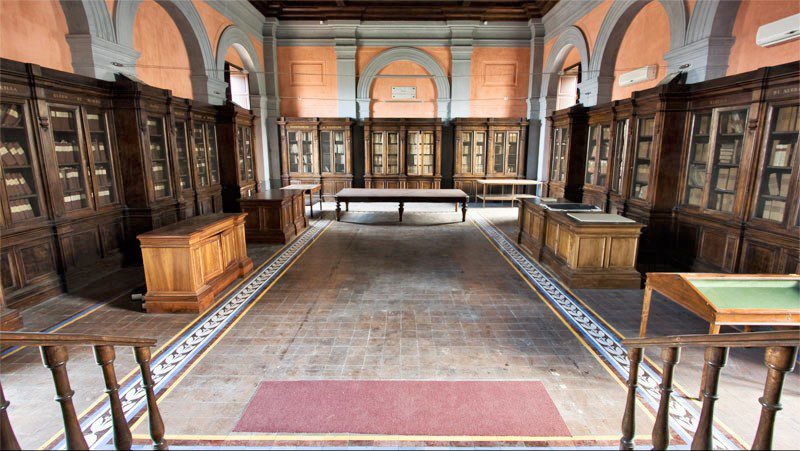
The heart of the life of the Institute – indeed, housing the Main Study Room, the Inventory Room, and the Reception Room – was also for the monks the center of the community. Its four splendid cloisters marked its rhythms; the Chapter Room, frescoed by Belisario Corenzio in the early 1600s with a complex Christological cycle, was the place for debate and discussion; the large Refectory, evocative and imposing, was the heart of the daily life of the monastic community.
Here coexist various eras and functions: the monastery, the nineteenth-century archive, the modern cultural institute. The visit to the State Archive of Naples today is limited to the first-floor rooms. The virtual tour, however, opens the doors to the “Secret Archive“: areas normally inaccessible because occupied by offices or document deposits that, despite their intended use, hide artistic and archival beauties of considerable importance.
The third floor offers to the eye relics from the Roman era, nineteenth-century precision instruments, and the oldest piece of the Archive, the Stone Charter, in that characteristic coexistence of documents and monuments that peculiarly qualify the monastic complex of Saints Severino and Sossio. On the fourth floor of the Institute, in particular, monumental rooms for the preservation of documents were set up: some of these were constructed in the first half of the nineteenth century. These rooms, not included in the usual tours of the Institute, are presented both for the importance of the documentary heritage preserved and for the interesting and varied archival shelving set-up solutions.



