


Copenhagen, the capital of Denmark, proves to be so affordable, absolutely within everyone’s reach. What to see in Copenhagen. The cosmopolitan Danish capital is a relaxing place suitable for tourists of all ages. Visiting Copenhagen: some tips on what to see in Copenhagen and what to do in the Danish capital or follow our 3-day itinerary in Copenhagen.
- Copenhagen places of interest
- 1 Rådhuspladsen
- 2 The Tivoli Gardens
- Copenhagen Museums things to see
- 3 Ny Carlsberg Glyptotek
- 4 National Museum of Copenhagen
- 5 Slotsholmen Island
- 6 Rosenborg Castle
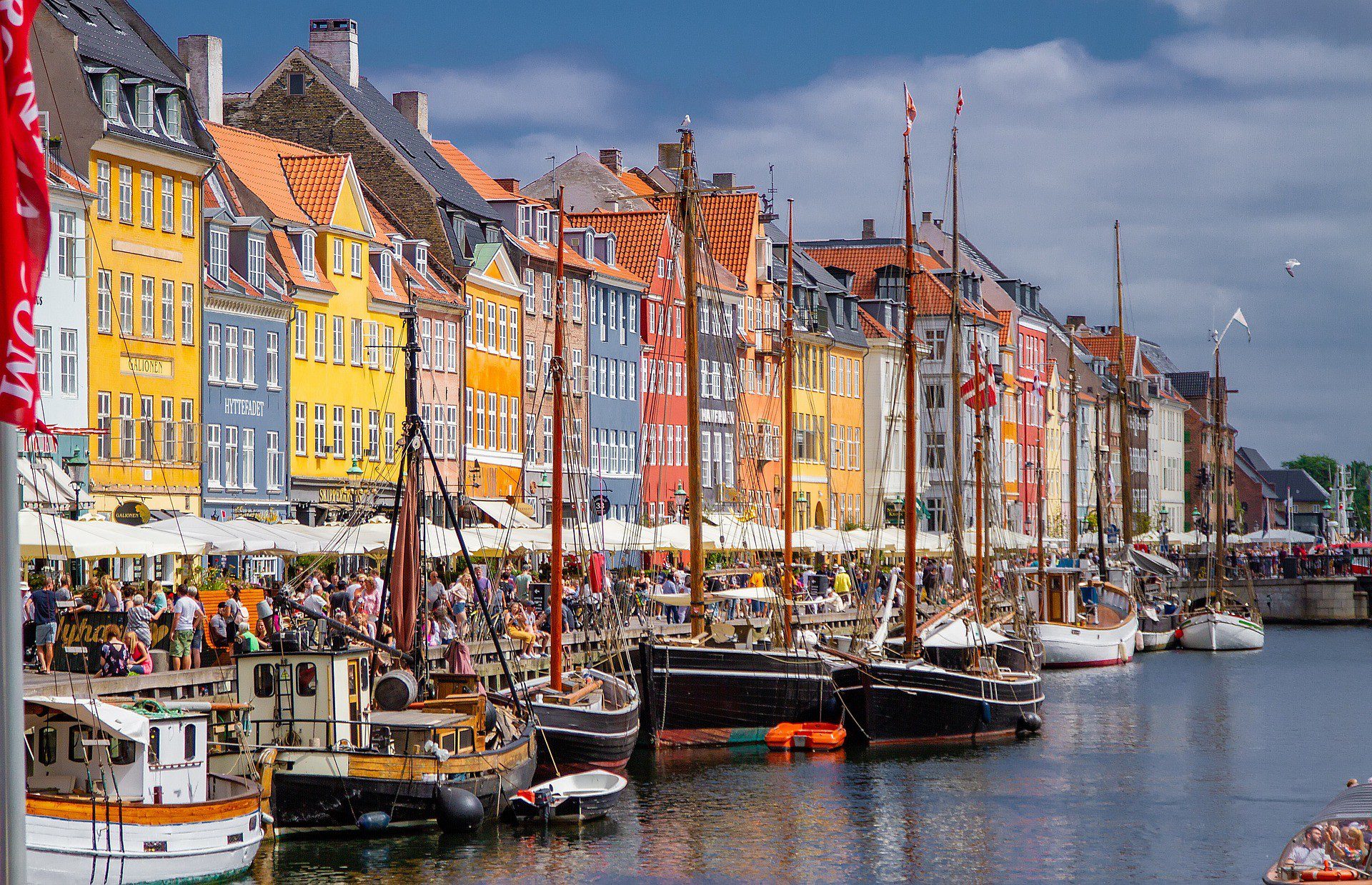
- 7 The colorful houses of the Nyhavn canal
- 8 Radhuspladsen, Stroget y el Barrio Latino en Copenhague
- Qué ver en Copenhague y alrededores
- 9 Christiania, the hippie community
- 10 How to get to Copenhagen
- 11 How to get around Copenhagen
- 12 Copenhagen Card
- 13 Copenhagen where to eat
- 14 Copenhagen where to sleep
Copenhagen places of interest
1 Rådhuspladsen
Rådhuspladsen er den mest betydningsfulde plads i København, meget kendt sammen med Tivoli-haverne og hovedbanegården. Amalienborg Slot er derimod dronningens residens. Hver dag kl. 12.00 afholdes det stemningsfulde Vagtskifte. Følger man molen ved Langelinie, kan man beundre det berømte monument Den Lille Havfrue. Med en “vandsbus”, til prisen af en busbillet, kan man sejle forbi alle de vigtigste monumenter i centrum: Operaen, Det Kongelige Teater, Det Sorte Diamant, som rummer det Kongelige Bibliotek.

Uundgåelige er endelig Københavns parker, ægte lunger i byens hjerte: fra Krogenshave med det pittoreske Rosenborg Slot til Frederiksberg Have med bænke ved kanalerne og en fantastisk udsigt over Zoologisk Have, med den nye “residens” for elefanterne, designet af arkitekten Norman Foster. Hele året er København vært for store festivaler og markeder. Der er ikke et tidspunkt på året, hvor Danmarks hovedstad fremstår uden betydning.
2 The Tivoli Gardens
You cannot visit Copenhagen without “The Tivoli Gardens” which represent the most visited attraction for the whole of Denmark, even though the Danes themselves are the main visitors. Opened since 1843, they remain open from mid-April to the end of September with the following hours: Sunday to Wednesday from 11:00 AM to 11:00 PM; Thursday and Saturday from 11:00 AM to midnight; Friday from 11:00 AM until 1:00 AM. The gardens are also open during the Christmas period from early November to the end of December with the following hours: Sunday to Thursday from 11:00 AM to 10:00 PM; Friday and Saturday from 11:00 AM to 11:00 PM. Inside is the Pantomime Theatre with performances of the commedia dell’arte. Every Saturday evening fireworks can be admired from the Tivoli Gardens.

Copenhagen Museums things to see
3 Ny Carlsberg Glyptotek
In the 19th century, the owner of Carlsberg beer had this museum built. Inside, there are Oriental collections, paintings by the Impressionists, and Mediterranean art. Very impressive is the Winter Garden topped by a huge glass dome. The museum is closed on Mondays, while from Tuesday to Sunday it is open from 10:00 AM to 4:00 PM. On Sundays, admission is free.

4 National Museum of Copenhagen
The National Museum of Copenhagen, Nationalmuseet, consists of four floors housing mostly Danish works but also some Oriental ones. Among the things to see in Copenhagen, the museum is very interesting for its section containing artifacts from 3000 years ago. The museum is open from Tuesday to Sunday, from 10:00 AM to 5:00 PM, and admission is free.

5 Slotsholmen Island
On Slotsholmen Island in the 12th century, the then Bishop Absalon built a castle. Since then, constructions have followed one another so that the island now hosts several buildings dated from the 12th century onwards. At the center of the island is the Christiansborg Slot, the Royal Palace of Copenhagen. The island also houses the Stock Exchange building and the Royal Library Garden (Bibliotekshaven).

6 Rosenborg Castle
The Rosenborg Castle is a castle built in the 15th century by Christian IV. Worth seeing are the Royal Gardens (Kongens Have) meticulously maintained and the galleries Statens Museum for Kunst, with art collections from all over Europe, and the Den Hirschsprungske Samling which brings together two centuries of Danish art collections. Rosenborg Castle is open every day except Monday (from June to August it is also open on Mondays), usually from 10:00 to 17:00 in the summer period and until 16:00 in the colder months. It is closed at the end of December. The two galleries have free admission and remain closed during holidays and Mondays. Opening hours are from 10:00 to 17:00 (on Wednesdays until 20:00) for the first gallery, and from 11:00 to 16:00 for the second gallery.

7 The colorful houses of the Nyhavn canal
Copenhagen what to visit. If you are still undecided about what to visit in Copenhagen, you can enjoy the view of the picturesque colorful houses along the Nyhavn canal. It is one of the many reasons that drives us to visit Copenhagen. And it is here that you find many public places, typical Danish establishments. A few steps away is Frederiksstaden, the area designed by Frederick IV which includes important buildings like the Amalienborg Palace (royal residence) and the remains of the Kastellet. To visit is the Frihedsmuseet with signs of the Danish resistance to the Nazis, open from October to April every day except Monday from 10:00 to 15:00 and from May to September from 10:00 to 17:00 with free admission. The Kunstindustrimuseet is another museum located in the area that gathers interesting art collections. It is open every day except Monday (like most museums in Copenhagen) from 12:00 to 16:00. Entrance requires a ticket.
8 Radhuspladsen, Stroget y el Barrio Latino en Copenhague
Qué hacer en Copenhague. Radhuspladsen es la plaza más importante de Copenhague. El Ayuntamiento (Radhuset) da justo a este amplio espacio. Es posible acceder a la torre que data de finales del siglo XIX, en los meses más fríos (octubre-mayo) a las 12:00, mientras que de junio a septiembre, de lunes a viernes de 10:00 a 14:00 y los sábados a las 12:00. La torre está cerrada los domingos. Desde aquí parte la calle peatonal más conocida de Copenhague, que lleva el nombre de Stroget. Es una calle llena de locales y artistas callejeros, además de gente. Las horas de la mañana son preferibles para evitar la multitud. También en el centro de Copenhague, se encuentra el Barrio Latino, lleno de locales, tiendas y iglesias del siglo XIX. Aquí está el Museo Erótica abierto de mayo a septiembre todos los días de 10:00 a 23:00 y en los otros meses del año de 11:00 a 20:00. El museo también se puede alcanzar en metro (parada Kongens Nytorv). También merece la pena visitar la torre Rundetarn, deseada por Cristiano IV para uso de observatorio. Abierta de septiembre a mayo de 10:00 a 17:00 todos los días excepto los domingos, que abre de 12:00 a 17:00. De junio a agosto, la apertura es de lunes a sábado de 10:00 a 20:00 y domingos de 12:00 a 20:00. Entrada con pago.

Qué ver en Copenhague y alrededores
9 Christiania, the hippie community
On the island of Christianshav there is a community made up of anarchists, new generation hippies, dealers, and extremely cheerful people. It is a place near Copenhagen worth seeing. It is a community formed over 30 years ago that has had quite a few problems over the years with public disorder due to unauthorized drug dealing (until recently cannabis was sold freely) and the illegal occupation of homes. It is an area, however, that can have its charm and therefore a visit is recommended even if today it appears more controlled compared to the past, when soft drugs were free.

See also:
- Hans Andersen’s Fairy Tale Route
- Christmas in Copenhagen
- Christmas Markets
- Easter in Denmark
- Beer Festival in Copenhagen
- When to go to Denmark
- Where to shop in Denmark
10 How to get to Copenhagen
Copenhagen flights. With the company EasyJet, daily connections from Milan Malpensa start from 21.99 euros one way, taxes included. And with Transavia from Pisa, Rome Fiumicino, and Naples, it costs 50 euros one way, all included. Copenhagen airport. The Copenhagen International Airport is located about 9 km from the city. From the Central Station trains depart, taking about 12 minutes to the airport, every 20 minutes, starting from 5 in the morning. If you plan to stay in the Nyhavn canal area, you have some trains that stop at Norreport station, which is connected to the Kongens Nytorv metro stop. The alternative to the train is buses that take about 25 minutes to reach the airport. The bus price is almost always the same as the trains. Those who want to reach Copenhagen by train should know that almost all international trains arrive directly at the Central Station.
11 How to get around Copenhagen
To get around, bicycles are highly recommended, just like the true Kobenhavner, the inhabitants of the capital Copenhagen. There are more than 2000 city bikes available, easily recognizable in the 110 racks in the center; rental is free, you just have to deposit a 20 Danish kroner security (more or less like, for us, the supermarket shopping cart), recoverable upon return. As for other means, as in most European cities, here tickets are valid for both buses, trains (within a certain radius), and the metro. The klippekort is a 10-ride pass, recommended for its convenience. Alternatively, a daily travel card or the Copenhagen Card is recommended, which, in addition to transportation, allows entry to some affiliated museums. The distance between the Central Station and the Nyhavn canal is about 30 minutes on foot.

12 Copenhagen Card
The Copenhagen Card provides access to all the main attractions and public transport within the entire metropolitan area of Copenhagen. You can choose between the 24, 48, 72, or 120-hour option. The card also allows you to enjoy discounts at restaurants and entertainment venues. Among Copenhagen’s places of interest, the Copenhagen Card grants free access to Amalienborg Palace, the Tivoli Gardens, and Frederiksborg Castle.
13 Copenhagen where to eat
What to eat in Copenhagen. One of the staple dishes of Danish cuisine is smorrebroed, rye bread slices topped with cold cuts, cheeses, fish, vegetables; in specialized restaurants, you can choose among many tasty variants. Danish cuisine is a happy mix of tradition and innovation, combined with great care for freshness and quality of raw materials. For those without particular needs and looking for an area in Copenhagen where to eat, Nyhavn can be a good choice. Here the venues are certainly not as important as those in Gammel Strand, where you find several high-level fish restaurants and cafes. The alternative can be Vesterbro where you find dishes and delicacies from all over the world or, to get away from the tourist dining concept, Vesterbrogade is recommended.

14 Copenhagen where to sleep
Copenhagen hotels. Another usually crucial chapter is accommodation but, in Copenhagen, you can stay in 5-star design hotels at the price of a hostel. In central Copenhagen the Danhostel Copenhagen City has been opened, entirely furnished with furniture and fixtures from the Danish house Gubi; almost a miracle of hospitality just steps from the monuments and main attractions. And there are 5 other hostels in the capital, including the most recent, Copenhagen Downtown, located in a convenient square with the pedestrian island, the famous Stroget, where the historic and charming porcelain shop Royal Copenhagen nests, which reserves the basement for sales and low-cost offers. Other tips on where to sleep in Denmark.
Another economical solution is the CabInn hotel chain, with fixed prices regardless of the season (90 euros for double rooms) and the very popular Sleep In, a kind of dormitory with shared bathrooms and services. There are several in the lively Norrebro district, such as Sleep in Heaven and the eco-friendly Sleep in green. In Copenhagen there are several areas where it is recommended to sleep. However, Vesterbro and Frederiksberg are the most recommended. Here you find a wide choice of selected hotels.