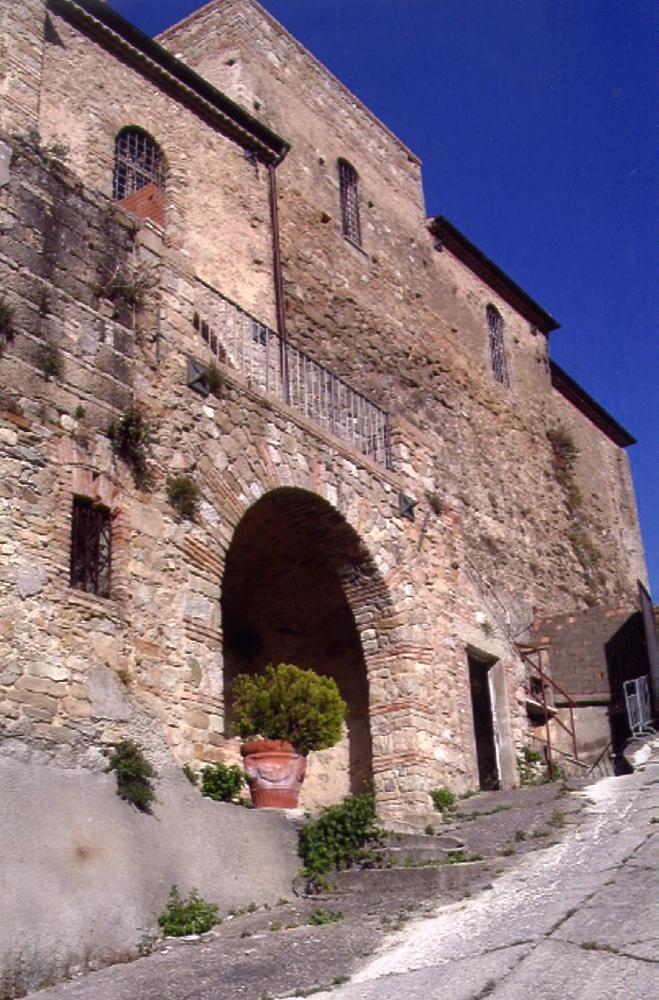
For nine years, – from 1686 to 1695 -, Vico stayed in the rooms of the Vatolla castle, with the task of overseeing and instructing the marquis’s boys; at the same time, thanks to the rich library of the castle, he was able to deepen his studies of literature and philosophy, until 1697, the year in which the scholar obtained the chair of eloquence at the University of Naples.
In those same rooms, the Vichian Museum was established. The building that houses the museum is a trapezoidal fortification with small and elegant turrets standing at its corners; it dates back to the Lombard period and has naturally been renovated several times from the sixteenth century onward. The small manor is today known as the Vargas castle, named after the last owning family, and forms the center of the village, overlooking the central square.
Since 1535, the castle has been inhabited by the lords of the village, who were the Griso family, the Del Pezzo, the Rocca marquises, and the Vargas Machuca marquises. The village was a fief of the Royal Monastery of the SS. Trinity of the city of Cava, as evidenced by the register of Benedictine fiefs (1791 – 1805).
Vatolla is arranged along a ridge of the gentle hills of Cilento, just a few kilometers from Agropoli. The small village preserves almost intact its ancient identity, both in architecture and culture. Here the citizens are very careful not to let the centuries of culture that have accompanied the life of the small center be lost into nothingness.
The tradition has preserved an ancient religious rite, the “Flight of the Angel”, while through collective intelligence many tools and work instruments have been patiently collected, which today form a rich collection of farming materials, kept in the old cellars of the castle. The restoration of the old houses is also carried out with great care, bringing to light the living stone now choked by many layers of plaster.
In a very panoramic position, at the edge of the village, there is a Franciscan convent from the 1600s. It was built over the ruins of a chapel from the 1500s, of which only a wall remains with a fresco depicting a “Pietà”. Inside the convent there is a beautiful cloister and a majolica refectory with a large fresco depicting the “Last Supper”, a work by Giuseppe De Vivo in 1738.
The Municipality of Vatolla, always respecting a plan for recovery and safeguarding of its territory, plans to restore the ancient water mill, built a short distance from the castle, in a small gorge where the water of a stream (now almost dry) in the past powered its blades.