

You can easily start from the Trinity College, in the southeast Dublin, with the fabulous Old Library, a renowned library not only in Ireland, which preserves illuminated manuscripts of priceless value, such as the Durrow Gospel, dating back to the mid-7th century AD.
In the spectacular Long Room, 64 meters long, there are about 200,000 ancient texts, marble busts, and the oldest existing Gaelic harp in Ireland. A real gem is also the Book of Kells, an illuminated manuscript with particularly elaborate decorations, probably made by the monks of Iona, a small Scottish island, who took refuge in Kells in 806 AD to escape a Viking raid. Considered one of the most beautiful manuscripts in the world, it contains the four Gospels in Latin and was transferred to Trinity College in 1600.
Also in this part of Dublin, there is the National Gallery, inaugurated in 1864, which houses over two thousand masterpieces by Irish, English, Italian, French, and Flemish masters from all eras. And the National Museum, with a remarkable collection of artifacts (e.g., the Ardagh Chalice, 800 AD), ranging from the Stone Age to the present day.
Moving clockwise, you can reach Southwest Dublin, where rises the St. Patrick’s Cathedral, the largest church in Ireland, of medieval origin (according to tradition, it was founded near a sacred well where the Saint baptized converts around 450 AD). The interiors are marked by a splendid choir, with banners and stalls bearing the insignia of the Knights of St. Patrick. The cathedral also houses the largest and most powerful organ in Ireland as well as monuments in memory of the writer Jonathan Swift and illustrious Anglo-Irish families.
Still in this southwest area, there is the Dublin Castle, a mighty Anglo-Norman castle (13th century), symbol for six centuries of English rule, and Christ Church Cathedral, today the Protestant cathedral, built by the Anglo-Norman conquerors between 1172 and 1220, in an elevated position overlooking the Liffey River. Its current appearance results from restorations carried out in the last decades of the 19th century. In the northern part of the city, we finally find O’Connell Street (a sort of Dublin’s Buenos Aires Avenue), the liveliest and most important Dublin artery, characterized by a fascinating mix of architectural styles and monuments to illustrious Irish people. And the Custom House, former customs house, now the seat of government offices, whose grand Georgian-style facade reflects in the Liffey.

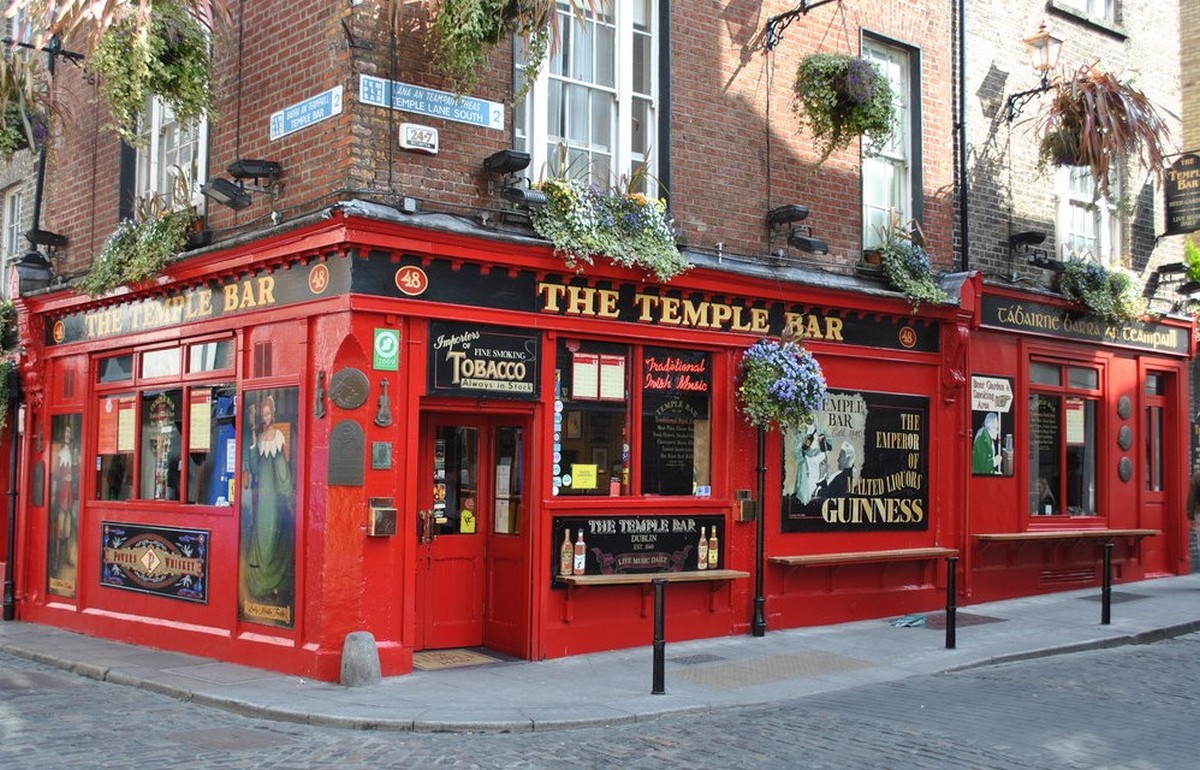
But Dublin is not just churches, streets, and buildings, it is also fun: the best spots are comfortably close to each other and create a real escape tour. The neighborhood of Temple Bar alone offers, for example, endless entertainment options, with great mid-priced restaurants, traditional pubs alongside trendier and more alternative bars; there are small theaters and the Irish Film Centre. Dancing and nightclubs finally allow you to enjoy everything from country music to disco dance.
In Temple Bar, a regular summer event is also street theatre performances. But the Dublin entertainment scene certainly does not end here; those who love serious theater and dramas can refer to the Abbey Theatre’s program located north of the Liffey or the Gate Theatre, in the same area of the city, where works by foreign artists are also staged.
Symphonic music lovers can follow the prestigious seasons of the National Symphony Orchestra, which performs inside the National Concert Hall. Meanwhile, for the die-hard pub enthusiasts, must-visit stops are McDaid’s, in the southeast, which, despite being frequented by crowds of patrons, has not lost its original bohemian atmosphere, and the Stag’s Head, in the southwest, a splendid Victorian pub, with a very long mahogany bar, mirrors, and original stained glass windows.