

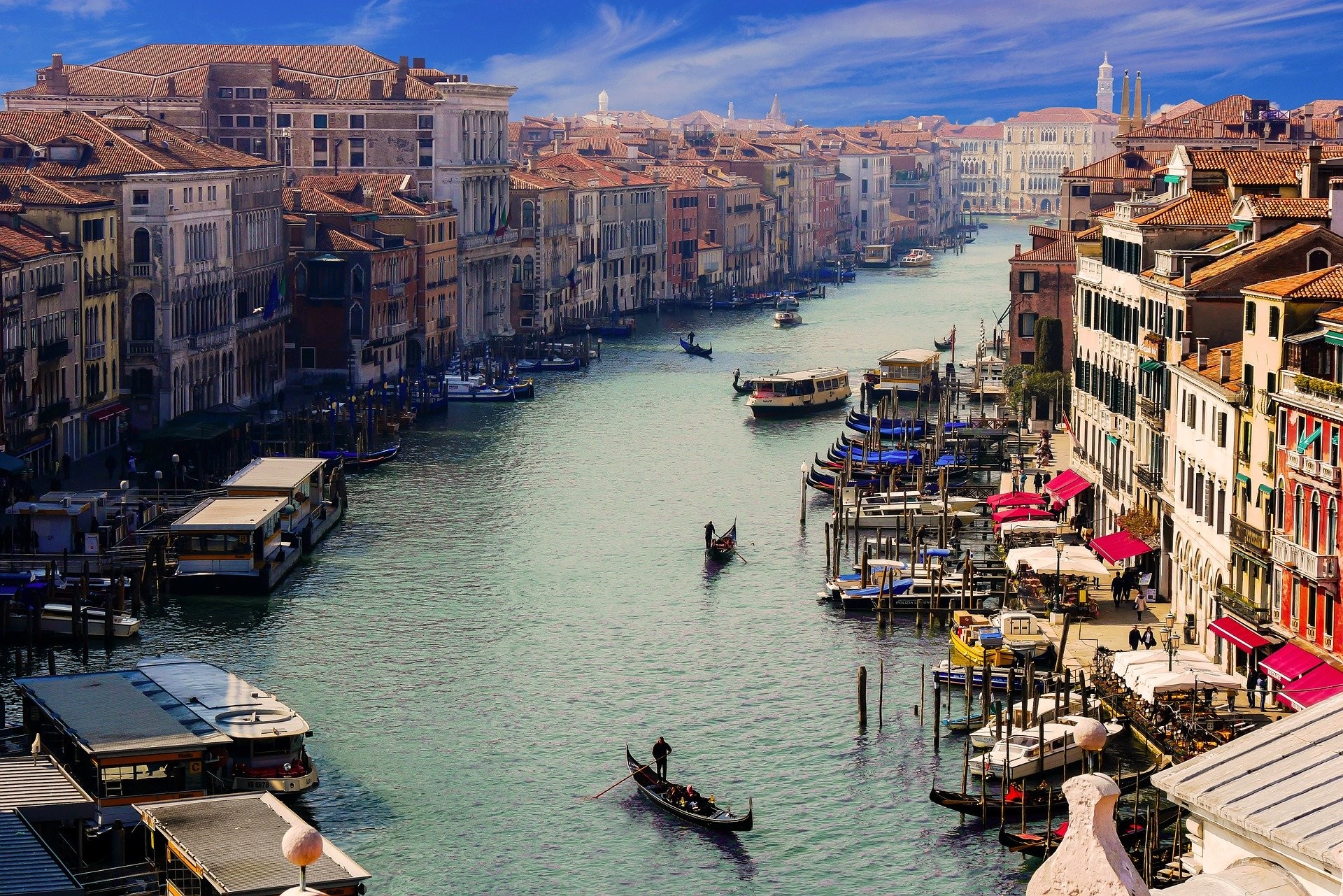

Venezia is a unique city in the world that requires a bit of time to visit. Reaching the various places in the city is very easy. You could use the motorboats that offer taxi services in Venice or, if you have more time available, enjoy an itinerary along the Grand Canal, passing under bridges and Venetian architecture. Our one-day itinerary starts from the Grand Canal and ends in the basin of San Marco.
- One-day itinerary in Venice
- Grand Canal
- Bridges of Venice
- Bridge of the Barefoot
- Rialto Bridge
- Academy Bridge
- Left Bank of the Grand Canal
- Vendramin Calergi Palace: Municipal Casino
- Ca’ d’Oro
- Ca’ de Mosto
- Grimani Palace
- Corner Spinelli Palace
- Grassi Palace
- Corner della Ca’ Granda Palace
- Right Bank of the Grand Canal
- Fondaco dei Turchi
- Ca’ Pesaro
- Ca’ Corner de la Regina
- Palazzo Papadopoli
- Ca’ Foscari
- Ca’ Rezzonico
- Palazzo Cini
- Palazzo Dario and Santa Maria della Salute
Along this itinerary, you will have the opportunity to stop at the various piers, docking points for the various palaces scattered along this route.
One-day itinerary in Venice
Grand Canal
Our itinerary starts right from the Grand Canal, the main waterway of Venice. Measuring 3800 meters long with a width varying between 30 and 70 meters, the Grand Canal winds from north to west and from south to east, forming an “S”-shaped circuit. The Grand Canal is dotted with noble buildings dating from the thirteenth to the eighteenth century. A characteristic feature of the palaces is the mooring poles that often display the coats of arms of Venetian noble families.
Bridges of Venice
Bridge of the Barefoot
The first of the bridges we encounter along our journey on the Grand Canal is that of the Barefoot, completely rebuilt in 1934.
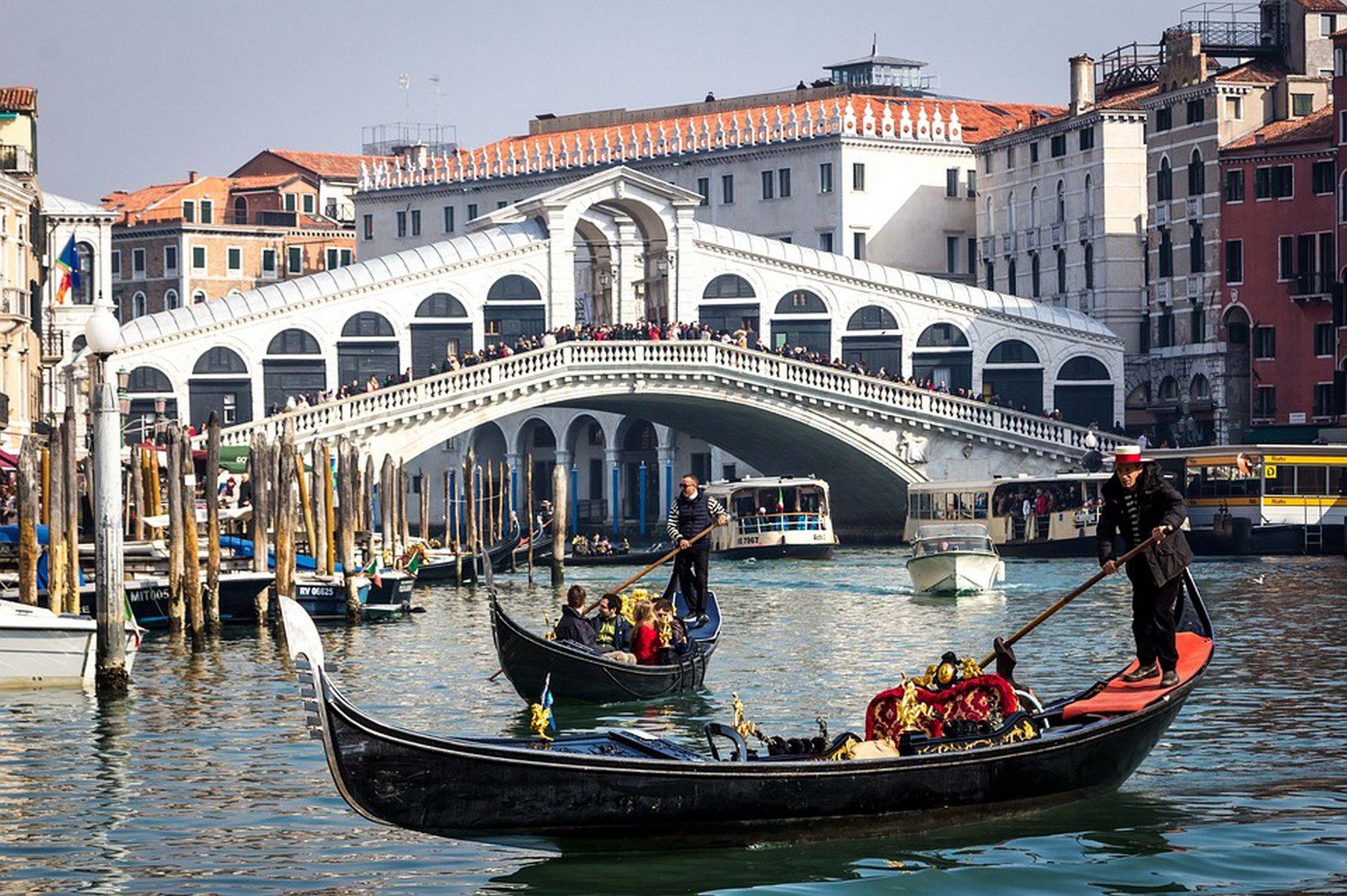
Rialto Bridge
It is undoubtedly the most famous bridge in Venice and represents one of the three that span the Grand Canal. The Rialto Bridge has a single arch and was built at the end of the 16th century by Antonio da Ponte.
Academy Bridge
The third bridge of the Grand Canal is the Academy Bridge. Like the Bridge of the Barefoot, it was also rebuilt in modern times (1934) to replace the 19th-century iron one. It has a wooden structure.
Left Bank of the Grand Canal
On the left bank of the Grand Canal, at the beginning of our itinerary, is the Venice Santa Lucia railway station, inaugurated in the second half of the nineteenth century but rebuilt after the war. Nearby is the Gli Scazi church, which in the 17th century was created by a community of Carmelites who found refuge here. Along the left bank of the Grand Canal there are a series of palaces of great value and architectural interest. Here are some.
Vendramin Calergi Palace: Municipal Casino
The Vendramin Calergi Palace is the palace where Richard Wagner died in 1883 and is the seat of the Municipal Casino. In Renaissance style, the palace was designed by Mauro Codussi.
Ca’ d’Oro
Headquarters of the Giorgio Franchetti Gallery, it presents a Gothic structure that underwent changes during the 19th century. The pier carries the same name.
Ca’ de Mosto
It is a fondaco structure dating back to the thirteenth century but has undergone a series of elevations over time. Known for having hosted, from the 1500s to the 1700s, the Leon Bianco hotel. Rialto pier.
Grimani Palace
Home to some judicial offices, the Grimani palace has three floors with Renaissance architecture. It was built by Michele Sammichele and features large arches and columns.
Corner Spinelli Palace
A true masterpiece of early Renaissance architecture, the Corner Spinelli palace was designed by Mauro Codussi at the end of the 15th century. Sant’Angelo pier.
Grassi Palace
Headquarters of the Grassi Foundation, the palace features Baroque architecture. Designed by Giorgio Massari, the palace hosts art exhibitions and important events.
Corner della Ca’ Granda Palace
Headquarters of the Prefecture, the palace was built by the architect Jacopo Sansovino. The reference pier is that of Santa Maria Zobenigo.
Right Bank of the Grand Canal
On the right bank of Venice’s Grand Canal, there are equally prestigious palaces. The main departure pier is Santa Chiara, which serves the piazzale Roma, where the Ponte della Libertà is located, connecting Mestre to the city of Venice. Here is what to see on the right bank of the Grand Canal.
Fondaco dei Turchi
The Fondaco dei Turchi is the palace housing the Natural History Museum. The Veneto-Byzantine architecture has been considerably altered, starting from the second half of the nineteenth century.
Ca’ Pesaro
A baroque palace begun by Baldassarre Longhena in the early seventeenth century and completed about a century later by Antonio Gaspari. It is home to the Museum of Oriental Art and the International Gallery of Modern Art.
Ca’ Corner de la Regina
A structure with two floors of loggias built by Domenico Rossi in the first half of the eighteenth century, Ca’ Corner houses the Historical Archive of the Venice Biennale. San Silvestro pier.
Palazzo Papadopoli
The Palazzo Papadopoli has a very sumptuous structure dating back to the early sixteenth century. It features two large loggias.
Ca’ Foscari
Eight arches and two loggias for this palace begun in the early years of the second half of the fifteenth century. Headquarters of the Ca’ Foscari University, it is presented in Venetian Gothic style.
Ca’ Rezzonico
A baroque construction begun by Baldassare Longhena, it was completed by Antonio Massari. It is home to the Museum of the Eighteenth-century Venice. Homonymous pier.
Palazzo Cini
Home to the Vittorio Cini Collection, which gathers paintings of the Tuscan school from the thirteenth to the fifteenth centuries, the Palazzo Cini features a Renaissance façade.
Palazzo Dario and Santa Maria della Salute
The Palazzo Dario features Renaissance architecture with three loggias, designed by Pietro Lombardo. Next to it is Santa Maria della Salute, built by Baldassarre Longhena in the second half of the seventeenth century, in Baroque style. Salute pier.