

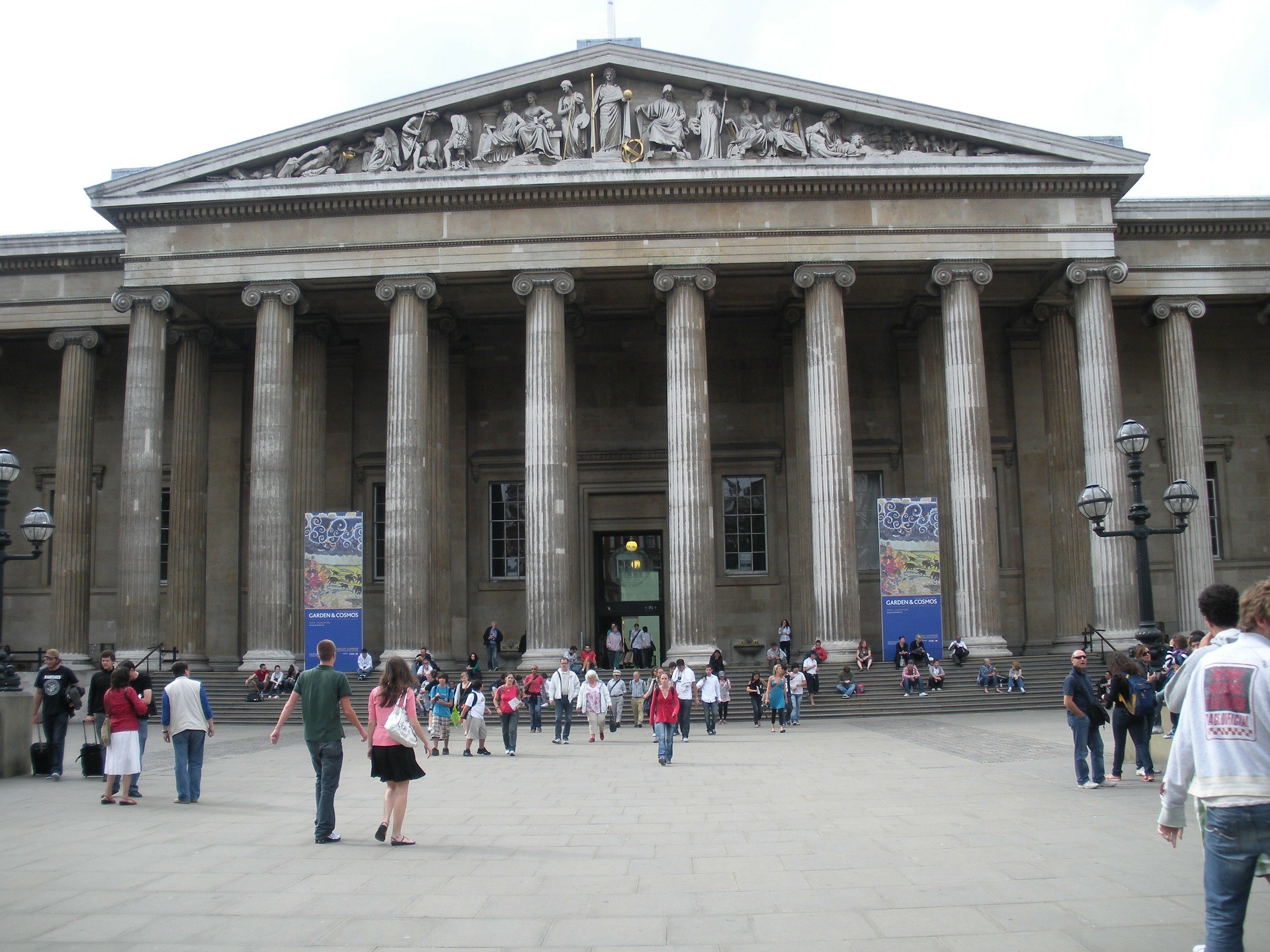

Il British Museum in London, England, was established in 1753 to receive the legacy of the scientist Sir Hans Sloane. The bequest of Sloane, which was housed in a villa in Bloomsbury, included more than 70,000 items, including books and manuscripts, natural history specimens, and classical, oriental, and American antiquities. In the following fifty years, it was enriched by other donations, especially literary ones.
- British Museum in London: the history
- The British Museum Today
- British Museum, what to see: works and attractions not to be missed
- Egyptian sculpture
- Assyrian sculpture
- Greek art
- The Egyptian funerary world
- The Ur standard
- Everyday life in ancient Greece and Rome
- The Early Middle Ages and the Sutton Hoo site
- The ethnographic collections
- British Museum: opening hours and useful information
- British Museum: metro and bus
- British Museum: price
- British Museum: in brief
British Museum in London: the history
Starting from the nineteenth century, the collection tended to specialize in antiquities: upon returning from the Battle of the Nile against Napoleon‘s troops, numerous Egyptian sculptures arrived at the British Museum, including the Rosetta Stone. Some English ambassadors acquired, or simply took possession of, archaeological artifacts from the countries where they served. The most famous and debated case is that of Lord Elgin, who brought the Parthenon marbles and parts of other monuments from the Acropolis of Athens to London. From the middle of the century, the British Museum also promoted numerous archaeological expeditions that allowed the institution to further expand its collection.
The building we know today was thus constructed, neoclassical and larger, and a selection was made: all natural history specimens were transferred to the Natural History Museum and, with the birth of the National Gallery, the idea of developing the collection of graphics and paintings was abandoned.
Until the end of the twentieth century, the British Museum was an exhibition space focused on archaeology and antiquities up to the English Middle Ages; the entire eastern wing of the ground floor was occupied by the King George III’s Library, with a precious display of manuscripts. In the center of the inner courtyard was the Reading Room, the iconic reading room also used by Gandhi, Karl Marx, George Orwell, and Oscar Wilde.

The British Museum Today
The end of the 20th century brought significant changes that are reflected in the current configuration of the museum. In 1997, in fact, the collection of books and manuscripts was transferred to the new headquarters of the British Library, next to the St Pancras station. This freed up the entire eastern wing of the ground floor and the Reading Room.
The inner courtyard was covered with a glass ceiling, a marvelous work by Norman Foster, and transformed into a large square connecting all the wings of the building. The eastern side now houses two large thematic galleries, dedicated respectively to the Enlightenment and to the history of collecting. Their purpose is to explain the factors that motivated the birth and development of the British Museum: on one side is the centrality of reason, and consequently scientific research, typical of the eighteenth century, and on the other, the importance of private donations.
Moreover, there was an effort to recover the original spirit of the institution, at the expense of the almost exclusive specialization in archaeology. However, abandoning the idea of the encyclopedic museum, the positioning as a “Museum of the World” was embraced, through which it is possible to explore two million years of human history and culture. To achieve this, 3 rooms on the first floor were dedicated to European art from 1400 to the present day and, above all, the ethnographic collections, previously housed in the Museum of Mankind, were brought back to Bloomsbury.
Without wishing to criticize this approach, the risk for the public is to find the route a bit dispersive, also due to the very large number of pieces on display. Therefore, here we suggest an itinerary lasting about 3 hours, trying to guide the visitor through the various historical periods, discovering the most important pieces in the collection.
British Museum, what to see: works and attractions not to be missed
Egyptian sculpture
Just after entering from the main entrance, you find yourself in the Great Court. Crossing the first door on the left, you immediately take a journey back thousands of years in time: you will indeed find yourself in the large gallery dedicated to Egyptian sculpture, dominated by statues, steles, and large sarcophagi covering the entire historical span of this civilization.

A place of honor in the gallery is reserved for the Rosetta Stone, the black stone bearing a decree of the Hellenistic king Ptolemy V written in three languages: Egyptian hieroglyphics, demotic Egyptian, and Greek. The presence of the Greek language allowed the deciphering of the hieroglyphic language and opened up the horizons of Egyptological studies.
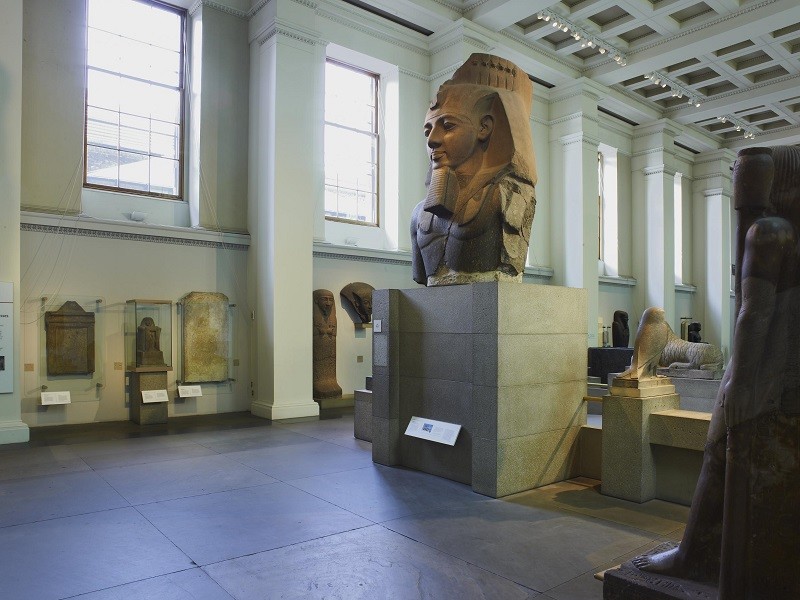
The largest sculpture in the gallery is the fragment of the statue of Ramses II from Karnak, about a thousand years older than the Rosetta Stone. Of this sculpture, only the head with part of the torso has survived, with a total height of more than two and a half meters. Along with a twin statue, it was part of the monumental entrance to the pharaoh’s tomb. Sculptures like this were designed to be a vehicle of divinity for the figure represented and therefore had to last forever: hence the explanation for their large size and the particularly hard stones in which they were carved.
Assyrian sculpture
Once you have walked through the Egyptian sculpture gallery, you are welcomed by two imposing winged lions with human faces guarding the door leading to the museum’s Assyrian sculpture section. The lions came from the palace of King Ashurnasirpal II at Nimrud (in present-day Northern Iraq) and date back to the 9th century BC.
The most important pieces in this section are the friezes from the royal palaces, located in adjacent rooms: from the Nimrud palace in rooms 7 and 8, from Nineveh in room 9, and from the palaces of Ashurbanipal at Nimrud and Sargon II at Khorsabad in room 10. They predominantly depict court scenes, war, and hunting. Lion hunting, in particular, was a prerogative of kings and symbolized the sovereign’s commitment to defending his people. The reliefs are so clear and detailed that they can be followed as if watching a film.

Greek art
The rooms dedicated to Greek art are a triumph of vase painting, architecture, and sculpture. Entering room 17 for the first time is often a heart-stopping moment: in front of you is the monument of the Nereids of Xanthos, a mausoleum shaped like a Greek temple with a high sculpted podium. It is believed that the monument was the tomb of Arbinas, ruler of Western Lycia in the 4th century BC.

The next room is dedicated to the friezes of the Parthenon, which rightly hold a place of honor. Considered the highest moment of classical Greek art, the Parthenon was dedicated to Athena, protector of Athens, and celebrated with its majesty the peak of the city’s splendor under the leadership of Pericles. The sculptures of the pediments (work of Phidias) and the metopes depict mythological scenes, while the frieze that ran along the long sides of the building represents the Panathenaic procession, the religious festival celebrating the goddess’s birthday.
Room 19 houses artifacts from other monuments of the Acropolis of Athens, the temple of Athena Nike and the Erechtheion, of which a caryatid is exhibited, one of the six female statues that served as columns.
Before leaving the first floor, it is worth visiting room 21 dedicated to the mausoleum of Halicarnassus. Considered one of the seven wonders of the world, the monument was inspired by that of the Nereids of Xanthos, but was much larger and more extravagant and far richer in sculptures and friezes. The huge horse displayed at the British Museum was part of a sculptural group depicting a quadriga, placed on top of the stepped roof.

The Egyptian funerary world
While the ground floor of the British Museum is, for obvious practical reasons, mainly used to display sculptures and architectural fragments, the first floor rooms exhibit smaller-sized objects. Thus, alongside the official and emphatic tone of some artworks, ample space is also given to everyday objects.
This is the case, for example, in the Egyptian rooms, among which rooms 61 to 63 are particularly popular as they are dedicated to the fascinating funerary world. In room 61, the furnishings and paintings from the tomb of Nebamun are exhibited. The paintings, in particular, allow us to have an idea of the lively visual impact of Egyptian tombs. Rooms 62 and 63 house a large collection of sarcophagi, mummies (including animals), and funerary objects.

The Ur standard
The first floor rooms dedicated to the Near East (from 52 to 59) explore the historical evolution of the various civilizations that succeeded each other in that geographical area over millennia (among these Sumerians, Babylonians, Assyrians, Hittites, Phoenicians, Persians).
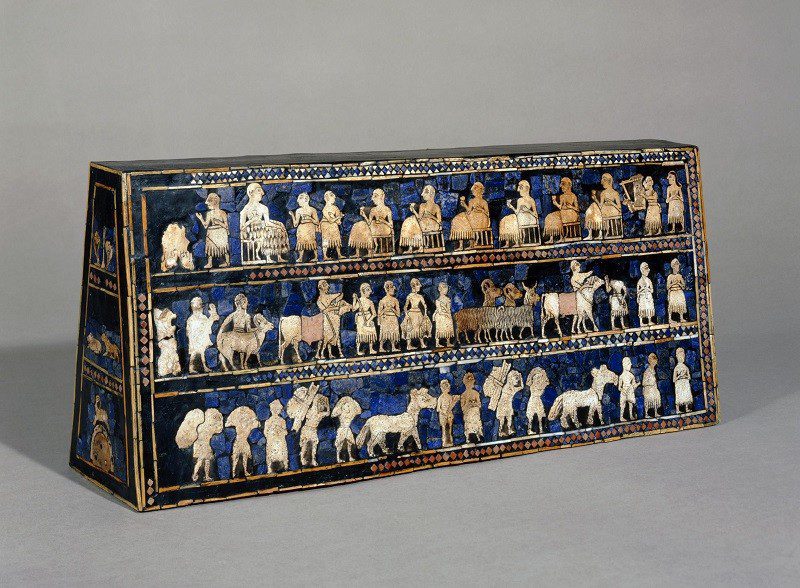
A stop is merited by the famous Standard of Ur, a Sumerian work from about 2500 BC, exhibited in room 56. The object is a wooden panel inlaid with lapis lazuli, shell, and mother-of-pearl and was probably hoisted on a pole and carried in procession. One side depicts war scenes, while the other features scenes of peace, following military success: a banquet, thanksgiving sacrifices to the deities, and slaves carrying the loot. The narrative develops in bands, like a comic strip, and the Standard of Ur is considered the highest example of this narrative mode in Mesopotamia.
Everyday life in ancient Greece and Rome
The aspects of daily life in Greece and Rome are extensively described in room 69. Don’t expect a parade of artworks, but rather a rich and well-considered selection of everyday objects grouped according to aspects of common life in the classical world.
If, however, you do not want to give up on aesthetics, in room 70 the beautiful Portland Vase from the Augustan era is on display: it is a cobalt blue vase with white glass cameo decorations. The subject represented is rather controversial, but the delicacy of the figures and the presence of Eros with his bow suggested it was a precious wedding gift. When the vase was acquired, it was completely fragmented. Therefore, its reconstruction earned a chapter of its own in the history of restoration.

The Early Middle Ages and the Sutton Hoo site
Room 41 is dedicated to the period of European history that marks the transition from the end of the Roman Empire to the origin of modern states (3rd–11th centuries AD).
A particular space is reserved for the Sutton Hoo site, in Suffolk. Excavations have brought to light two Anglo-Saxon cemeteries from the 6th and 7th centuries AD respectively. Alongside the burial mounds, the most remarkable discovery was that of a funeral ship. Although the wooden parts have completely decayed over time, their imprint on the ground and the metal rivets remaining in their original position allowed the exact shape to be reconstructed. The funerary equipment is particularly rich and includes weapons decorated with garnets, silver cups, a helmet, a six-string lyre, and beautiful gold ornaments of exquisite workmanship.

The ethnographic collections
The rooms visited so far belong to the classical collection of the British Museum. But, as mentioned, the museum’s new concept also allows room for some interesting ethnographic collections distributed throughout all floors of the building. In the basement, it is possible to admire artifacts from Africa, while on the upper floors from North America, Mexico, China, India, Korea, South Asia, and Japan.
The last marvel we recommend is exhibited in the room dedicated to the theme of life and death (room 24 on the ground floor): it is one of the mysterious statues from Easter Island.

British Museum: opening hours and useful information
The British Museum is open every day from 10 AM to 6 PM. Entrance to the permanent collection is free, while temporary exhibitions require a ticket. Currently, it is necessary to book your entrance on the website www.britishmuseum.org and follow the indicated route. Some rooms are closed.
British Museum: metro and bus
The British Museum is easily reachable by underground (stations Holborn and Tottenham Court Road) and by numerous buses (the most convenient is 14).
British Museum: price
The visit to the British Museum is free. However, we suggest some things to do and see in London skipping the line.
British Museum: in brief
The British Museum is undoubtedly one of the most important and well-known tourist attractions of the multiethnic British capital, namely London.
The city bathed by the Thames hosts a series of fascinating and world-famous museums, but the British Museum is the main one in terms of number (over eight million objects) and prestige of the works it contains. An important aspect is that, like all other city museums except the wax museum (Madame Tussauds), it has free admission. This is a commendable London exception to the rule, since in the vast majority of other cities around the world culture is paid for.
The British Museum was built in 1753 by the physician and scientist Hans Sloane and is one of the few museums in the world capable of testifying, through paintings, sculptures, and other objects, the presence of man starting from the dawn of humanity and spanning all the centuries up to the present day. Inside it houses artifacts that identify all the cultures of the world, both contemporary and those belonging to past centuries.
The museum is divided into nine different sections: Africa and the Americas, Ancient Near East, Asia, Great Britain and Europe, Egypt, Greece and Rome, Japan, Coins and Medals, Prints and Drawings.
Among the most famous and prestigious works in the British Museum halls we mention the Rosetta Stone (a stone slab on which writings in hieroglyphic, demotic, and Greek appear), the Egyptian mummies, the sculptures of the Parthenon, and the Oxus treasure.
This treasure trove full of priceless treasures is only a small part of the immense artistic-cultural-architectural heritage that London can boast. One week is the most suitable period of time to admire all the most important attractions of the city of the queen.