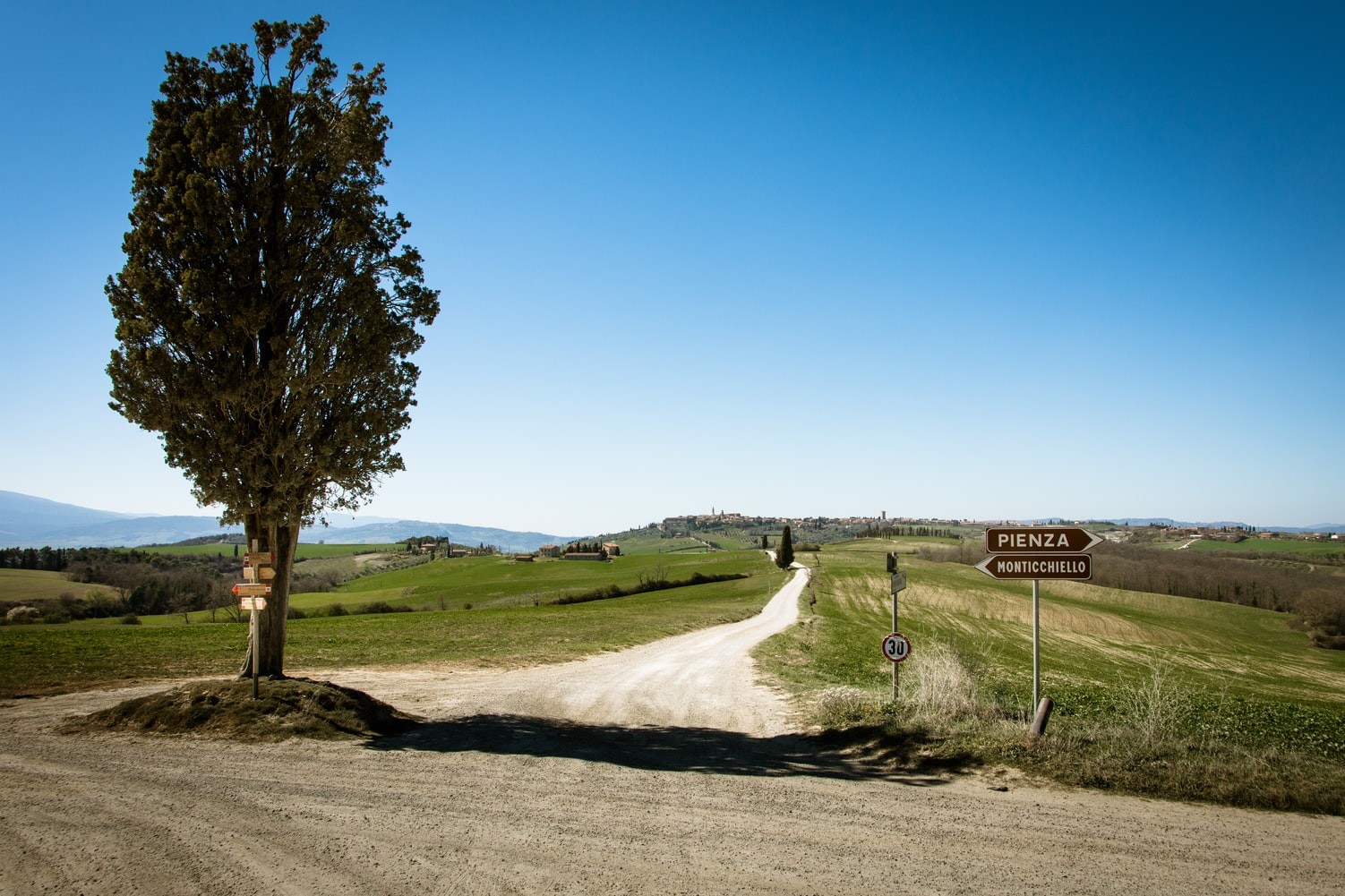


La storia di Pienza, cittadina della Toscana di 2.000 abitanti in provincia di Siena, fra la Val d’Orcia e la Valdichiana, inizia nel 1462 quando il papa Pio II, al secolo Enea Silvio Piccolomini, dopo essersi fermato nella nativa Corsignano durate un viaggio a Mantova ed essere rimasto sfavorevolmente colpito dal suo aspetto povero e degradato, decide di trasformare la città e di edificarvi la sua residenza estiva.
- 1 The ideal Renaissance city
- 2 Medieval buildings
- 3 Piazza Pio II
- 4 Pienza Cathedral
- 5 Piccolomini Palace
- 6 Town Hall or Palazzo Pretorio
- 7 Episcopal Palace or Borgia Palace
- 8 Diocesan Museum of Sacred Art of Pienza
- 9 Tepotratos Museum of Monticchiello, Pienza
- 10 Rossellino Street
- 11 What to eat in Pienza
- 12 Where to sleep in Pienza
Per fare ciò affida l’incarico a Bernardo Rossellino, architetto seguace di Leon Battista Alberti.
Here are 10 things to do and see in Pienza, UNESCO World Heritage Site.
1 The ideal Renaissance city
Leon Battista Alberti was one of the theorists of the ideal Renaissance city, whose main characteristic was the organization of space based on ideal principles of balance, functionality, and rational order. The Pienza of Rossellino represents one of the first applications of these principles. Although the works lasted only until 1464, the year of the death of both the pope and the architect, the work has a completed meaning and has not undergone changes until today.
Rossellino leaves the structure of the medieval side streets unchanged, but clearly defines the urban layout with a central street, the current Corso Rossellino, which connects the two city gates, the Porta del Giglio and the Porta al Prado. On this occasion, the entire city wall is rebuilt. The center of the village is the Piazza Pio II, where the Cathedral and the main city palaces rise.

2 Medieval buildings
About forty medieval public and private buildings are renovated or replaced, giving a widespread stylistic homogeneity: this intervention involves the cardinal residences, but also 12 dwellings for the people located near the walls in the area of the Giglio Gate.
The unified vision of the project is evident: the perspectives created by the road layout and the lines of the paved streets that neatly integrate with the vertical lines of the buildings make the whole particularly harmonious. Despite the different appearance of the various buildings, the Renaissance stylistic imprint is clear and completely replaces the medieval one. Finally, and once again according to the parameters of the ideal city, visual spaces are opened, such as the portico of Palazzo Piccolomini, which connect the city with the surrounding environment.
3 Piazza Pio II
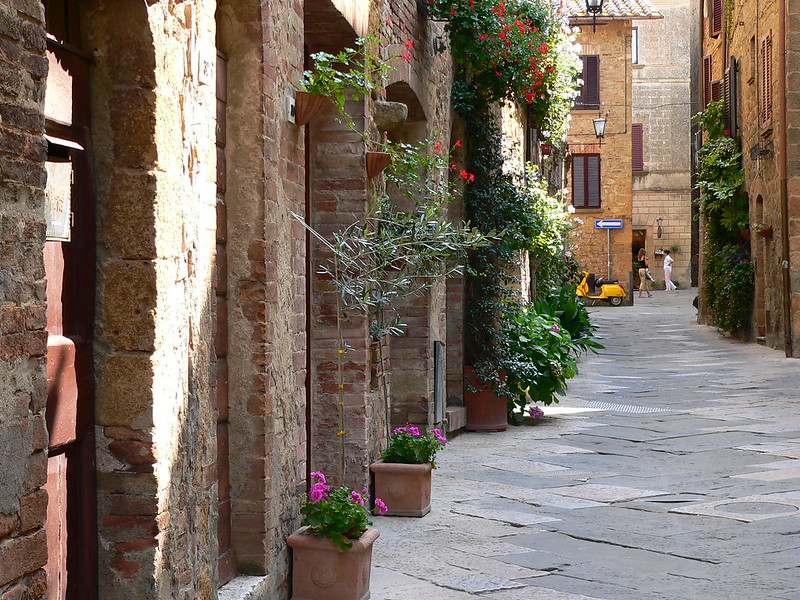
The center of Pienza, as mentioned, is the Piazza Pio II, adjacent to the main street. Its trapezoidal shape arises from the need to place the main buildings of the city in a confined space, respecting the road axis and at the same time counterbalancing the perspective convergence of the lines of the buildings towards the horizon. The perspectives are further emphasized by the flooring, made of terracotta divided by travertine strips, forming a sort of grid.

4 Pienza Cathedral
The Pienza Cathedral occupies a scenic position in the square. Its exterior appearance is Renaissance and recalls the style of Leon Battista Alberti. On the pediment reigns the emblem of the Holy See and the Piccolomini family. Since Pius II was fascinated by the German Hallenkirchen and the work of some intellectuals such as Nicholas of Cusa, the interior of the Cathedral features several references to the German Gothic style; the most evident is represented by the stained glass windows. Finally, you can also admire valuable paintings by Sienese artists such as Vecchietta, Matteo di Giovanni, and Sano di Pietro.

5 Piccolomini Palace
To the right of the Cathedral is the pope’s residence, Palazzo Piccolomini. Inspired by the Florentine Palazzo Ruccellai, a work of Alberti, it features an exterior of smoothly rusticated stone. The most evocative element of the building is the hanging garden, bounded by a façade with three orders of arches, and open to the Val d’Orcia. The garden itself, divided geometrically by rectangular flowerbeds, serves as a link between architecture and nature, harmoniously integrating these two entities. The first floor of the Piccolomini Palace is open to the public as a museum. It testifies with period furnishings how the history of Pienza is closely linked to the Piccolomini family.

6 Town Hall or Palazzo Pretorio
Opposite the Cathedral stands the Town Hall (or Palazzo Pretorio) with a ground floor portico and a sturdy battlemented tower, typical of the Sienese and Florentine tradition.

7 Episcopal Palace or Borgia Palace
In front of the Palazzo Piccolomini, you can admire the Episcopal Palace (also known as Borgia Palace since the pope gave it to Cardinal Rodrigo Borgia) and the House of the Canons, currently home to the Cathedral Museum.

8 Diocesan Museum of Sacred Art of Pienza
The Diocesan Museum of Sacred Art of Pienza was established at the beginning of the twentieth century as the Cathedral Museum to display, in the canons’ house, works from the Cathedral Treasury. It was reopened on May 7, 1998, as a diocesan museum.

9 Tepotratos Museum of Monticchiello, Pienza
The long history of the Teatro Povero di Monticchiello, developed over more than forty years of activity, has given life to the very particular structure of TEPOTRATOS: artistic-museum installations through which not only traditional theater, but also the peasant world and culture that generated it try to project themselves towards the future. This is the meaning of the large overturned oak, with roots to the sky, placed at the center of the exhibition. It is in this way that tradition and progress, chronologically and culturally distant realities, merge in an interactive and multimedia show, where modern technology, arts, and craftsmanship become the bond with which that past world approaches today’s spectacle. From microchips flow the songs of the maggiaioli and those of the bruscello, the films of the Teatro Povero come to life, of the befanate, the torches, Sega la vecchia….peasant craftsmanship and a vast collection of old work tools. Of that work, refined sculptures that speak to us of the changes that have occurred in these lands that were and for the most part still are indissolubly linked to generations of farmers are encountered as works of art. A testimony to this link is the very structure in which TEPOTRATOS rises, once the granary of the largest farm that collects the farms in Monticchiello, today recovered for the community thanks to the Teatro Povero.
10 Rossellino Street
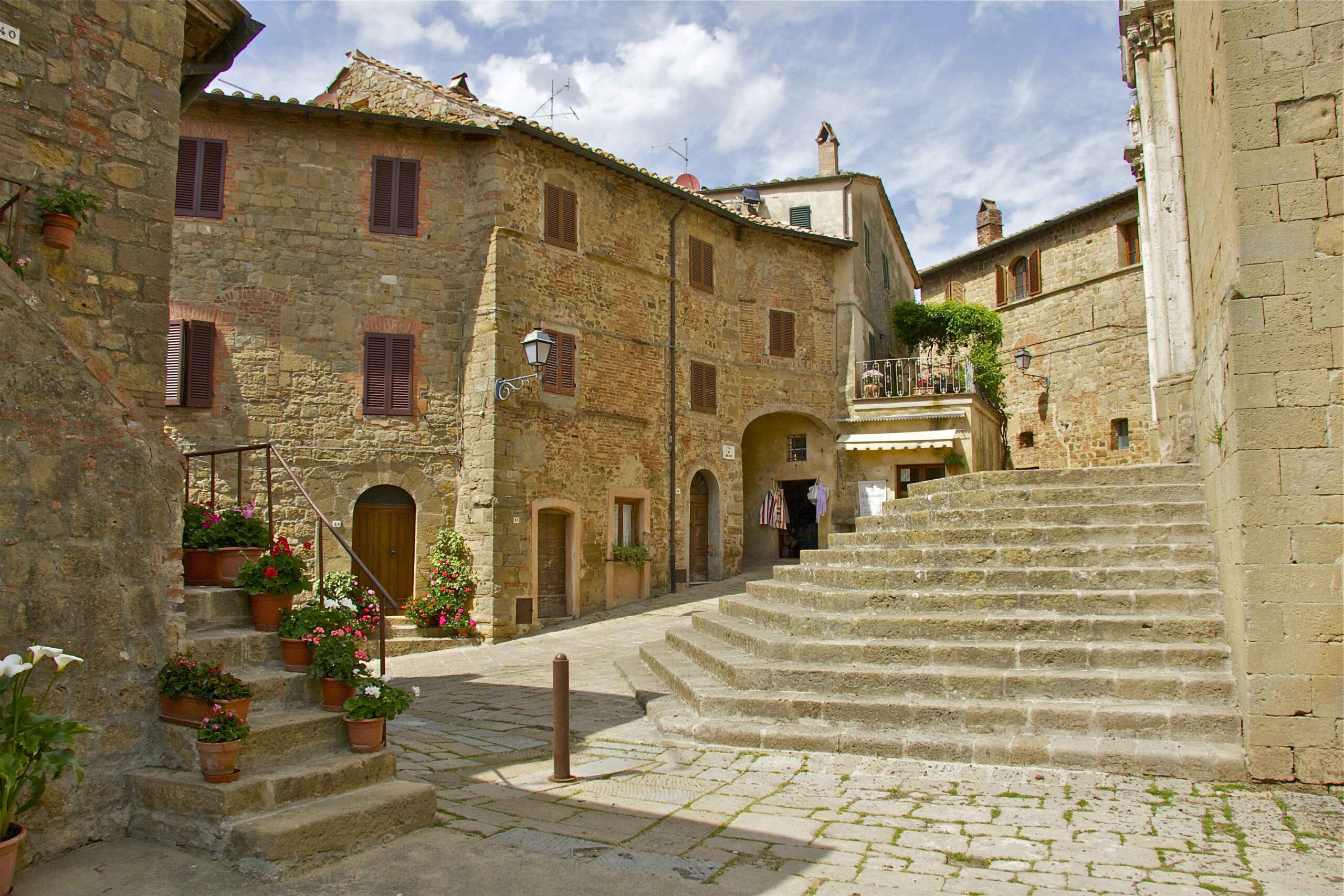
The main road axis of the urban layout of Pienza is the current Rossellino Street, along which there are numerous examples of valuable civil architecture bearing the names of noble families such as Ammannati, Gonzaga, and Jouffroy. Along the street also faces the 13th-century Church of San Francesco, in a sober Franciscan Gothic style. Finally, Rossellino Street is also the shopping street, with numerous shops selling typical local products, foremost among them pecorino cheese.

11 What to eat in Pienza
The Pietina cuisine is very varied and deeply rooted in local traditions. Not to be missed are the “bistecca alla fiorentina“, the crostini al fegato, the cold cuts and the cheeses of the area, such as the well-known “pecorino di Pienza“. Also widespread, as in several areas of Tuscany, are dishes based on game.

12 Where to sleep in Pienza
Pienza offers several hospitality options. As in the rest of Tuscany, Pienza offers both hotel accommodations and non-hotel facilities. Sleeping in Pienza can have a variable cost depending on the type and the tourist offer.