

Copenhagen, the capital of Denmark, proves to be so affordable, absolutely within everyone’s reach. What to see in Copenhagen. The cosmopolitan Danish capital is a relaxing place suitable for tourists of all ages. Visiting Copenhagen: some tips on what to see in Copenhagen and what to do in the Danish capital or follow our 3-day itinerary in Copenhagen.
- Copenhagen places of interest
- 1 Radhuspladsen
- 2 The Tivoli Gardens
- Copenhagen Museums things to see
- 3 Ny Carlsberg Glyptotek
- 4 National Museum in Copenhagen
- 5 Slotsholmen Island
- 6 Rosenborg Castle
- 7 The colorful houses of the Nyhavn canal
- 8 Radhuspladsen, Stroget and the Latin Quarter in Copenhagen
- What to see in Copenhagen and surroundings
- 9 Christiania, the hippie community
- 10 How to get to Copenhagen
- 11 How to get around Copenhagen
- 12 Copenhagen Card
- 13 Copenhagen where to eat
- 14 Copenhagen where to sleep
Copenhagen places of interest
1 Radhuspladsen
Radhuspladsen is the most important square in Copenhagen, well known along with The Tivoli Gardens and the Central Station. The Amalienborg Castle, on the other hand, is the queen’s residence. Every day at 12:00 pm, the impressive Changing of the Royal Guard takes place. Following the pier at Langelinie, you can admire the famous Little Mermaid monument. Taking a water bus, at the cost of a bus ticket, you can pass by all the most important monuments of the city center: the Opera, the Drama Theatre, the Black Diamond Building, which houses the royal library.

Finally, a must-see are the parks of Copenhagen, real lungs in the heart of the city: from Krogenshave, with the picturesque Rosenborg Castle to the Frederiksberg Gardens, with benches by the canals and a spectacular view of the Zoo, with the new “residence” for the elephants, designed by the architect Norman Foster. Throughout the year Copenhagen hosts important festivals and markets. There is no time of year when the Danish capital appears insignificant.
2 The Tivoli Gardens
You cannot visit Copenhagen without “The Tivoli Gardens” which represent, for the entire Denmark, the most visited attraction even though it is the Danes themselves who are the main visitors. Opened since 1843, they remain visitable from mid-April to the end of September with the following hours: from Sunday to Wednesday from 11:00 to 23:00; Thursday and Saturday from 11:00 to midnight; Friday from 11:00 until 1:00 at night. The gardens are also visitable during the Christmas period from early November to the end of December with the following hours: from Sunday to Thursday from 11:00 to 22:00; Friday and Saturday from 11:00 to 23:00. Inside there is the Pantomime Theatre with performances of the commedia dell’arte. Every Saturday evening the fireworks can be admired from the Tivoli Gardens.

Copenhagen Museums things to see
3 Ny Carlsberg Glyptotek
In the 19th century, the owner of Carlsberg beer had this museum built. Inside are oriental collections, paintings by the Impressionists and from the Mediterranean. Very evocative is the Winter Garden overshadowed by a huge glass dome. The museum is closed on Mondays, while from Tuesday to Sunday it is open from 10:00 AM to 4:00 PM. On Sundays, admission is free.

4 National Museum in Copenhagen
The National Museum in Copenhagen, Nationalmuseet, consists of four floors housing mostly Danish works but also some Oriental ones. Among the things to see in Copenhagen, the museum is very interesting, especially the section containing artifacts from 3000 years ago. The museum is open from Tuesday to Sunday, from 10:00 AM to 5:00 PM, and admission is free.

5 Slotsholmen Island
On Slotsholmen Island in the 12th century the then Bishop Absalon had a castle built. Since then, constructions have followed one another so that now the island hosts several buildings dating from the 12th century onwards. In the center of the island is the Christiansborg Slot, that is, the Royal Palace of Copenhagen. On the island is also the stock exchange building and the Royal Library Garden (Bibliotekshaven).

6 Rosenborg Castle
The Rosenborg Castle is a castle built in the 15th century by Christian IV. Not to be missed are the Royal Gardens (Kongens Have) meticulously maintained and the galleries of the Statens Museum for Kunst, with art collections from all over Europe, and the Den Hirschsprungske Samling which groups two centuries of Danish art collections. Rosenborg Castle is open every day except Monday (from June to August it is also open on Mondays), usually from 10:00 to 17:00 in the summer period and until 16:00 in the colder months. It is closed at the end of December. The two galleries have free entrance and are closed during holidays and Mondays. Opening hours are from 10:00 to 17:00 (Wednesday until 20:00) for the first gallery, and from 11:00 to 16:00 for the second gallery.

7 The colorful houses of the Nyhavn canal
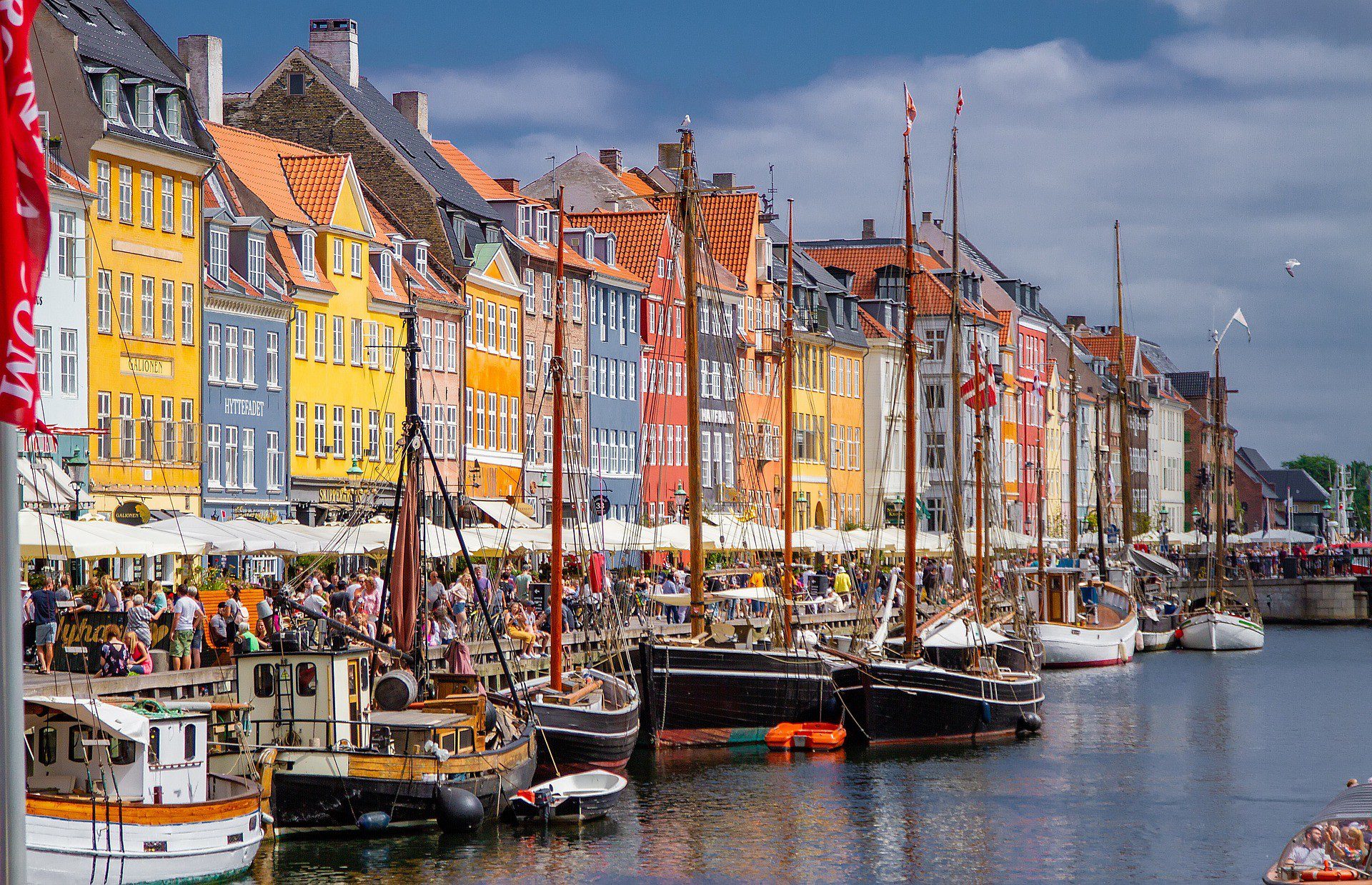
Copenhagen what to visit. If you are still undecided about what to visit in Copenhagen, you can enjoy the view of the picturesque colorful houses along the Nyhavn canal, one of the many reasons that drives us to visit Copenhagen. And it is here that many Danish characteristic public places are located. A few steps away is Frederiksstaden, the area designed by Frederick IV that groups important buildings such as the Amalienborg Palace (royal residence) and the remains of the Kastellet. To visit is the Frihedsmuseet with signs of Danish resistance against the Nazis, open from October to April every day except Monday from 10:00 to 15:00 and from May to September from 10:00 to 17:00 with free admission. The Kunstindustrimuseet is another museum located in the area that gathers interesting art collections. It is open every day except Monday (like most museums in Copenhagen) from 12:00 to 16:00. Entry requires a ticket.
8 Radhuspladsen, Stroget and the Latin Quarter in Copenhagen
What to do in Copenhagen. Radhuspladsen is the most important square of Copenhagen. The City Hall (Radhuset) faces this large area. It is possible to access the tower dating back to the late 19th century, during the colder months (October-May) at 12:00, while from June to September, Monday to Friday from 10:00 to 14:00 and on Saturday at 12:00. The tower is closed on Sunday. This is where the best-known pedestrian street of Copenhagen starts, called Stroget. It is a street packed with venues and street artists, as well as crowds. Morning hours are preferable to avoid the throng. Also in the center of Copenhagen is the Latin Quarter, full of venues, shops, and 19th-century churches. Here you’ll find the Erotica Museum open from May to September every day from 10:00 to 23:00 and during other months of the year from 11:00 to 20:00. The museum can also be reached by metro (stop Kongens Nytorv). You should also visit the Rundetarn tower commissioned by Christian IV for use as an observatory. It is open from September to May from 10:00 to 17:00 every day except Sunday, when opening hours are from 12:00 to 17:00. From June to August, it is open Monday to Saturday from 10:00 to 20:00 and Sunday from 12:00 to 20:00. Entrance fee applies.

What to see in Copenhagen and surroundings
9 Christiania, the hippie community
On the island of Christianshav there is a community made up of anarchists, new generation hippies, dealers, and people of extreme cheerfulness. It is a place near Copenhagen worth seeing. It is a community that was established over 30 years ago and over the years has faced quite a few problems of public disorder due to the unauthorized drug dealing (until recently cannabis was sold openly) and the illegal occupation of housing. However, it is an area that can have its charm and therefore a visit is recommended even though today it appears more controlled compared to the past when soft drugs were free.

See also:
- The fairy tale road of Hans Andersen
- Christmas in Copenhagen
- Christmas Markets
- Easter in Denmark
- Beer Festival in Copenhagen
- When to go to Denmark
- Where to shop in Denmark
10 How to get to Copenhagen
Copenhagen flights. With the company EasyJet, daily connections from Milan Malpensa start from 21.99 euros each way, taxes included. And with Transavia from Pisa, Rome Fiumicino, and Naples, you pay 50 euros each way, all included. Copenhagen airport. The Copenhagen International Airport is about 9 km from the city. From the Central Station, trains depart, taking about 12 minutes to the airport, approximately every 20 minutes, starting from 5 in the morning. If you plan to stay in the Nyhavn canal area, you have some trains that stop at Norreport station, which is connected, in turn, to the Kongens Nytorv metro stop. The alternative to the train is buses which take about 25 minutes to reach the airport. The price of buses is almost always the same as trains. Those who want to reach Copenhagen by train should know that almost all international trains arrive directly at the Central Station.
11 How to get around Copenhagen
To get around, bicycles are highly recommended, just like the true Kobenhavner, the inhabitants of the capital Copenhagen. There are more than 2000 city bikes available, easily recognizable in the 110 racks in the city center; the rental is free, you just need to pay a deposit of 20 Danish kroner (more or less like, for us, the shopping cart at the supermarket), refundable upon return. As for other means of transport, as in most European cities, here tickets are valid for both buses, trains (within a certain radius), and the metro. The klippekort is a 10-ride pass, recommended for convenience. Alternatively, a daily travel card or the Copenhagen Card is recommended, which, in addition to transportation, allows entry to some partnered museums. The distance between the Central Station and the Nyhavn canal is about a 30-minute walk.

12 Copenhagen Card
The Copenhagen Card gives access to all the main attractions and public transport in the entire metropolitan area of Copenhagen. You can choose between the 24, 48, 72, or 120-hour options. The card also allows you to enjoy discounts at restaurants and entertainment venues. Among Copenhagen’s points of interest, the Copenhagen Card grants free access to the Amalienborg Palace, the Tivoli Gardens, and the Frederiksborg Castle.
13 Copenhagen where to eat
What to eat in Copenhagen. One of the staple dishes of Danish cuisine is smorrebroed, slices of rye bread topped with cold cuts, cheese, fish, vegetables; in specialized restaurants, you can choose from many tasty variants. The Danish cuisine is a happy mix of tradition and innovation, combined with great care for freshness and quality of the raw materials. For those without particular needs and looking for an area of Copenhagen to eat, Nyhavn can be a good choice. Here the places are certainly not as important as those in Gammel Strand, where there are several high-level fish restaurants and cafés. The alternative can be Vesterbro, where you will find dishes and delicacies from around the world or, to get away from the concept of tourist dining, Vesterbrogade is recommended.

14 Copenhagen where to sleep
Copenhagen hotels. Another usually crucial chapter is accommodation but, in Copenhagen, you can stay in 5-star design hotels at the price of a hostel. In central Copenhagen, the Danhostel Copenhagen City has opened, entirely furnished with furniture and furnishings from the Danish house Gubi; almost a miracle of hospitality just steps from monuments and main attractions. And there are 5 other hostels in the capital, the most recent being Copenhagen Downtown, located in a small square convenient to the pedestrian island, the famous Stroget, where the historic and charming Royal Copenhagen porcelain shop nests, offering clearance sales and low-cost offers in the basement. More advice on where to sleep in Denmark.
Another economical solution is the hotels of the CabInn chain, with fixed prices regardless of the season (90 euros for double rooms), and the very popular Sleep In, a kind of dormitory with shared bathrooms and services. There are several in the lively Norrebro district, such as Sleep in Heaven and the ecological Sleep in green. Copenhagen has several areas recommended for sleeping. However, Vesterbro and Frederiksberg are the most recommended. Here you find a wide choice of selected hotels.