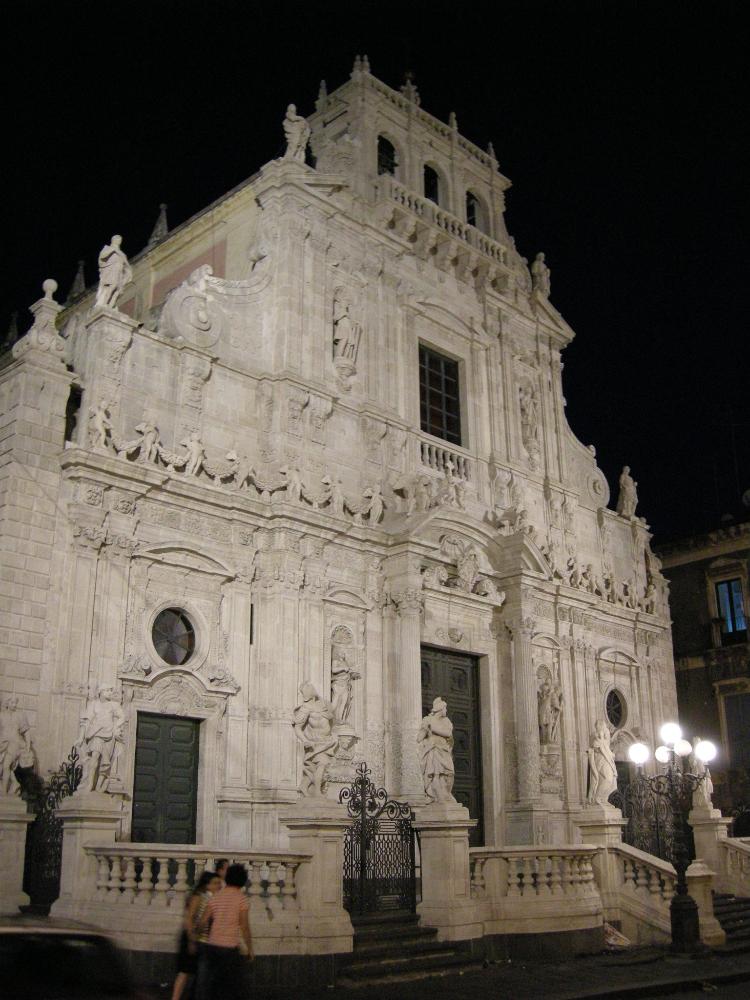


Visiting it means undertaking a journey spanning 3000 years, concentrated in just one square kilometer, shaped by Greek temples, Christian churches, Swabian, Aragonese and Baroque palaces, Arab alleys, flowered courtyards, shops, modest houses, and large public buildings. To see is the Maniace Castle, crouched in the southern part, built in the first half of the 13th century by Frederick II of Swabia and used both as a residence and a defensive stronghold. Having survived both the 1693 earthquake and a sudden explosion of gunpowder in 1704, it has maintained its original square plan and preserved only one corner tower. The Cathedral, born in the 5th century as a temple of Athena, underwent various renovations to become a Christian basilica, up to its current Baroque forms; it houses important works of art and a seventeenth-century statue of Saint Lucia. The lively Cathedral Square is lined with fine Baroque palaces, including Palazzo Beneventano from Bosco and Palazzo del Senato. In the northern part of Ortigia is the Temple of Apollo from the 6th century BC, considered the oldest in Sicily; over the centuries it became a Byzantine church, Arab mosque, Norman church, and Aragonese barracks. In Ortigia, all streets, all tour routes lead to the sea. At sunset, the large natural harbor becomes a magical place, filled with the last voices, the last gestures of the day, and the scents of fish coming from nearby restaurants. To the north, on the mainland, stretches the Neapolis, with the imposing Archaeological Park, which includes the Greek Theatre, the Roman Amphitheater, the Altar of Hiero II, the Latomia of Paradise with the Grotto of the Ropemakers and that of Dionysius’s Ear, a necropolis, and the evocative Street of the Tombs.
Ortigia Island, Historic Center of Syracuse
Ortigia Island encompasses the historic center of Syracuse: due to its unique geographic position, it was the first to be inhabited and to witness important expressions of the greatest Mediterranean civilizations.
Al je reizen in één app: vluchten, hotels, cruises, treinen, taxi’s, vakanties en huwelijksreizen.
We vergelijken realtime de prijzen van meer dan 100 bureaus om de beste deals te vinden, zonder extra kosten.
FullTravel App is een gratis metazoekmachine: lowcost en lijnvluchten (700+ maatschappijen), hotels (Booking, Airbnb…), cruises, treinen, bussen, taxi’s, fietsen, vakanties, huwelijksreizen en nog veel meer.