


The Garden of the Royal Stables
The complex of the Royal Stables Factory was built during the period when Florence was the capital, between 1866 and 1869, due to the court’s need for stables larger than those existing in the city, capable of housing the horses and the quarters for the service staff.
It constitutes the large green area enclosed between the Boboli Garden, Via della Pace e del Mascherino, Viale Machiavelli and Porta Romana, within which the Stables buildings are located, currently home to the Art Institute, and the Pagliere, intended to be the Museum of Figurative Arts of the Twentieth Century. There are also smaller buildings of the former Horse Infirmary and Mascalcia, currently used as residential for the staff of this administration.
The original layout of the Stables was quite faithful to the current one, with a round entrance to the gallop track, the covered riding school, consisting of two symmetrical wings arranged around two courtyards, as well as the porter’s quarters, the weekly stable masters’ rooms and the stable guard’s room, and His Majesty’s room.
The Cavalry of the Garden of the Royal Stables, Florence.
The area in front of the Stables, the so-called Cavallerizza, was closely connected with the building, an integral part of the surrounding garden’s arrangement. The original connection between the Cavallerizza and the upper floor of the Pagliere, along the embankment, through a path presumably used for carts carrying hay, is still readable, as well as the Geometrical Cadastral Plan of the viale dei Colli, drawn by Giuseppe Poggi, 1868, the area of the Royal Stables, Arch. Disegni SBAPSAE FI, PT, PO indicated by the presence of the side gate, on the right with respect to the access to the building from the avenue.
Once the court moved to Rome, the stables lost their original function and remained unused for a long time, until in 1919 the main body, consisting of the former riding school, was assigned to the Royal Art Institute, so that its impressive collection of plasters taken from ancient models could be placed in the room that had been the king’s gallop track.
The area is subject to restriction by Ministerial Decree of November 5, 1951: “Declaration of considerable public interest of the territory of the hills south of the city of Florence and east of via Senese located within the municipality of Florence.” Which states “… recognized that the above location as a whole constitutes a fundamental and characteristic element of the local landscape.”
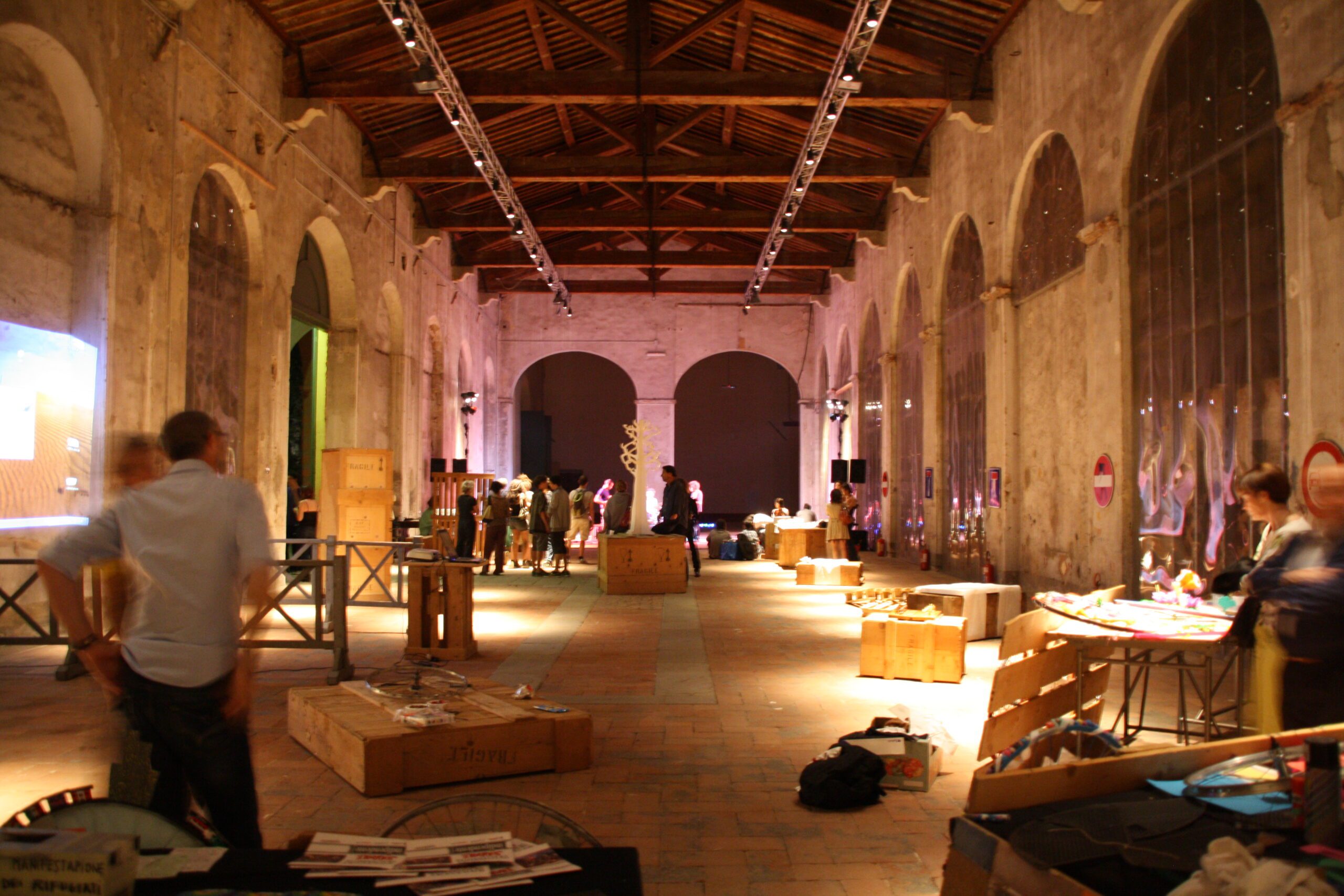
The Pagliere
The building of the Pagliere is a complex of great architectural importance and typologically unusual in the Florentine building landscape. It consists of a long central body organized on two levels and two lateral wings that stand as protruding blocks, articulated on three levels, with a facade characterized by an arcade portico on viale Machiavelli and another on the garden of Porta Romana, with large windows with terracotta latticework.
The ground floor of the building, currently divided by partitions, was originally made up of a single large room, used for housing horses, divided by pillars and covered by cross vaults. The upper floor, preceded by a loggia, was instead the hay storage, ventilated through the arched openings, with the characteristic architectural motif of the terracotta latticework.
The flooring bears traces of the original function, due to the presence of stone rather than terracotta corresponding to the passage of carts. The two lateral bodies were intended to house the service personnel and are still partly inhabited by personnel of the Superintendence assigned to the custody of the building.
The Pagliere Building remained unused for a long time, until in the early 1930s it became the Pagliere Building.
The rooms on the first floor during the setup works of the event hosted the scenography workshops of the Municipal Theater. The new destination was linked both to the size of the room, where sets were made, and to the close relationship of the Theater with the scenography workshop of the School, which at that time was known throughout Italy for the quality of its teachings, especially in the fields of painting and decorative sculpture.
The monumental canvas backdrops, from 1932 to 1950, were painted at the Pagliere, where artists such as Giorgio de Chirico, Felice Casorati, Gino Severini, Toti Scialoja, Mario Sironi, came to oversee the execution of their projects. From 1950 until 1987 it was used instead as a theater warehouse.
The original function of the building is clearly recognizable from the large windows bricked with terracotta latticework as well as from the orientation of the building bodies, which allowed perfect air circulation inside, essential to preserve the ‘Straw’.
The southern facades, more exposed to the sun’s rays, are protected by the portico, while the northern facades have large dimensions to allow maximum penetration of light and air transversely.
Information on the Garden of the Royal Stables and Pagliere
Piazzale di Porta Romana, 1 50125 Florence