


The Royal Stables Garden
The complex of the Royal Stables Factory was built during the period when Florence was the capital, between 1866 and 1869. The court needed stables larger than those already in the city, able to accommodate horses as well as staff quarters.
This large green area sits between the Boboli Gardens, Via della Pace e del Mascherino, Viale Machiavelli, and Porta Romana. Inside are the Stables buildings, now home to the Institute of Art, and the Pagliere, designated as a Museum of 20th-Century Figurative Arts. There are also smaller buildings such as the former Horse Infirmary and Mascalcia (farriery), presently administrative staff residences.
The original design of the Stables remains largely intact, with a rotunda entrance leading to the riding track, an indoor arena with two symmetrical wings around separate courtyards, porter’s quarters, stables for head grooms, and rooms for the royal guards, including one for His Majesty.
The Equestrian Arena of the Royal Stables Garden, Florence.
The area in front of the Stables, known as the Cavallerizza, was closely linked to the main building and formed an integral part of the landscape. The original passage between the Cavallerizza and the upper level of the Pagliere is still visible, along the embankment—likely once used by hay carts—along with the Catasto Geometric Map of Viale dei Colli drawn by Giuseppe Poggi in 1868, indicating the area of the Royal Stables. The presence of the side gate, to the right upon entering from the avenue, is also original.
After the royal court moved to Rome, the stables lost their original function and remained unused for years. In 1919, the main building—once the riding arena—was given to the Royal Institute of Art to display its impressive collection of plaster casts of classical models in what was once the king’s riding hall.
The area was protected by Ministerial Decree on November 5, 1951, declaring it of significant public interest: “Declaration of substantial public interest for the hills to the south of Florence and east of Via Senese within the municipality of Florence,” recognizing the area as a key feature of the local landscape.
The Pagliere
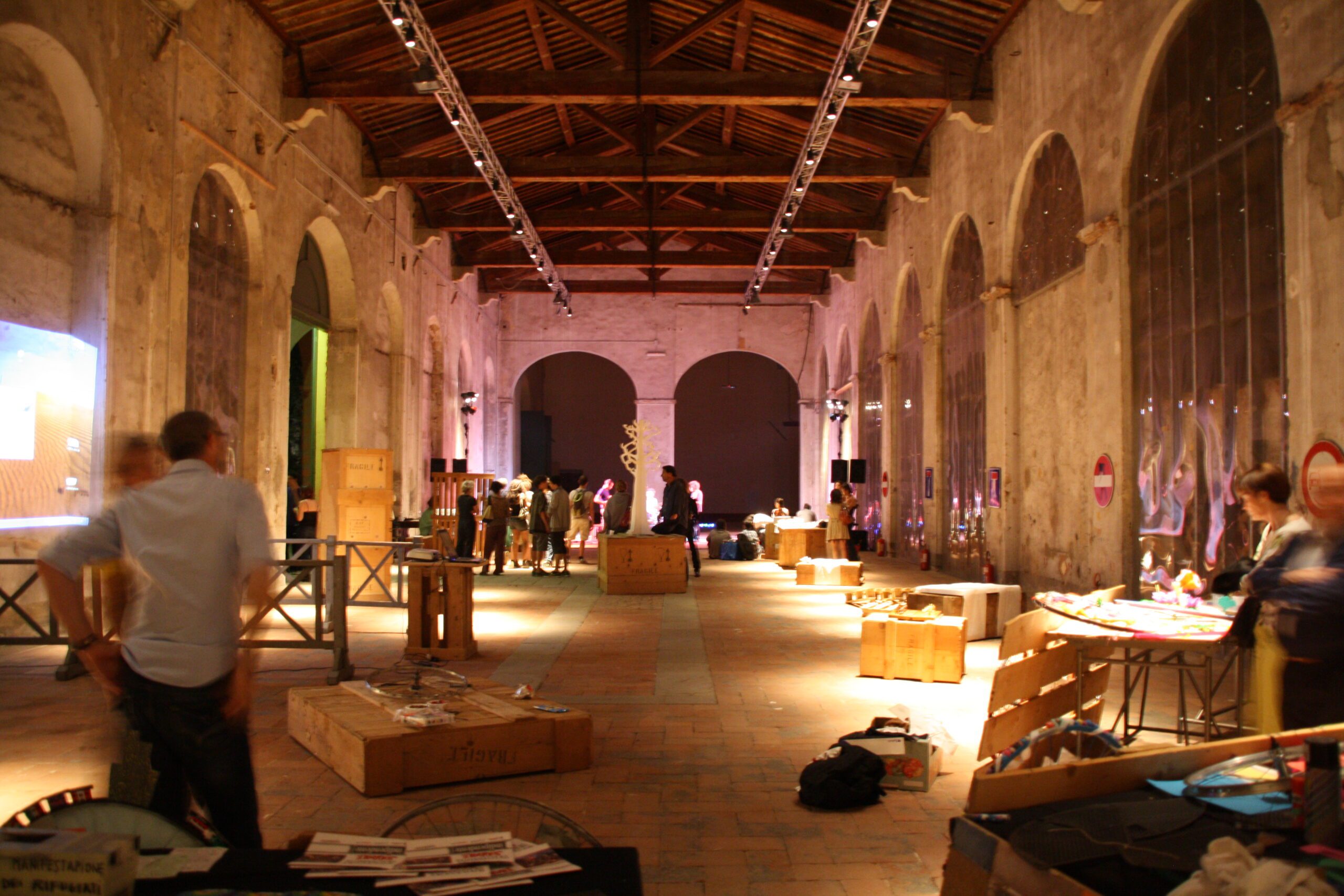
The Pagliere building stands out in Florence’s architectural scene: with a long central body set on two levels and two flanking wings arranged over three floors, it features arcaded porticos along Viale Machiavelli and toward the Porta Romana garden, with large windows fitted with terracotta grilles.
The ground floor, now subdivided, was originally one vast space for sheltering horses, marked by pillars and cross-vaulted ceilings. The upper floor, accessed by a loggia, served as a hayloft and was ventilated by arched openings with the typical terracotta design.
The floors still show traces of the original use: stone paving (rather than terracotta) in the passageways of horse-drawn carts. The two side wings housed staff, and some are still occupied by custodial staff from the Heritage Office.
The Pagliere Building sat unused for a long period before, in the early 1930s, becoming known simply as the Pagliere Building.
During set-up for major exhibitions, upstairs rooms housed the Theatre set design workshops. This was due to their ample space—perfect for creating stage scenery—and the close connection between the Theatre and the school’s scenography program, then renowned across Italy, especially in painting and decorative sculpture.
From 1932 to 1950, the monumental stage backdrops were painted at the Pagliere, with artists like Giorgio de Chirico, Felice Casorati, Gino Severini, Toti Scialoja, and Mario Sironi overseeing their designs. From 1950 to 1987, it served as storage for the Theatre itself.
The building’s original use is clear from the large windows with terracotta grilles and the orientation of its structures, designed to maximize air circulation—essential for storing straw.
The south facades, exposed to the sun, are shaded by arcades, while the north facades are large to help sunlight and air flow transversely inside.
Information on the Royal Stables Garden and Pagliere
Piazzale di Porta Romana, 1 50125 Florence



