

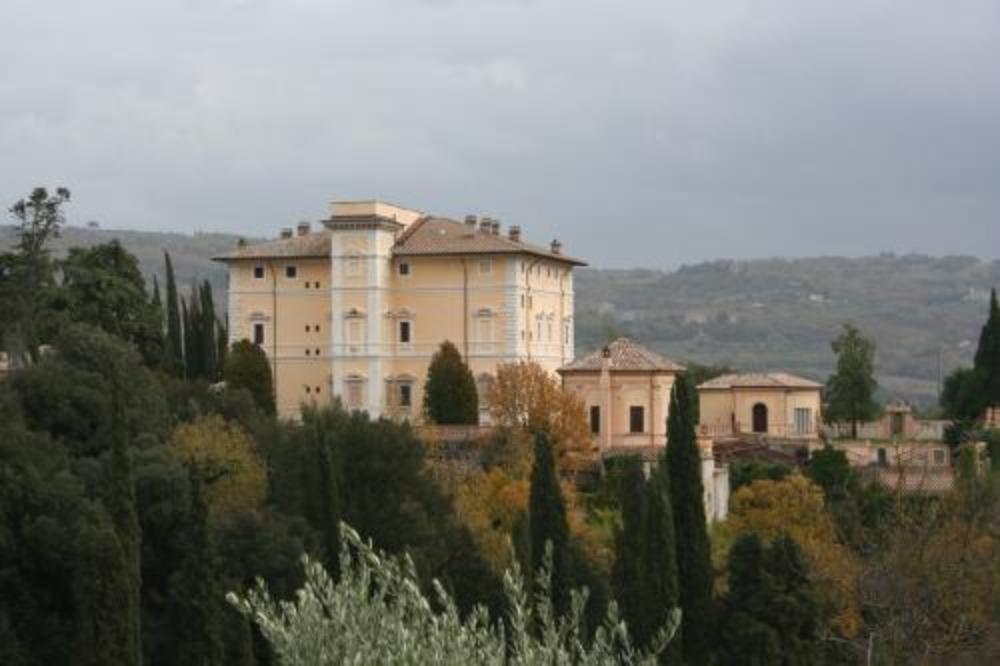


The most famous of the Umbrian villas, called del Cardinale, after its first owner, stands imposing on the hill dominating the narrow valley of the Caina stream, at the foot of the western slope of Monte Tezio, near Perugia. The complex overlooks the countryside from the top of a terrace and occupies the entire Cardinale hill, of probable archaeological significance, rich in waters, secret conduits, high above the valley that led to the sea routes, towards the domains of the Vitelli and Montefeltro families. The commissioner of the construction works of what was originally designed as a magnificent summer residence, corresponding to the Renaissance concept of a “place of delights,” around 1575, was Cardinal Fulvio della Corgna, who most likely turned to the architect Galeazzo Alessi, the favored designer of the powerful family. The cardinal’s nephew, Diomede della Penna, adopted by him, inherited the residence before the family died out and the villa was sold in 1644 to the Oddi family, who became Oddi Baglioni and, in the second half of the nineteenth century, transformed it into an important cultural salon that remained so even with the subsequent Cesaroni and Parodi families. The palace appears as a compact block in its rectangular plan, resting on a terrace with large underground rooms crossed by the gallery for carriage access. The importance of the main facade is emphasized by the rusticated arched entrance door with steps, topped by the balcony of the main hall, on which opens a taller and recessed window compared to the other windows. Inside, the villa is arranged around the sumptuous main staircase, the central hall with a richly decorated wooden coffered ceiling, and richly decorated walls. The frescoes of the villa were signed in 1581 by Salvio Savini, the preferred painter of the della Corgna family. Further decorations are by Leopardi and Labruzzi. The complex includes several annexes such as the caretaker’s house, the gardener’s house, the lemon house, the orchid greenhouse, and the four hunting lodges. At the southern end of the complex stands the village, once providing service to the villa. The green area is organized around the long access avenue that rises up the hill. The layout is from the sixteenth century and underwent significant transformations in the seventeenth and eighteenth centuries, which is why the currently visible imprint is Baroque. To the left of the villa is the winter garden on three levels connected by stairs, while to the right the English-style park develops, modified in the second half of the nineteenth century (main entrance, large square with the Heron fountain, lake with islands) and enriched with new plants. The villa has been owned by the Ministry of Cultural Heritage since 1996 and, together with the lemon house, is used for conferences and events.
Information on Villa del Colle del Cardinale
Frazione Colle Umberto,
06121 Perugia (Perugia)
075 5741415
Source: MIBACT