


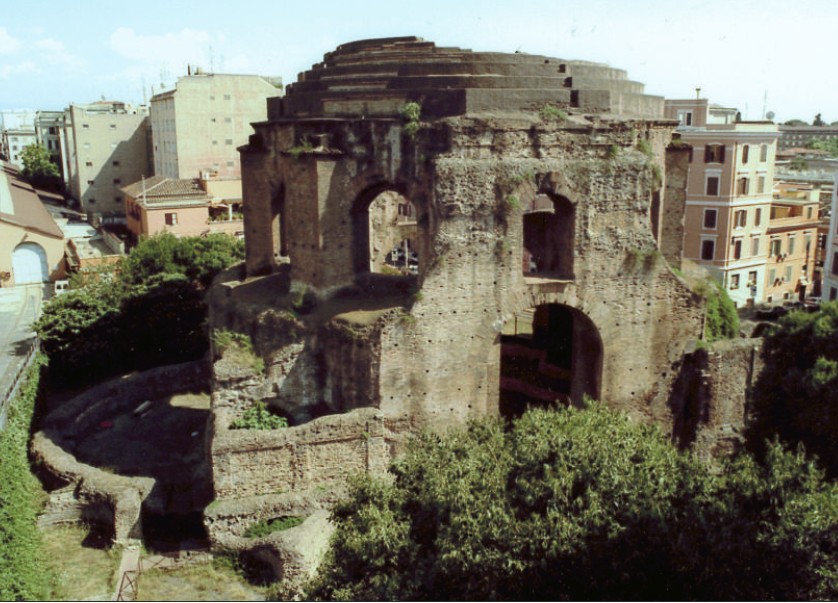


The “Temple of Minerva Medica” is actually a monumental hall, built in two phases during the early decades of the 4th century AD, in an area that presumably belonged a century earlier to Emperor Gallienus (Horti Liciniani).
Its central, polylobed plan with a “daisy” profile, the meticulous attention to proportions, and the progressive lightening of the masonry towards the top make it one of the most unique and daring monuments of the 4th century, comparable only to those in the great imperial cities of Cologne and Constantinople.
Due to its impressive size—a diameter of 25 m and a maximum dome height of 32 m, now reduced to about 24—it was one of the most striking sights in Rome until the modern transformations of the Esquilino district, which wedged it between the tracks of Termini Station and the surrounding 19th-century buildings.
Typical of the late antique era is its vast “sail-shaped” segmented dome—the third largest in Rome after the Pantheon and the Baths of Caracalla—illuminated and lightened by large windows, harmoniously transitioning from a polygonal to hemispherical shape. The building features dense, uniform brickwork; semicircular niches on each side of the decagon except for the entrance; and massive pillars acting as buttresses.
The interior and exterior spaces are expanded by deep niches along nine sides, perfectly symmetrical and topped by large arched windows. Traditional architectural elements, like columns, are found at the entrance and in the four large side niches.
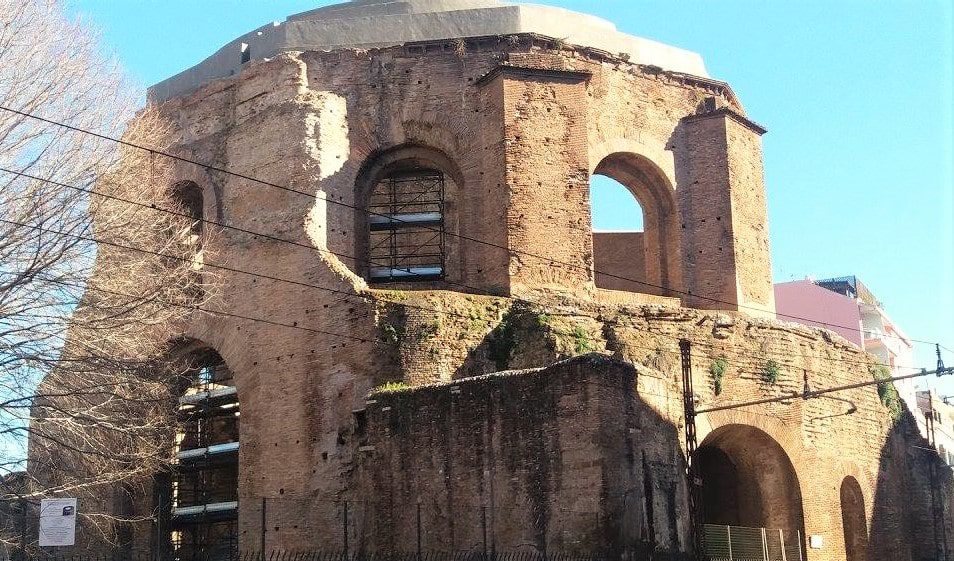
To ensure the building’s stability, the open niches were walled up, and powerful external buttresses were added between the niches around the angled pillars, changing the external silhouette of the monument.
In addition, two large apses were placed along the transversal axis outside the central pavilion, which was itself surrounded by other curved or apsidal rooms—including a double-apsed, narthex-like space added at the entrance.
The main hall and its annexes were richly decorated: traces of glass-paste mosaics still remain on the dome, now covered by a layer of plaster; the walls once lined with marble slabs set on a typical mortar and tile base; and vibrant stone mosaics and opus sectile decorated the floors.
Highlighting the luxury of the complex—now thought to be an imperial commission, perhaps by Maxentius or Constantine—a system of hypocausts ran under some rooms, suggesting the decagonal hall may have served as a banquet space.
Despite extensive scholarship making it one of antiquity’s best-studied monuments, the building’s structural issues were long overlooked. This led to the collapse of the dome in 1828 and prompted major restoration work in the 1940s; further consolidation and restoration of the entire monument is ongoing.

, was part of a large late-antique complex once thought to be an imperial residence, serving as a prestigious reception hall.)