


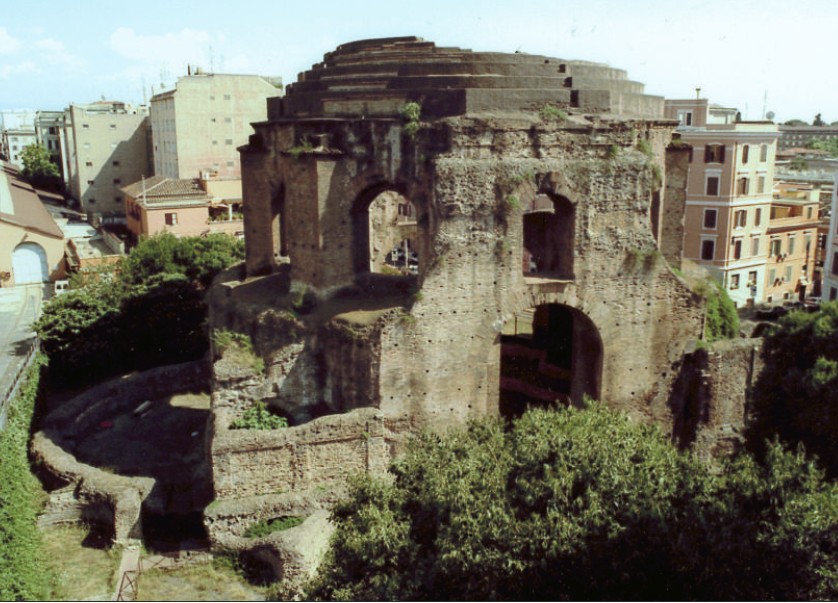


Il “Temple of Minerva Medica” is actually a monumental hall, built in two phases in the early decades of the 4th century AD in an area presumably belonging, in the previous century, to the emperor Gallienus (Horti Liciniani).
The central polylobed plan with a “daisy” shaped profile, the careful study of proportions, and the progressive lightening of the walls towards the top make it one of the most unique and daring monuments of the 4th century, comparable to the great imperial cities of Cologne and Constantinople.
Due to its impressive dimensions – a diameter of 25 m and a maximum dome height of 32 m, today reduced to about 24 – it is one of the most significant monuments in the views of Rome, until the modern upheavals of the Esquiline district layout forced the monument between the rails of Termini Station and the popular housing of the Umbertino district.
Typical of the late antique period is a very large “sail” type segmented dome – the third in Rome after the Pantheon and the Baths of Caracalla – illuminated and lightened by large windows, which harmoniously takes a shape from polygonal to hemispherical; a dense and regular brickwork; semicircular niches present on all sides of the decagon, except the entrance; massive pillars acting as buttresses.
The space appears expanded inside and outside thanks to the deep niches on nine sides, arranged with absolute symmetry and surmounted by large arched windows; the traditional architectural element, represented by columns, returns instead at the entrance and in the four large niches placed on the sides of the building.
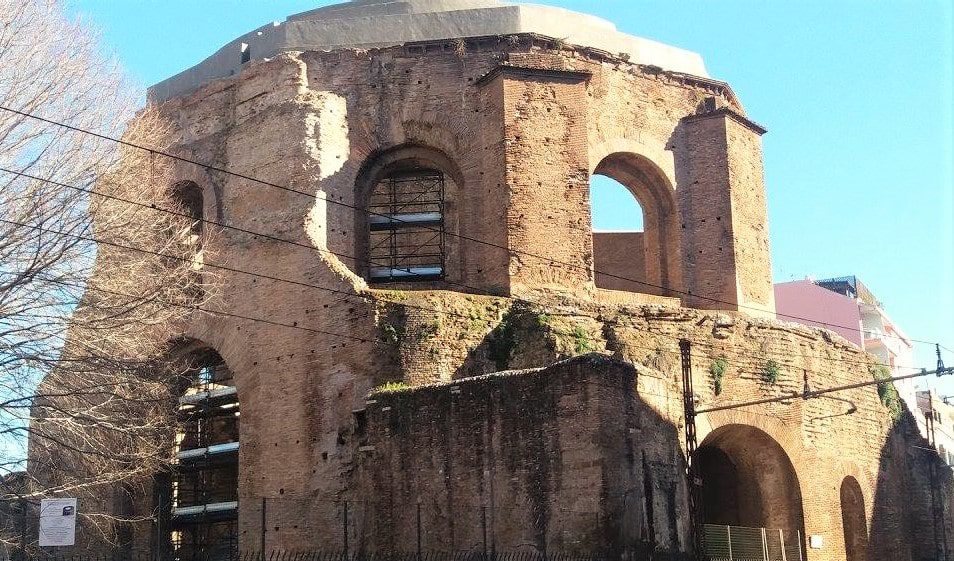
To ensure the building’s stability the open niches were sealed, creating continuity in the structure by constructing, on the outside, in the resulting spaces between the niches, massive buttresses attached to the corner pillars, interventions that modified the external shape of the building.
Furthermore, two large exedras, arranged outside on the transversal axis, flanked the central plan pavilion, inserted into a complex of other rooms mainly of curved or apsidal shapes: among these, an elongated double-apsed space, similar to a narthex, added in front of the entrance.
The main hall and annexes were to be enriched with sumptuous decoration: on the dome remains of glass paste mosaics survive, later covered by a layer of plaster; on the walls there were marble slabs, laid on the typical mortar preparation and fragments of tiles; the floors were covered with stone mosaics and opus sectile in vibrant colors.
Underlining the luxury of the complex, which a recent hypothesis attributes to imperial patronage (Maxentius or Constantine), a system of hypocausts ran under some of the identified rooms, suggesting for the decagonal hall the hypothesis of triclinial functions.
The extensive bibliography, which seems to make it one of the most studied monuments of antiquity, has so far contrasted a worrying underestimation of structural problems, which led in 1828 to the collapse of the dome, subject to a complex restoration in the 1940s; while a consolidation and restoration intervention of the entire monument is underway.


, apparteneva ad un grande complesso di epoca tardo-antica, già interpretato come residenza imperiale, del quale costituiva un grande ambiente di rappresentanza.)