


First Day in Naples: from the Duomo to the Church of Santa Chiara
Begin your trip in Naples’ historic center, starting at the magnificent Duomo, commissioned in the late 1200s by Charles of Anjou. In the renowned San Gennaro chapel, you’ll find a silver bust-reliquary of the city’s patron saint. The chapel also holds a vial containing his blood, which is displayed to worshippers twice a year—on the first Sunday in May and on September 19th (the feast day)—as they await the traditional ‘miracle’ of its liquefaction.
This ritual has continued for over six centuries. Nearby, between Anticaglia and via dei Tribunali, lies Napoli Sotterranea (Underground Naples, 1st century BC), accessible via the cloister of San Lorenzo Maggiore and the left flank of San Paolo Maggiore. Deep below the surface, you’ll discover aqueducts, shops, bakeries, markets, treasuries, and catacombs all carved into the tuff—spaces also used as air-raid shelters during World War II.
Back on the surface, it’s worth admiring the many religious buildings that decorate the area: Santa Maria Maggiore church with its Romanesque bell tower dating to the 6th century; the Renaissance Cappella Pontano; San Paolo Maggiore, built atop an ancient pagan temple; the medieval San Lorenzo Maggiore; and the beautiful Girolamini complex.
Spaccanapoli
You’ve arrived in Spaccanapoli, one of Naples’ most famous neighborhoods, following the ancient decumano of the Greco-Roman city. Alongside the iconic San Gregorio Armeno, known as the street of nativity artisans, don’t miss treasures like the 18th-century Cappella Sansevero—home to the spectacular marble Veiled Christ by Giuseppe Sanmartino; and San Domenico Maggiore church, with its delightful square and commemorative spire built after the 1656 plague. Nearby, discover charming piazzetta Nilo and the 15th-century church of Sant’Angelo.
Heading south, you’ll reach another Neapolitan treasure: the Church of Santa Chiara, built in 1310 by the Angevin kings to house their tombs. Though later draped in baroque decoration, a 1943 fire revealed its original Gothic lines. The 18th-century Clarisses’ Cloister, famous for its hand-painted majolica tilework, is a must-see.
Second Day in Naples: from Piazza Plebiscito to Capodimonte
As you continue south towards Piazza del Plebiscito, you enter modern Naples—characterized by grand open spaces and luminous architecture. The piazza’s semicircular colonnade of San Francesco di Paola and the Royal Palace are iconic symbols of Naples, which became the capital of the Kingdom of the Two Sicilies in 1734.
Teatro San Carlo and Galleria Umberto I
Don’t miss the monumental staircase and the court theater. A short walk brings you to the Teatro San Carlo, inaugurated on November 4, 1737, and the oldest opera house still active in the world. Opposite, Galleria Umberto I is famed as Naples’ elegant social salon; beneath it, in the Salone Margherita, variety shows and Belle Époque stories flourished at the start of the 20th century.
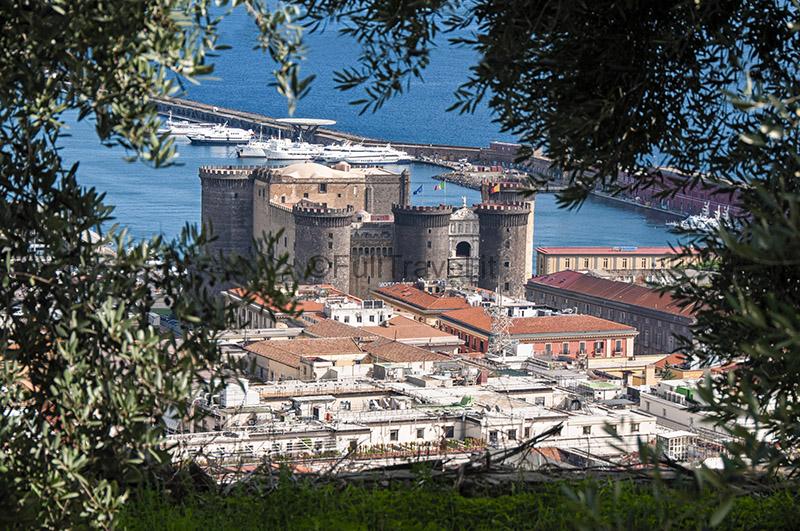
Continue your stroll to Piazza del Municipio, where the striking outline of Maschio Angioino (Castel Nuovo) and its grand Aragonese Arch (1443) dominate the view. Don’t miss a ride on the funicular to Vomero Hill, home to Castel Sant’Elmo—a stunning panoramic viewpoint—and the baroque Certosa with its cloister and the Museum of San Martino, famed for its extensive nativity scene collection.
Cap off your visit with a stroll along the waterfront from Santa Lucia to Porto Sannazzaro, passing by Castel dell’Ovo, and a tour of the Capodimonte Palace, housing the Farnese painting collection and Naples’ largest park.