


First day in Naples: from the Duomo to the Church of Santa Chiara
You can start from the ancient city of Naples, precisely from the Duomo, grand and imposing, built at the end of the 1200s by Carlo D’Angiò. In the chapel of San Gennaro, the most visited, the saint is depicted by a silver bust-reliquary. In a tabernacle, the ampoule with the blood is kept, which, twice a year, on the first Sunday of May and September 19 (patron saint’s feast), is shown to the crowd of faithful awaiting the miracle of liquefaction.
A ritual that has been repeated for over six hundred years. In this area, between the Anticaglia and via dei Tribunali, deep underground lies also the Napoli Sotterranea (1st century BC), which, among various entrances, has the cloister of the church of San Lorenzo Maggiore and the left side of San Paolo Maggiore. At tens of meters in depth, aqueducts, workshops, ovens, markets, treasuries, catacombs entirely carved into tuff are discovered. Spaces used as air-raid shelters also during the Second World War.
Back on the surface, it is worth taking a look at the myriad of religious buildings that dot the area: the church of Santa Maria Maggiore, whose origins date back to the 6th century, with the Romanesque bell tower; the Renaissance Cappella Pontano; San Paolo Maggiore built on the ruins of a pagan temple; medieval San Lorenzo Maggiore and the church of the Girolamini with the beautiful convent complex.
Spaccanapoli
We are now in Spaccanapoli, a very popular district, corresponding to the ancient lower decumanus of the Greco-Roman city. In addition to the famous San Gregorio Armeno, the street of nativity scene artisans, treasures not to be missed are the eighteenth-century Cappella Sansevero, with the marble statue of the Veiled Christ, masterpiece of sculptor Giuseppe Sanmartino; the church of San Domenico Maggiore, built between the 13th and 14th centuries, with the beautiful square and the devotional spire erected after the plague of 1656. And the delightful piazzetta Nilo with the 15th-century church of Sant’Angelo.
Heading south, you reach another place very dear to Neapolitans: the church of Santa Chiara built in 1310 by the Angevin rulers, to house their remains. For a long time, its austere Gothic lines were covered by a Baroque cladding, but when, in 1943, a fire almost completely destroyed it, the original construction was brought to light. Beautiful is the 18th-century Clares’ Cloister, with pillars and seats covered with painted majolica.
Second day in Naples: from Piazza Plebiscito to Capodimonte
Heading south, towards Piazza del Plebiscito, you dive into the new Naples, made of large spaces and imposing yet sunny architectures. Examples are the semicircular colonnade of San Francesco di Paola that adorns the square and the Royal Palace, symbol of Naples which, in 1734, became the capital of the Kingdom of the Two Sicilies.
San Carlo Theater and Galleria Umberto I
To see are the grand staircase and the court theater. Just nearby is the San Carlo Theater, inaugurated on November 4, 1737, the oldest opera house in the world. Opposite opens the Galleria Umberto I, the city’s most elegant and glamorous lounge, where in its underground theater, the Margherita hall, variety shows and the stories of Naples’ Belle Epoque triumphed in the early 1900s.
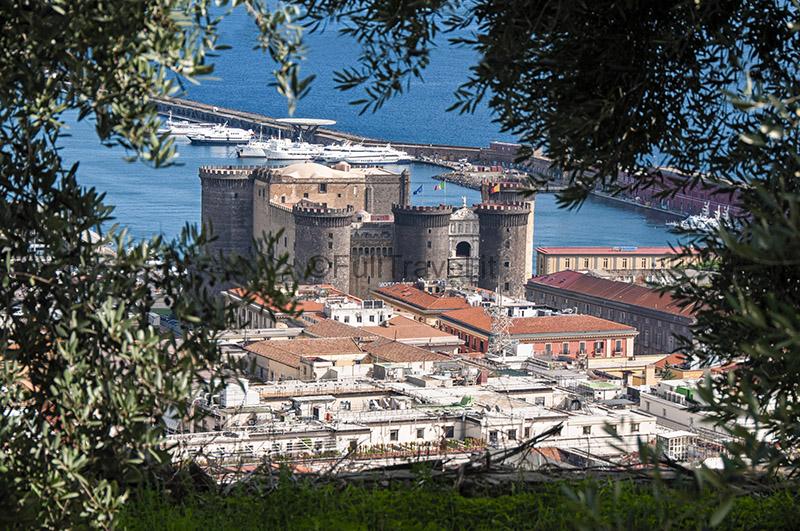
The walk downtown ends in Piazza del Municipio in front of the outline of the Maschio Angioino (New Castle), with the grand Aragonese Arch (1443). Not to miss at all is a trip by funicular to the Vomero hill, where Castel Sant’Elmo naps, a stunning panoramic spot on the city and gulf, the baroque Certosa with the cloister, and the San Martino Museum, with the precious collection of 18th-century nativity scenes.
And a walk along the Santa Lucia waterfront to the Porto Sannazzaro, passing in front of Castel dell’Ovo and a visit to the Capodimonte Royal Palace, with paintings from the Farnese collection and the wonderful park, the largest green area in the city.