


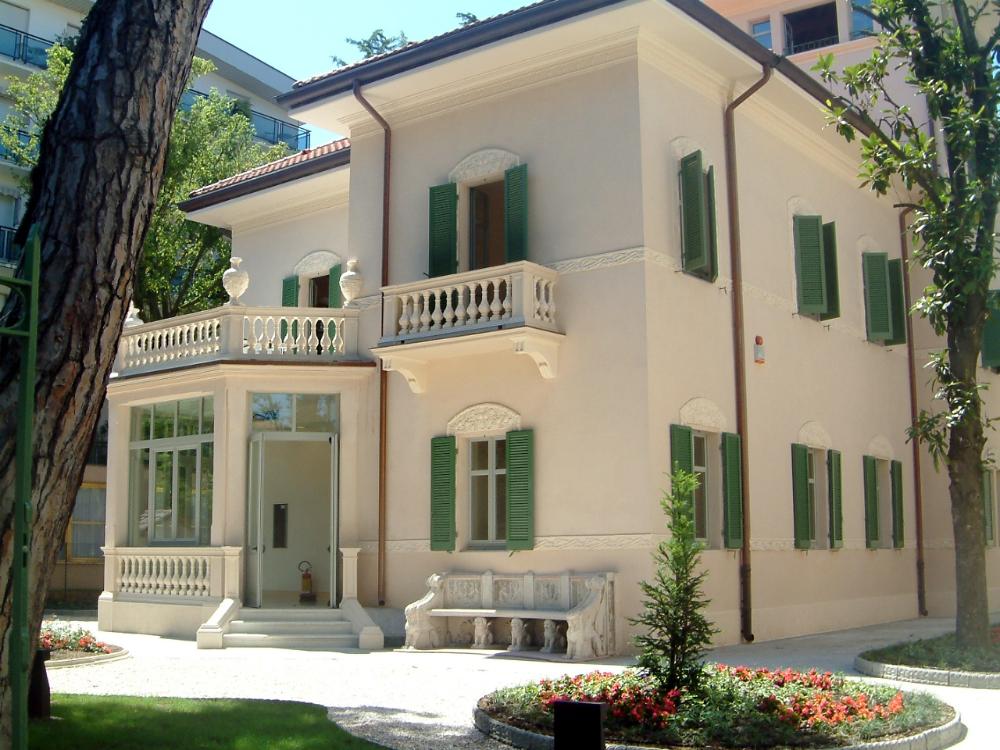


The museum was inaugurated on the initiative of the Municipality with the technical and scientific collaboration of the Regional Institute for Cultural Heritage. The museum is housed within Villa Franceschi, one of the remarkable Liberty-style architectures of Riccione. Here is arranged the municipal art collection, comprising hundreds of works mostly created from the post-war period onwards. The most interesting core, currently located at the Pesa Civic Center, was formed in the 1960s following some painting competitions, one of which was dedicated to the marine environment theme, and donations, such as those from the Franceschi heirs and the painter from Forlì Maceo Casadei (Portrait of Fulvia), works by Tesi, Sughi, Faccioli. At the Riccione Gallery, a group of works from the modern art collections of the Emilia-Romagna Region will soon be deposited and displayed. The museum project also includes rooms for periodic and thematic exhibitions.
The new museum institute houses the Municipal Art Collection, composed of a heritage formed during the awards season, in the two decades following the post-war period, from the Franceschi and Casadei donations; and the ‘Arcangeli Collection’, owned by the Emilia-Romagna Regional Art Collection since 1973. Paintings, sculptures, drawings, and graphic samples of figurative poetics, especially from Romagna, abstract and informal historical and contemporary art, will be available to the public with works by Giancarlo Balzani, Enzo Anginoni, Maceo Casadei, Roberto Sebastian Matta, Amleto Montevecchi, Franco Fiorucci, Carlo Crispini, Guido Fabbri, Guerrino Bardeggia, Giorgio Bastianelli, Nildo Breviglieri, Romano Buratti, Walter Faraoni, Mario Magnanelli, Nello Pari, Giacomo Pastore, Auguso Montevecchi, Armido Della Bartola, Guido Di Carlo, Aldo Astolfi, Boris Bonomi, Miksic Jusa, Rodolfo Pantaleoni, Ugo Rassati, Guido Roveri, Paolo Tommaselli, Sante Arduini, Federico Moroni, Nello Leonardi, Leonardo Castellani, Gino Mandolesi, Giovanni Omiccioli, Giò Pomodoro, Alberto Sughi, Giulio Turci, Luigi Veronesi, Virgilio Guidi, Vasco Bendini, Vincenzo Satta, Sergio Vacchi, Pompilio Mandelli, Giuseppe De Gregorio, Giovanni Romagnoli, Giulio Ruffini, Bruno Saetti, Mattia Moreni, Ervardo Fioravanti, Tino Repetto, Vittorio Tavernari, Maurizio Bottarelli, Bruno Pulga, Nani Tedeschi, Emilio Vedova, Nino Corazza, Luciano Minguzzi, Gino Gandini, Rezio Buscaroli, Cristina Roncati, Giovanni Poggeschi, Giovanni Korompay, Farpi Vignoli, Mario Nanni, Andrea Raccagni, Giannetto Fieschi, Carlo Corsi, Giovanni Ciangottini, Rosalba (Bianca Arcangeli), Renato Birolli, Gian Franco Fasce, Piero Ruggeri, Emilio Greco, Renzo Pasqualini, Angelo Biancini, Ennio Morlotti, Piero Giunni, Giuseppe Gagliardi, Vittorio Mascalchi, Tino Pelloni, Severo Pozzati, Alberto Burri, Bruno Olivi, Giorgio Baratti.
The institute, structured in the building in three different sections such as the belvedere tower, the gallery, and the terrace, aims to be a dynamic cultural service focused on interdisciplinary experimentation; it utilizes a monthly online magazine, https://villafranceschi.it, which has become the electronic hub for contemporary cultural initiatives promoted locally, and has established the Creolo Competition ([email protected] or the contest editorial office: [email protected]) previously won by Cristina Ballerini, now in its third edition and aimed at encouraging visual and literary creativity expressed through multimedia means.
The recent exhibition activity proposed creating within the rooms of the Agolanti Castle a work in progress based on the synergy of different artistic disciplines: painting, photography, installations, video, music, performance. Several cycles of meetings titled “Conversations on the Contemporary. The Artists Speak: Experiences and Paths of Creativity” were also proposed, featuring renowned artists and critics from the Emilia-Romagna and Marche regions: Vittorio D’Augusta with Giorgio Cortenova, Marco Neri with Claudio Spadoni, Paolo Icaro and Stefano Verri with musician Paolo Giaro’s intervention, Leonardo Pivi with Marco Senaldi, Paolo Serra and Giancarlo Papi, Fathi Hassan with Gaia Serena Simionati, Marcello Jori with Roberto Daolio, Sabrina Mezzaqui with Susan Mohamed, Luca Caccioni with Walter Guadagnini, Luigi Carboni and Stefano Verri, Gabriele Arruzzo and Alberto Zanchetta, and finally Davide Eron Salvadei with Marta Gargiulo.
In 2004, the Illustrissimi Competition was also born, aimed at promoting young talents, and for the exhibitions of works, it always makes use of the Agolanti Castle: the exhibitions have been dedicated to developing the themes: Odyssey. Inexhaustible Source of Exhibitions and Mysteries, The Great Flood, Castles in the Air and finally the latest edition dedicated to the theme of Earth.
In 2006, the fourth edition of the Artefatta exhibition took place, an annual event conceived and organized by the Department of Culture of the Municipality of Riccione. Among the exhibitions, the monographic “Faces of Life” by Nicolosa Rastelli Leziroli and one on Virgilio Guidi (2007) should also be remembered, and for the “Effettodoppler” exhibition involving several local municipalities, Niconote was hosted with the performance “Fever 103°”. In 2008, “Modigliani. The Genius’s Life” was notable; for 2009, “Aldo Borgonzoni (1913-2004). Witness of Time. Works from the Thirties to Two Thousand”; for 2010, “Gian Marco Montesano. The Ghost of the Work” and “Around 60. New Myths and New Figures of Art”, the collective “Paper Dreams. Paintings, Drawings, and Engravings by 20th Century Masters” (2011) and “Lucio Saffaro. The Secret Places of Being and Time”.
Information about Modern and Contemporary Art Gallery “Villa Franceschi”
Via Gorizia, 2,
47838 Riccione (Rimini)
0541600113
[email protected]
https://www.riccioneperlacultura.it
Source: MIBACT



