


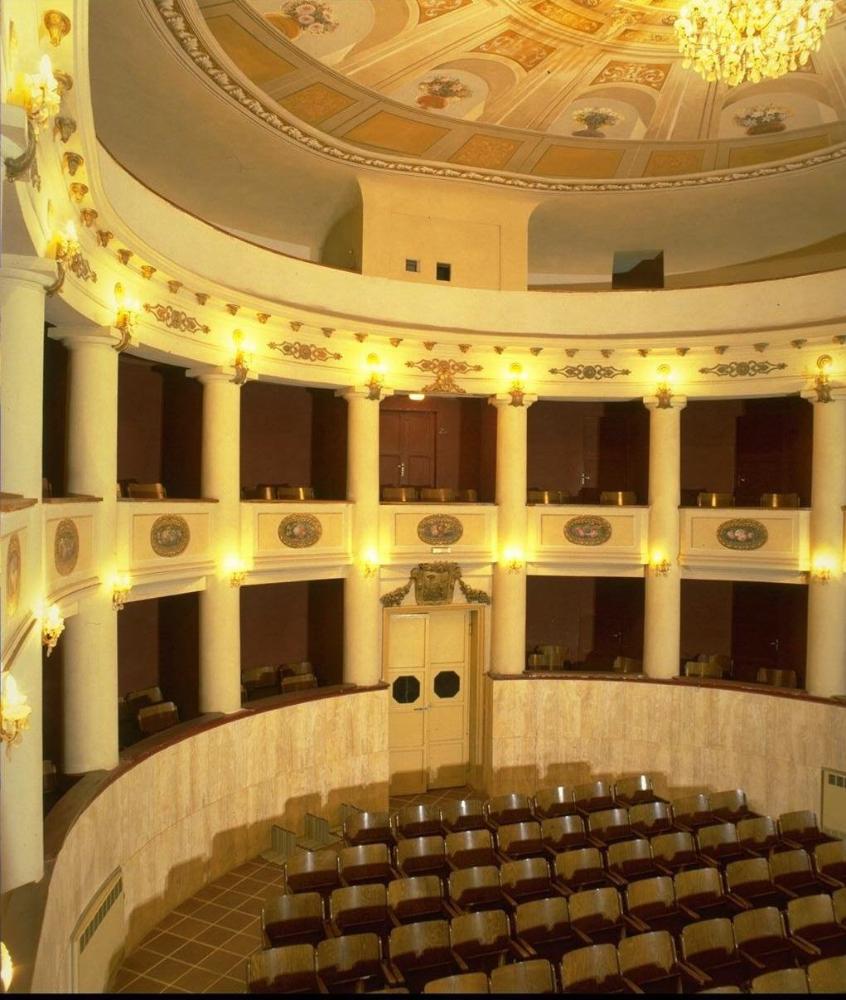


The first news of a show staged in Brisighella dates back to September 29, 1593. On that day, the young people of the town performed a Judith in the main square, a work by a native of Brisighella, which we can only suppose was a tragedy. Certain reports of performances appear again at the end of the 17th century. Here, as in other towns, the youth gathered during Carnival to put on some plays, supported by public funds. The preferred venue was the hall of the Public Palace, “kindly” granted for the staging of dramas and comedies. This continued until 1824, when the demolition of the old palace was decided. The engineer Mollari was called from San Giovanni in Persiceto to take care of the new building, which had to include a space suitable for nighttime performances. The design of the Municipal Theater was entrusted to the same municipality’s engineer, Giuseppe Mascolini; the work estimate, examined by the cardinal legate, was approved on January 28, 1829. By order of the prior Giulio Metalli, construction was carried out in secret to quiet the “idle gossip” and controversies of those who wanted to use that space to build a chapel. For a long time, most of Brisighella’s inhabitants had wished for a theater and even more ardently wanted to enjoy public performances: so much so that the administration was forced to grant it to some touring companies while the theater was still in an unfinished state. For financial reasons, this was in fact the last part of the Public Palace to be built (cf. Metalli 1869, p. 136, vol. VI). The scenography and machinery works were done by Gaspare and Romolo Liverani, of whom two letters are preserved in the Municipal Archive. The building was practically completed in 1832, although further expenses were made in 1835 for the final completion. The inauguration was nonetheless scheduled for September 1832, on the occasion of the Feast of the Blessed Virgin of Monticino; the pro-legate of Ravenna authorized an expense of thirty scudi for the necessary staging. Metelli, in his History of Brisighella, states that “for this purpose a company of skilled actors, led by Mascherpa who served the Duchess of Parma and Piacenza, was brought in; they performed some comedies by Goldoni and Nota” (cit. p. 187, vol. IV). In the new theater, sparkling with lighting, the audience greatly enjoyed these performances. The space that Maccolini had available to build the theater was located behind the main hall of the municipal residence; it had an irregular plan, with one side wider and one narrower, ending with a semicircle resembling a church choir. The shape that best suited it, according to the designer, was the so-called horseshoe. For a theater serving a town of two thousand people, Maccolini intended to use tight boxes and aisles, which were for a few, to the advantage of the stalls that would serve everyone. Once the project was conceived, Maccolini consulted some illustrious masters in Bologna to refine it, although their names are unknown. Currently, the theater has a rather small horseshoe-shaped hall and two tiers of boxes (twenty-four in total, plus the royal box) divided by twelve sturdy Doric columns supporting the gallery. The decoration is very simple: a series of medallions adorn the boxes on the second tier; a gilded stucco cornice runs all around the entablature above the columns. The proscenium arch, equally simple, has floral decorations and gilded stucco medallions. On the domed ceiling, a trompe-l’œil perspective is painted, consisting of twelve arched windows, each with a flower vase in the center. The theater is lit not only by the central chandelier but also by a series of wall sconces. In recent times, the theater has undergone several restorations. First, immediately after the war to repair damage caused by the war events, and finally in the 1960s. During the latter restoration, the roof was redone using technologies popular at that time (asbestos cement and reinforced concrete), resulting in the loss of the old wooden trusses. The vault and its decorations were also restored. Therefore, what we see today is a classical revival designed by the surveyor Casadio, who directed the work at that time, and executed by the local painter Tonino Del Re. The intervention also modernized the stalls’ flooring, while emergency exits were resolved with two doors leading to the under-stage area. In the past, the theater’s activity was lively and intense, while currently, only occasional cultural events are held, as the entire structure requires appropriate safety upgrades. (Lidia Bortolotti)
Information about Maria Pedrini Theater
Via Naldi, 2,
48013 Brisighella (Ravenna)
Source: MIBACT



