


The lower area is decorated with military trophies and allegorical bas-reliefs while two 19th-century cast iron lanterns crafted at the Royal Pietrarsa Factory rest on the rich pierced marble balustrade; in the center, the Savoy coat of arms.
The Grand Staircase leads to a bright Corridor, originally an open loggia, now protected by 19th-century glass panes, overlooking rooms and back rooms of the Historic Apartment as well as the Court Theater and the Royal Chapel. The “Grand Formal Apartment” commissioned by Ferdinand II of Bourbon is presented in its museographic form as the “Historic Apartment”; inside, most of the oldest rooms where institutional and representative functions were held can be visited, splendidly decorated and adorned with paintings, statues, tapestries, and period furniture while the private daily use rooms (bedrooms, bathrooms, kitchens) have not survived.
The setup mostly corresponds to the arrangement of the Palace during the Savoy era, although the 17th-century section still plays an important role in the ceiling decoration with historical frescoes glorifying the victorious Spaniards, and the artistic testimonies of the 18th and 19th centuries also serve to document the distinguished role of the Palace.
The route unfolds from the Hall of the Diplomatic Corps, passing through numerous rooms and back rooms – notable are the Maria Cristina Room, which leads to the apartments inhabited until 1837; the King’s Study, richly furnished with Weisweiler furniture – up to the Hall of Hercules, venue for balls and receptions, built in the mid-17th century and today characterized by the “Cupid and Psyche” tapestry series from the Royal Naples Factory woven by Pietro Duranti based on cartoons by Fedele and Alessandro Fischetti between 1783 and 1789, where the large bronze clock with Atlas holding the globe, an 18th-century French manufacture, is exhibited.
From the corridor, you access the Court Theater, the former 17th-century “Royal Hall” intended for celebrations and shows with movable sets, refurbished in its current form by Ferdinando Fuga in 1768.
On the eastern side of the loggia opens the Palatine Chapel, built starting from 1646 to a design by Cosimo Fanzago and dedicated to the Assumption, later rearranged between 1808-15 by Antonio De Simone and then by Gaetano Genovese, and finally heavily remodeled in the postwar period; inside, the high altar, from the church of Santa Teresa agli Studi, the lavish work of Dionisio Lazzari with hard stones, agates, lapis lazuli, onyx, jaspers, and amethysts; on the ceiling, the Assumption by Domenico Morelli.
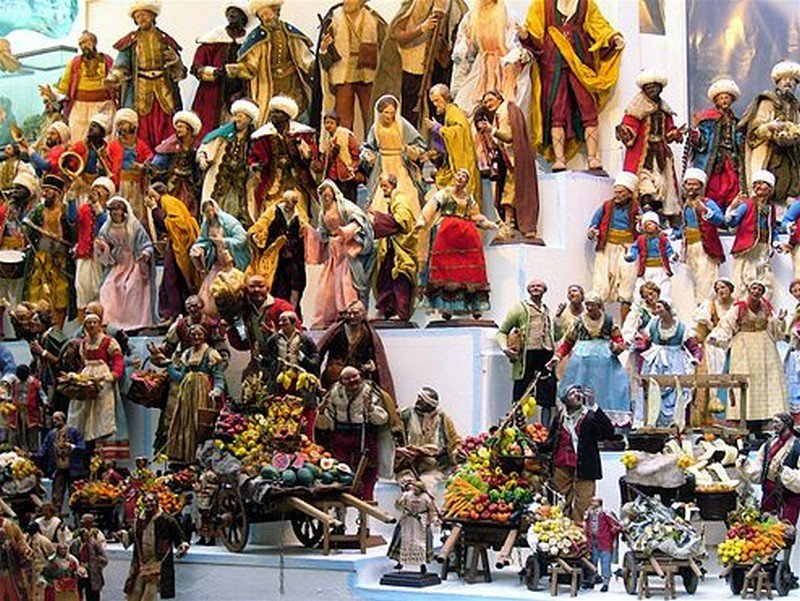
The chapel hosts the permanent exhibition “Sacred Art of the Palace,” within which the precious Nativity scene of the Banco di Napoli with 18th and 19th-century sculptures was recently installed.


 and later modified and decorated by Gaetano Genovese (1838-58).)