

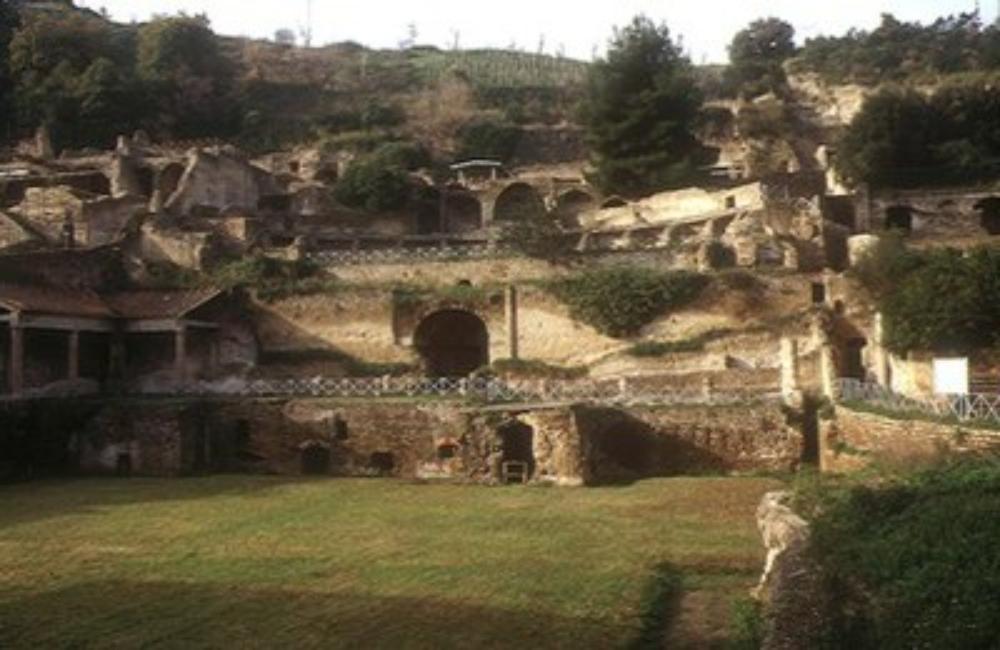


The Baia hillside is occupied by archaeological structures arranged on terraces known as the Baia Baths. The complex appears as a series of residences made up of separate architectural units, organized on different terrace levels and connected by stepped ramps. The first architectural complex is called the Villa of the Ambulatio and is spread over six terraces. The highest terrace houses the domestic quarter, with a peristyle, living rooms, and cubicula (bedrooms) on the sides of a large central hall open to the landscape. The second terrace, originally serving as the base for the one above, was later reinforced and transformed into a covered portico (ambulatio). It is longitudinally divided into two naves by a series of pillars linked by arches and features a large central hall corresponding to the one above. The lower levels of this building underwent several changes over time that altered the original use of the spaces. The entire complex initially had marble or black-and-white mosaic floors. The section called the Sosandra complex occupies the central area of the entire explored site. The structure is spread over four levels: the residential area develops on the two upper levels, the highest of which contains service rooms, and the one below houses triclinia, day rooms, and a small laconicum (sauna room) decorated with stucco, overlooking the gulf, preceded by a columned portico, and decorated with refined mosaic floors. From the largest room in this sector comes the marble statue known as Aspasia, also called Aphrodite Sosandra (a Roman copy of a Greek original), which gives the complex its name. The two lower levels of the building are arranged for a dramatic effect with an upper semicircular area and a lower open courtyard. The remaining part is occupied by thermal buildings used up to the medieval period. The so-called Mercury sector is named after a circular thermal natatio with a domed vault, called the “Temple of Mercury” by early travelers. It comprises two building units, the first of which is little known because its rooms are underground and submerged up to the vault springer or have been destroyed by modern constructions. From one of these rooms comes the head of Apollo Omphalos, a Roman marble copy of a Greek bronze original. The southern unit of this quarter, built in the Severan era, includes lavish rooms both architecturally and decoratively. Probably all these buildings were part of the Palace of Alexander Severus, which might have extended to the sea. Finally, the so-called Venus sector owes its name to 18th-century scholars who labeled some rooms on the lowest level of the complex as “Venus’s Rooms,” characterized by refined stucco decorations on the vaults. It includes three building units from different periods, placed on three different levels. The lowest one is altered on the eastern side by the modern coastal road, which isolated the so-called Temple of Venus, a thermal building with a circular interior plan and octagonal exterior, originally covered by a “ribbed” vault. This quarter also has a different orientation than the upper ones and consists of two quarters arranged on the western side of a large open area, partially excavated, with a fountain, a small room with mosaics, and an exedra that functioned as a summer dining room on its north side. The structures on the west side include two building units from different chronological phases: the northern one is made up of the thermal rooms called “Venus’s Rooms,” later converted into cisterns and service rooms; the southern one on the western side is made up of Hadrianic era baths developing around the rectangular apse hall, covered by a semicupola vault and aligned with the Temple of Venus. A grand staircase leads to the intermediate level of this sector, which also served as a terrace and substructure for the lower level, consisting on the western side of the so-called Small Baths. Made up of a circular laconicum and a basin, they originally belonged to a late Republican villa and were later integrated with other thermal rooms, identifiable as the calidarium and tepidarium, when the building assumed a public function. In the uphill area of this complex, two statues representing the Dioscuri were found at different times.
Information about Baia Archaeological Park
Via Sella di Baia, 22
80070 Bacoli (Naples)
0818687592
[email protected]
https://www.archeona.beniculturali.it
Source: MIBACT