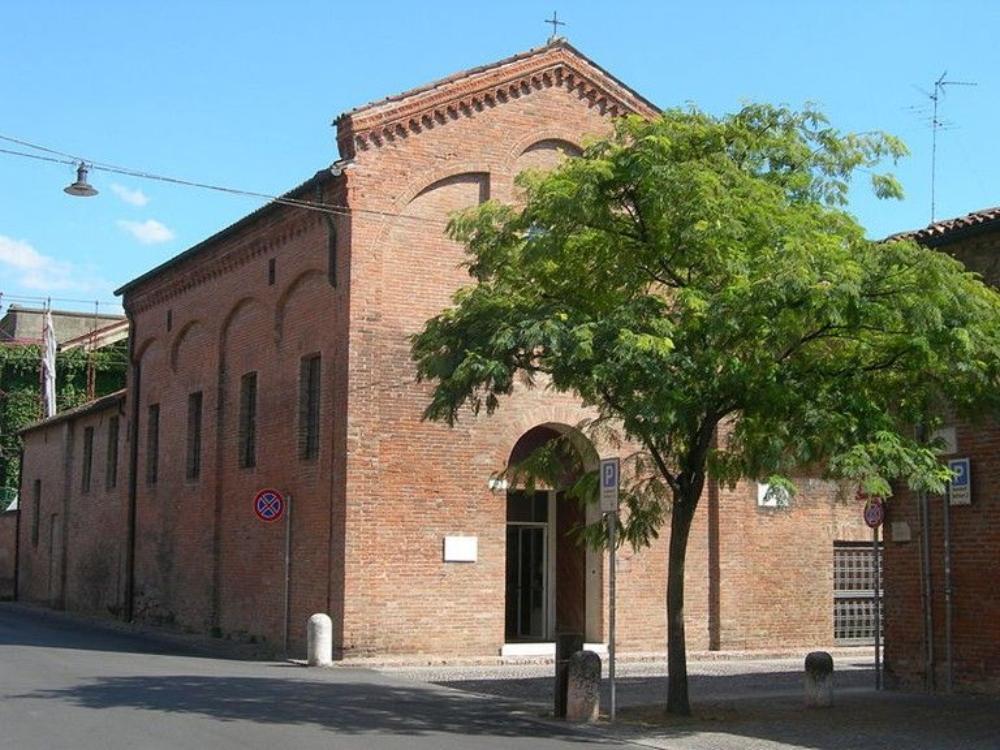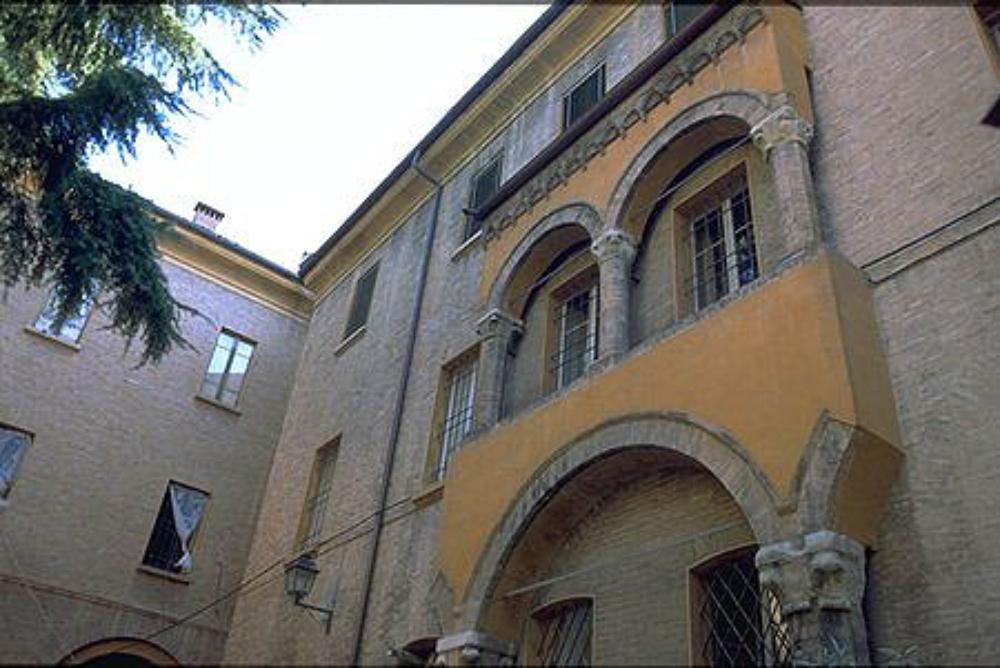


The chosen site for the new headquarters of the Classense Library, in Ravenna, was the area facing the Church of San Bartolomeo in “Turricula” and the Hospital of Santa Maria della Misericordia. Construction continued until 1798, the year of the Napoleonic suppression, after which the complex became the seat of the city’s main library institutions. Evidence of the original structure includes the ancient entrance door, with the date “1523” inscribed on its lintel, and part of the first cloister.
Additional works were carried out over time, resulting in a layered construction process, reflecting the contributions of multiple generations of architects and craftsmen. Despite the coexistence of different formal solutions that mirror the conventual structure, with spaces for prayer, study, and work, the complex embodies a succession of styles and historical traditions ranging from Renaissance to Neoclassicism. A 16th-century vestibule with a portal carved by Marco Peruzzi in 1581, enhanced by two telamons and two large basins with statues of the Order’s saints, San Romualdo and San Benedetto, leads to the refectory, the “Dantean Hall,” where the annual cycles of Lecturae Dantis have been held since 1921.
Created in the last two decades of the 16th century, the vast room is decorated with an fresco by Luca Longhi (1507–1590) depicting the Wedding at Cana (1580), while the painter’s workshop decorated the ceiling. In the following century, the so-called Manica Lunga, the new hospice, the dormitory’s upper floor, and the Church of San Romualdo — converted in 2004 into the Museum of the Risorgimento based on a project by Stefano Piazzi — were constructed.
Built between 1630 and 1632 according to the design of architect Luca Danesi (1598–1672), the place of worship was decorated by Giovanni Battista Barbiani (1593–ca. 1658) in the dome and choir lunette, while later ornamentation was done by Cesare Pronti (1626–1708) and Bartolomeo Boroni (1703–1787). Among the construction projects launched in the 17th and 18th centuries was the building of the internal cloister, remarkable for its elegance and grandeur, featuring a Doric colonnade in Istrian stone; designed by the Tuscan Giulio Morelli, it was supplemented between 1738 and 1740 by the central well created by the Ravennan Domenico Barbiani (1675–1752) from drawings by Giovanni Paolo Panini.
But it was in 1704 that, by the will of Abbot Pietro Canneti (1659–1730), the “memorable undertaking” of the monumental Camaldolese library began, entrusted to the architect Giuseppe Antonio Soratini (1682–1762). The project aimed to equip the complex with a designated library space, which had been housed in a single monastery room since 1648. No trace remains of this original structure, except for medallions alternating with emblems on the walls that document the activities of various academies that met in the complex during the 17th century. Collaborating with Architect Soratini were carver Fausto Pellicciotti, for the wooden shelves by Antonio Martinetti, who crafted the stucco decorations, and Francesco Mancini (1679–1758), who painted two large oil-on-canvas works depicting the union of the Greek and Latin Churches at the Council of Florence through the efforts of Ambrogio Traversari and Gregory IX, as well as the Camaldolese monk Graziano, plus the ceiling fresco showing Divine Wisdom sending Theology, Philosophy, and other Sciences to defeat Heresy, Ignorance, and Schism.
A vestibule leads to the vast hall, opening with a central archway accessible via a dramatic double flight of stairs. The three upper rooms — Science Hall, Arts Hall, and Hall of the Holy Fathers — extended Soratini’s project until 1780, after his death in 1762. The Science Hall, built in 1780 to designs by Camillo Morigia (1743–1795), is considered a “jewel of neoclassical style.” The ceiling’s stuccoes by Giacomo Bonesani, Paolo Giabani, and Paolo Trifogli frame a late Baroque fresco with antique motifs, depicting The Triumph of Virtue, a metaphor for the victory of Virtue over the oblivion of Time, painted by Mariano Rossi (1731–1807).
Displayed in glass cases are scientific and mathematical instruments donated along with the library by Camillo Morigia. On the second floor, the sequence of 18th-century rooms furnished with wooden shelves from the period, some coming from the suppressed libraries of the Ravennan abbeys of San Vitale and Santa Maria in Porto, is noteworthy. The adaptation and carving work are attributed to Ambrogio Moretti and Francesco Ferrari, following designs by Domenico Barbiani. Among the upper rooms are the Ricci Hall, housing the bibliographic collection and private archive of Corrado Ricci (1858–1934) (donated 1934), and the Dantean Hall, which since 1908 preserves a collection of rare Dante editions that previously belonged to Leo S. Olschki and were acquired by the Municipality of Ravenna in 1905.
In 1984, Marco Dezzi Bardeschi designed the Hall of the Eight Pillars in the Manica Lunga on the ground floor, formerly a warehouse in Classe and now an exhibition space. The mosaic floor, alluding to the theme of celestial harmony and an imaginary map referencing a lost land (Ravenna-Atlantis), was created by students of the Art Institutes of Florence and Ravenna and the Academy of Fine Arts in Ravenna, based on designs by Maria Grazia Brunetti and Dezzi Bardeschi himself. Another functional intervention was carried out by Gianpiero Cuppini in the new building block facing the ancient one.