

The Abbey of Cava de’ Tirreni was founded by Saint Alferius Pappacarbone who, retiring in 1011 to the Selano valley, beneath the great Arsiccia cave, to lead an eremitic life, was prompted by the arrival of disciples to build a modest-sized monastery with an attached small church.
- What to see in the Abbey of Cava de’ Tirreni
- Basilica of the Holy Trinity
- Basilica Altar
- Dome and Fountain
- The Cloister of the Abbey of Cava de’ Tirreni
- Museum of the Abbey of the Holy Trinity
- Library of the Abbey of Cava dei Tirreni
- Guided tours of the Abbey of Cava de’ Tirreni
- Mass Schedule at the Abbey of Cava de’ Tirreni
- Basilica of Cava de’ Tirreni Hours
The Abbey of Cava de’ Tirreni has over a millennium of life: ten centuries of uninterrupted monastic history since Saint Alferius founded that cenobium with a fortunate intuition in the choice of site.
An inexhaustible vitality and enlightened cultural policy have characterized this and other famous Benedictine abbeys following the famous Abbey of Montecassino, which was once also a model of splendor and elegance. Furthermore, the prosperous finances of the Cava abbey, owner of vast estates in the South, allowed the abbots to hire the most prestigious and up-to-date artists of the time and to use others, of lesser rank, more continuously.
What to see in the Abbey of Cava de’ Tirreni
Basilica of the Holy Trinity
Expanded and transformed into a multi-nave basilica during the time of Abbot Saint Peter I (1079-1123), the Abbey went beyond the local sphere, heading a vast monastic congregation (Ordo Cavensis). In 1394, Pope Boniface IX elevated it to a bishopric, placing it at the head of a diocese.
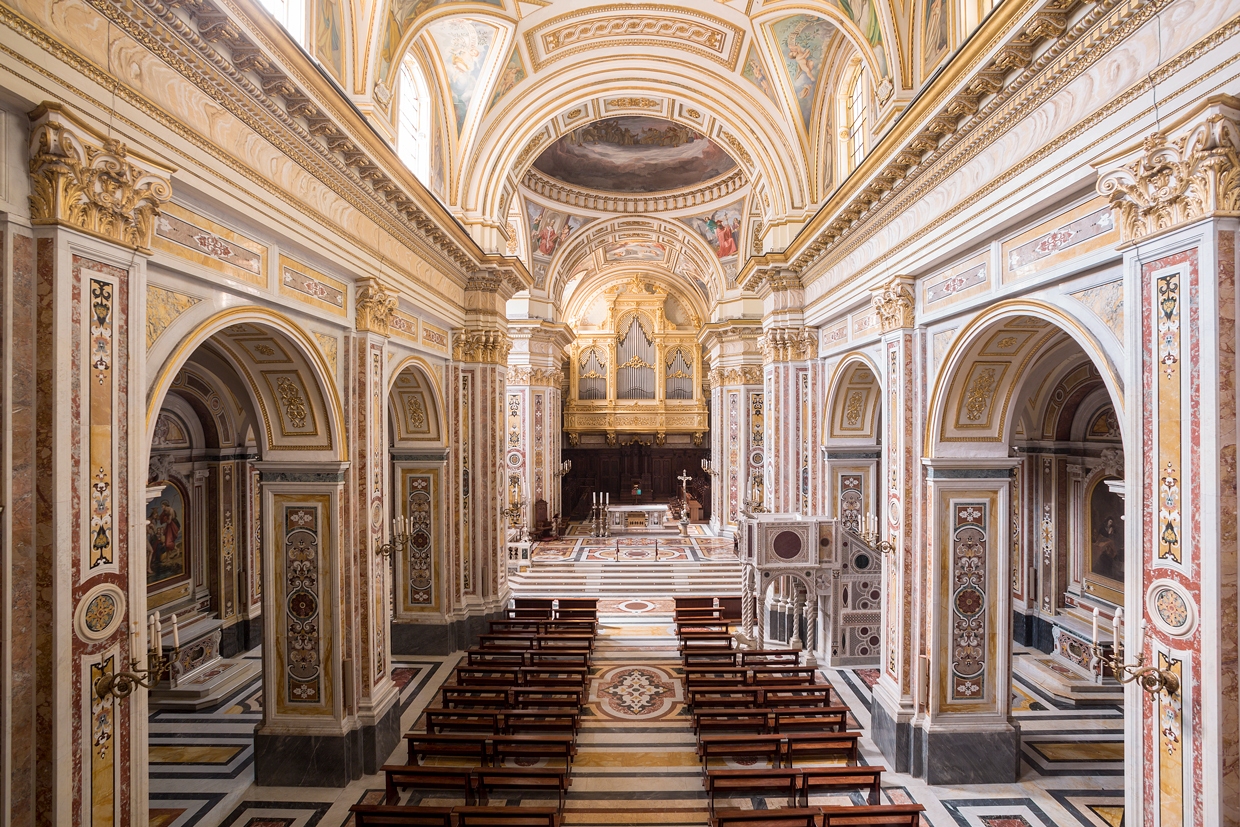
The current basilica was built in 1761 on the initiative of Abbot D. Giulio De Palma and designed by architect Giovanni del Gaizo. The interior, especially after the modern wall cladding and the multicolored marble flooring, is bright and harmonious. Of the ancient basilica, besides the 12th-century cosmatesque style marble pulpit, remain two chapels whose altars feature precious sculptures by Tino da Camaino, commissioned by the abbot and royal counselor Filippo de Haya: on the altar of the first chapel on the left, which has an 11th-century frontal panel, there is a relief depicting the Madonna with Child between Saint Benedict and Saint Alferius presenting abbot De Haya to the Madonna.
Basilica Altar
On the altar of the second chapel to the right are the two groups of pious women and Roman soldiers at the foot of the cross. Just beyond the balustrade, on the walls, are four marble statues among which stand out the 16th-century figures of Saint Felicity and Saint Matthew.
Moving forward, to the right is the grotto cell of Saint Alferius, housing the urn containing his relics; to the left is the altar of Saint Leo with his urn and, on the wall, other saints’ relics. The frescoes of the basilica are the work of Calabrian painter Vincenzo Morani, who in 1857 depicted on the choir vault “Saint Alferius in contemplation of the Holy Trinity.”
Dome and Fountain
In the dome is a vision of the Apocalypse; in the right transept the “Death of Saint Benedict”; on the left the “Resurrection” with prophets and apostles. Under the 12 basilica altars rest the relics of the 12 saint abbots. Next to the church, the fountain created in 1772 by Tommaso Liguoro is noteworthy.
The Cloister of the Abbey of Cava de’ Tirreni
The small cloister from the 11th-13th centuries, albeit modest in size, is the most evocative and characteristic part of the Cava de’ Tirreni abbey: although it has undergone several alterations, its structure recalls contemporaneous Amalfi cloisters and those of San Domenico in Salerno and Santa Sofia in Benevento, divided into quadriforas with horseshoe arches, reflecting Muslim influences.
Adjacent to the cloister is the great Chapter Hall from the 13th century, where some fine Roman sarcophagi, mostly from the 3rd century AD, are arranged. Also very evocative are the various underground environments of the abbey and cloister, dating from different periods – starting from the 9th-10th century with later reconstructions in the 12th century – known as the “Lombard cemetery”, used as a burial place for monks and laypeople who, out of devotion, wished to be buried there.
Museum of the Abbey of the Holy Trinity
Many works of the Museum of the Abbey of Cava de’ Tirreni can be admired in their original settings or in locations acquired during various restorations. Others were placed in the Museum, which occupied three evocative rooms belonging to the ancient Palatium from the late 13th century, reserved for guests. Additional works joined the monument’s collections at times subsequent to their execution, such as the altarpiece painted for the church of San Cesareo by Agostino Tesauro or the tondo executed by Francesco Penni based on a design by Raphael.
Following the extensive assortment of protomes, amphorae, Roman sarcophagi, and medieval sculpture fragments in the first room, the magnificent 13th-century hall exhibits precious and elegant 14th-15th century paintings of the Sienese school, a polychrome wooden statue depicting a Madonna with Child attributable to the same period, and a large collection of 16th-century panel paintings.
The rich sequence of canvas paintings, which for long periods were stored and thus missed the scrutiny of the latest criticism, is housed in the recently restored room. Essential or idyllic interpretations of famous biblical themes, crowded battle scenes or mystical assemblies, imposing depictions of church doctors and ecstatic saints create an ideal path spanning two centuries of painting, the 17th and 18th, featuring notable expressions of naturalistic, classicist, or baroque styles in large paintings or sketches.
Showcases display objects made of metal, porcelain, ivory, and ceramics from various eras and workshops. Notable among them are a 12th-century ivory box of delicate Byzantine craftsmanship, rare medieval ceramics likely produced in the convent’s own workshops, a fine selection of 18th-century plates from Abruzzese workshops, 15th-century Neapolitan glazed tiles, and precious liturgical vestments. A 14th-century nautical chart and some choir books, displayed in two cases, provide only a glimpse of the precious paper and parchment materials that the Abbey preserves in its very rich archive.
Library of the Abbey of Cava dei Tirreni
Within the abbey complex, the Library is located, one of the eleven annexed to the National Monuments, with an attached Archive whose origins date back to the foundation of the monastery itself (11th century) to supply books to the monks, as required by the Rule of Saint Benedict.
The archive, located in two rooms from the late 18th century, contains precious parchment and paper manuscripts, more than fifteen thousand parchments, the oldest dating from 792 AD. Among the most famous codices are: the Visigothic Bible of the 9th century, the Codex legum Langobardorum of the 11th century, the Etymologiae by Isidore of the 8th century, the De Temporibus by Bede of the 11th century, and the De septem sigillis by Benedetto da Bari of the 12th century, on whose margins the monks recorded the most important events of the abbey and contemporary world. These marginal notes constitute the Annales Cavenses, published several times.
Regarding the parchments, private documents are arranged chronologically and kept in the diplomatic room’s chests, each containing 120 parchments, while public documents are housed in the great chest numbering over seven hundred. The documents published in the Codex Diplomaticus Cavensis cover the years 792-1080 and number exactly 1669. Consultation is made easy for researchers by a Regestum Pergamenarum. The adjoining library, spread over three rooms, holds over 80,000 volumes including numerous incunabula and important 16th-century books.
The library’s benefactors, on the other hand, were the monks of San Giustina (many incunabula bear notes of purchase made in Venice expressly for Cava), abbot D. Vittorino Manso (first to separate printed books from manuscripts and, to safeguard the library’s integrity, obtained in 1595 from Pope Clement VIII a papal bull forbidding the removal of books from the library under threat of excommunication), and abbot D. Filippo De Pace (his name appears in thousands of volumes). A serious damage was caused to the library on Christmas night of 1796, when from the overhead Corpo di Cava a mass of earth and rubble fell, “totally ruining” the library, as stated in a news report: many books and some manuscripts were certainly lost in the disaster.

In the 19th century, natural elements spared the Benedictine monks’ library; however, government upheavals did not: the suppression of religious orders struck the abbey in 1807 by the King of Naples Joseph Bonaparte and in 1866 by the Savoia king Victor Emmanuel II. In both cases, the abbot was left responsible — in 1807 as director of the establishment and in 1867 (under a new law) as conservator of the National Monument — while some monks remained as custodians, effectively making the library state property.
This legal status has remained unchanged to date. The monks, on their part, have continued to devote themselves to management with the same care used for preserving and expanding the book collection. As in the past, growth has favored and continues to favor the disciplines most suited to a monastic library: patristics, theology, law, and history.
Guided tours of the Abbey of Cava de’ Tirreni
Guided tours every weekday and holidays, hours: from 8:30 AM to 12:00 PM. For groups it is preferable to book and agree on different timings. Phone: 089.463922 / 347 1946957
Itinerary: Cathedral, Chapel of the Holy Fathers of Cava, Grotto of Saint Alferius, The Ancient Chapels with 11th-century altars, Romanesque Cloister, Old and New Chapter Halls, Chapel of Saint Germano, Catacombs, Lombard Cemetery, Museum.
Mass Schedule at the Abbey of Cava de’ Tirreni
Weekdays
- 7:30 AM – Holy Mass with Gregorian chant
- 4:00 PM – Vespers with Gregorian chant
Sundays and holidays
- 11:00 AM – Holy Mass with Gregorian chant
- 4:00 PM – Vespers with Gregorian chant
Basilica of Cava de’ Tirreni Hours
Open on weekdays
- Morning: 7:15 AM – 12:00 PM
- Evening: 4:30 PM – 6:30 PM
Sundays and holidays
- Morning: 8:15 AM – 12:15 PM
- Evening: 4:30 PM – 6:30 PM
- Confessions from 9:30 AM to 10:30 AM