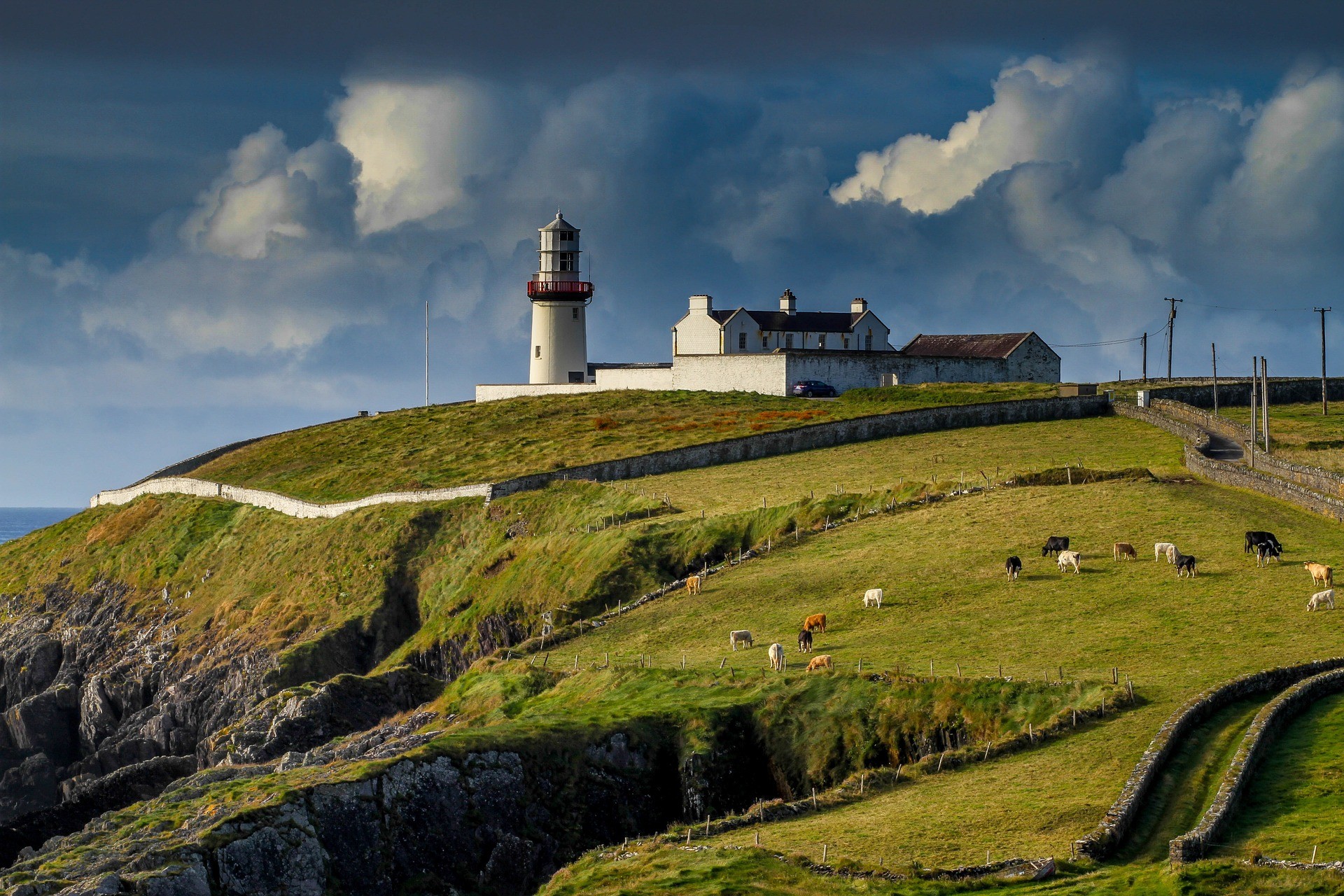


L’Abtei von Cava de’ Tirreni wurde von San Alferio Pappacarbone gegründet, der sich 1011 im Selano-Tal unter der großen Höhle Arsiccia zurückzog, um dort ein eremitisches Leben zu führen, aber durch den Zustrom von Schülern veranlasst wurde, ein Kloster von bescheidenen Ausmaßen mit einer kleinen angegliederten Kirche zu errichten.
- What to see in the Abbey of Cava de’ Tirreni
- Basilica of the Most Holy Trinity
- Basilica Altar
- Dome and Fountain
- The Cloister of the Abbey of Cava de’ Tirreni
- Museum of the Abbey of the Most Holy Trinity
- Library of the Abbey of Cava de’ Tirreni
- Guided Tour Badia di Cava de’ Tirreni
- Badia di Cava de’ Tirreni Mass Times
- Basilica Cava de’ Tirreni Opening Hours
Die Abtei von Cava de’ Tirreni hat über tausend Jahre Bestand: zehn Jahrhunderte ununterbrochene klösterliche Geschichte seit der Gründung dieses Cenobiums durch Sant’Alferio mit einer glücklichen Intuition bei der Standortwahl.
Eine unerschöpfliche Vitalität und eine aufgeklärte Kulturpolitik haben diese und andere berühmte Benediktinerabteien im Gefolge der berühmten Abtei von Montecassino geprägt, die früher auch ein Vorbild für Prunk und Eleganz war. Die wohlhabenden Finanzen der Abtei von Cava, die im Süden umfangreiche Besitzungen besaß, ermöglichten es den Äbten, die prestigeträchtigsten und aktuellsten Künstler der Zeit zu engagieren und andere, von geringerem Rang, kontinuierlich zu beschäftigen.
What to see in the Abbey of Cava de’ Tirreni
Basilica of the Most Holy Trinity
Expanded and transformed into a basilica with multiple naves during the time of Saint Peter I, abbot (1079-1123), the Abbey emerged from the local sphere, becoming the head of a vast monastic congregation (Ordo Cavensisis). In 1394, Pope Boniface IX elected it as a bishopric, placing it at the head of a diocese.
The current basilica was instead built in 1761 on the initiative of abbot D. Giulio De Palma and based on the design of architect Giovanni del Gaizo. The interior, especially after the modern wall coverings and the floor made of multicolored marbles, is bright and harmonious. Of the ancient basilica remain, besides the marble ambo in Cosmatesque style from the 12th century, two chapels whose altars hold precious sculptures by Tino da Camaino, commissioned by the abbot and royal counselor Filippo de Haya: on the altar of the first chapel on the left, which features an 11th-century antependium, there is a relief depicting the Madonna with child between Saint Benedict and Saint Alferius presenting abbot de Haya to the Madonna
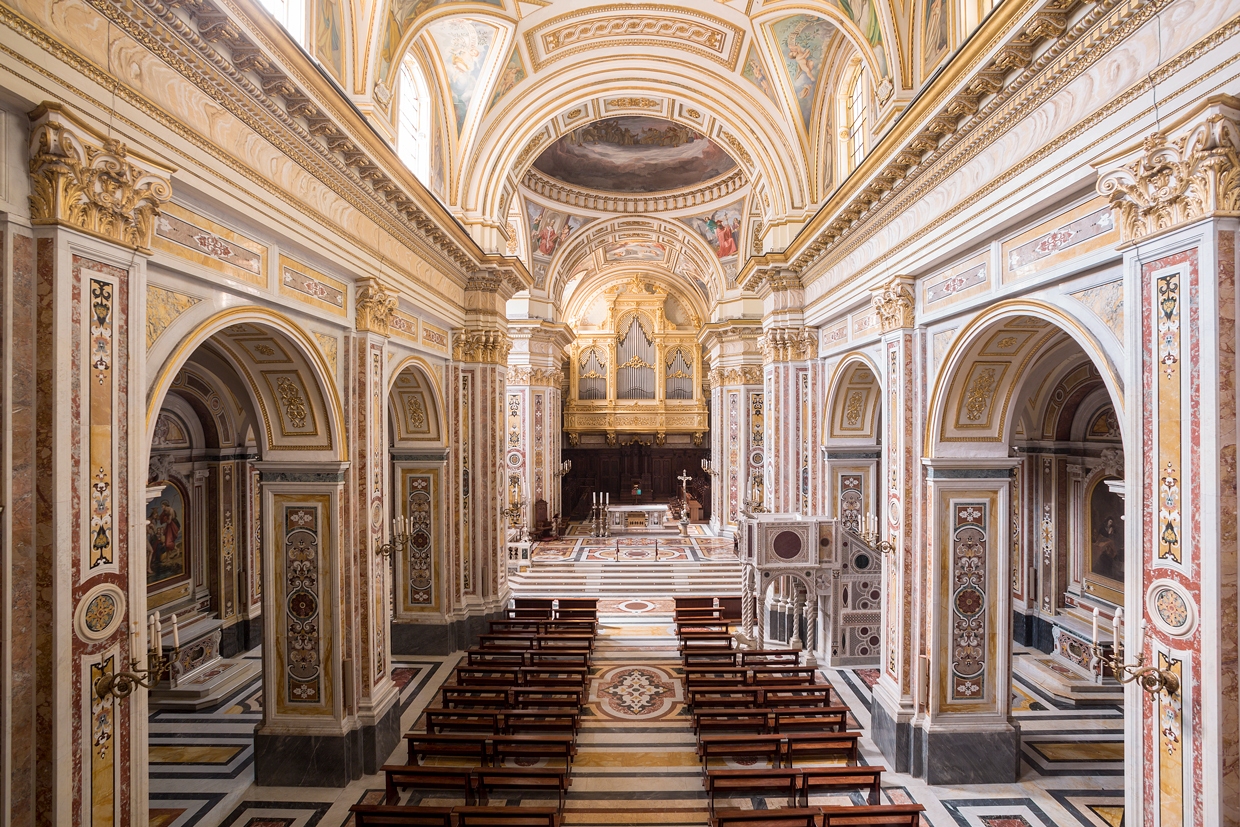
Basilica Altar
On the altar of the second chapel on the right are the two groups of the pious women and Roman soldiers at the foot of the cross. Immediately after the balustrade, on the walls, four marble statues among which notable are the 16th-century ones of Saint Felicity and Saint Matthew.
Moving forward, on the right is the cave cell of Saint Alferius, with the urn housing his relics, on the left the altar of Saint Leo with its urn and, on the wall, other relics of saints. The frescoes of the basilica are the work of the Calabrian painter Vincenzo Morani, who in 1857 depicted on the choir vault “Saint Alferius in contemplation of the Most Holy Trinity.”
Dome and Fountain
In the dome there is a vision of the Apocalypse; in the right transept the “Death of Saint Benedict”; on the left the “Resurrection” with prophets and apostles. Under the 12 altars of the basilica are deposited the relics of the 12 holy abbots. Next to the church there is the fountain made in 1772 by Tommaso Liguoro.
The Cloister of the Abbey of Cava de’ Tirreni
The small cloister from the 11th-13th centuries, although of small proportions, is the most evocative and characteristic part of the abbey of Cava de’ Tirreni: although it has undergone several alterations, its structure recalls the contemporary Amalfi cloisters and those of San Domenico in Salerno and Santa Sofia in Benevento, divided into quadruple windows with horseshoe arches, which testify to Muslim influences.
Adjacent to the small cloister is the great Chapter Hall, from the 13th century, where some precious Roman sarcophagi are placed, mostly dating from the 3rd century AD. Also very evocative are the rooms, of different eras – built starting from the 9th-10th century with subsequent renovations in the 12th – existing in the underground of the abbey and small cloister, the so-called “Lombard cemetery,” used as cemetery for monks and laypeople who, out of devotion, wanted to be buried there.
Museum of the Abbey of the Most Holy Trinity
Many works of the Museum of the Abbey of Cava de’ Tirreni can be admired in their original location or in settings acquired during various modernizations. Others were placed in the Museum occupying three evocative rooms belonging to the ancient Palatium from the late 13th century, reserved for guests. Other works entered the monument’s collections later than their execution, such as the altarpiece painted for the church of San Cesareo by Agostino Tesauro or the tondo executed by Francesco Penni based on a design by Raphael.
Following the extensive collection of protomes, amphorae, Roman sarcophagi, and fragments of medieval sculptures in the first room, in the magnificent 13th-century hall are displayed precious and elegant 14th-15th century paintings of the Sienese school, a polychrome wooden statue depicting a Madonna and Child from the same time period, and a vast collection of 16th-century panel paintings.
The rich sequence of canvas paintings, for which, also due to the long stay in storage, the most updated critical scrutiny has been lacking, is housed in the recently renovated hall. Essential or idyllic interpretations of famous biblical themes, crowded battle scenes or mystical meetings, imposing depictions of church doctors and ecstatic saints allow for an ideal path spanning two centuries of painting, the 17th and 18th, in meaningful manifestations of naturalistic, classicist, or baroque workmanship and in the format of large paintings or sketches.
In the display cases are objects in metal, porcelain, ivory, and ceramics from different eras and workshops. Among others stand out an ivory casket from the 12th century of delicate Byzantine workmanship, rare examples of medieval ceramics, probably produced in the same convent workshops, a precious collection of plates from Abruzzo workshops of the 18th century, 15th-century Neapolitan maiolica tiles, and precious liturgical vestments. A 14th-century nautical chart and some choral books, arranged in two display cases, provide only a sample of the precious paper and parchment material that the Abbey preserves in the very rich archive.
Library of the Abbey of Cava de’ Tirreni
Inside the abbey complex is located the Library, one of the eleven annexed to the National Monuments, with an attached Archive whose origins date back to the very foundation of the monastery (11th century) to supply books to the monks, as stipulated by the Rule of Saint Benedict.
The archive, placed in two rooms from the late 18th century, houses precious parchment and paper manuscripts, more than fifteen thousand parchments, the oldest of which dates back to 792 AD. Among the most famous codices are: the Visigothic Bible from the 9th century, the Codex legum Langobardorum from the 11th century, the Etymologiae by Isidore from the 8th century, the De Temporibus by Bede from the 11th century and the De septem sigillis by Benedict of Bari from the 12th century, on whose margins monks noted the most important events of the abbey and the contemporary world. Such marginal notes constitute the Annales Cavenses, published several times.
Regarding the parchments, private documents are arranged chronologically and placed in the diplomatic room in chests each containing 120 parchments, while public documents are in the great chest numbering over seven hundred. The documents already published in the Codex Diplomaticus Cavensis belong to the years 792-1080 and are exactly 1669. Consultation is made easy for scholars by a Regestum Pergamenarum. The adjoining library, distributed in three rooms, holds over 80,000 volumes including numerous incunabula and important 16th-century prints.
Those who greatly contributed to the library were, on the contrary, the monks of Saint Justina (many incunabula bear annotations of purchase made in Venice expressly for Cava), abbot D. Vittorino Manso (who was the first to think of separating printed books from manuscripts and, to safeguard the integrity of the library, in 1595 obtained from Pope Clement VIII a bull prohibiting the removal of books from the library under the threat of excommunication), abbot D. Filippo De Pace (his name appears in thousands of volumes). Serious damage was caused to the library on Christmas night 1796, when a mass of earth and rubble from the overlying Corpo di Cava collapsed, which “totally ruined” the library, as chronicled in a report: in the disaster many books and also some manuscripts were certainly lost.

In the 19th century, the Benedictine monks’ library was not ravaged by natural elements but by the storms of governments: the suppression of religious orders struck the abbey in 1807 by order of the King of Naples Joseph Bonaparte and in 1866 by order of the Sardinian king Victor Emmanuel II. In both cases, the abbot was left responsible, in 1807 as director of the Institution and in 1867 (under a new law) as conservator of the National Monument, while some monks remained as custodians, effectively making the library property of the State.
This legal status has remained unchanged until today. The monks, for their part, have continued to devote themselves to management with the same care adopted in conserving and increasing the book collection. As in the past, growth has favored and favors the disciplines most suitable for a monastic library: patristics, theology, law, and history.
Guided Tour Badia di Cava de’ Tirreni
Guided tours every weekday and holiday, hours: from 8:30 to 12:00. For groups, it is preferable to book in advance and arrange different times. Phone: 089.463922/347 1946957
Route: Cathedral, Chapel of the SS.Padri Cavensi, Grotto of Saint Alferio, The Ancient Chapels with 11th-century altars, Romanesque Cloister, Old and New Chapter House, Chapel of Saint Germano, Catacombs, Lombard Cemetery, Museum.
Badia di Cava de’ Tirreni Mass Times
Weekdays
- 7:30 AM – Holy Mass with Gregorian Chant
- 4:00 PM – Vespers with Gregorian Chant
Sundays and holidays
- 11:00 AM – Holy Mass with Gregorian Chant
- 4:00 PM – Vespers with Gregorian Chant
Basilica Cava de’ Tirreni Opening Hours
Open on weekdays
- Morning: 07:15 – 12:00
- Evening: 16:30 – 18:30
Sundays and holidays
- Morning: 08:15 – 12:15
- Evening: 16:30 – 18:30
- Confessions from 9:30 to 10:30