
Tourists worldwide have continued searching for flights to reach Italy, but confidence has inevitably wavered due to the pandemic events.

Add us to your preferred sources.

All players in the tourism supply chain, starting from accommodation, restaurant, and intermediary businesses, up to the activities indirectly involved in the sector, are trying to understand when tourism will restart. They are closely monitoring the evolution of the health situation to detect improvements, decreases in infections, signs of returning to normality, knowing that travel bans are not the only obstacle to overcome.
Summary
Travel Restrictions
Travel restrictions undoubtedly represent the main reason preventing us from buying a ticket and leaving, but the fear of contagion has a strong impact on the traveler’s sense of security: concerns about personal health greatly influence when and where flows will return, and generally, tourists will try to avoid crowded places, preferring lesser-known destinations, and seeking guarantees of health safety in accommodations. Furthermore, it must be considered that although tourism is becoming increasingly a primary consumer good, the worsening economic condition will lead many families to forego vacations.
Digital Footprints of the Tourist
Especially in this period, it has become crucial to have data that listen to the moods of demand, better understand travelers’ intentions of travelers, and outline future trends: analysts, research agencies, union organizations, and various institutions are trying to gather as much information as possible, both through traditional survey methods and by reading the digital footprints left by tourists online. Tourists are unconscious producers of big data: they visit websites, check prices, verify hotel availability without knowing that all this information becomes a rich source of raw data.
Since traveling is currently impossible (and we don’t even know when we will do it again), most data come from the preliminary phases of the trip, just before the actual experience, known as the dreaming phase: users get inspired, plan, inform themselves, choose new destinations. The data captured during this phase are important as they help us understand travelers’ interests and their confidence in the future: even during the worst moments of the pandemic, travelers never stopped researching and planning their trips.
Travel Mood in 2020
Analyzing flight search data from the first international meta-search engine by number of users, it emerges that tourists worldwide continued searching for flights to Italy, but confidence inevitably wavered during the events: while in January searches were stable and aligned with usual trends, news about the first cases in Italy (February 21-27) had a very strong impact. As uncertainty about the future increased, in just three weeks, searches plummeted by 62%, and with the start of the lockdown, by 91%.
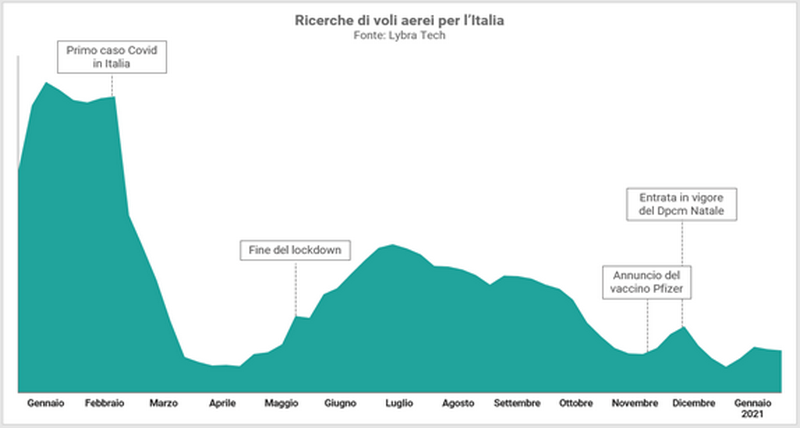
Only with the start of Phase 2 and the easing of restrictions did tourists resume planning their trips, with even more positive variation rates with the start of Phase 3. However, this was a contained and temporary increase: despite the improved health situation in summer, Italians preferred to vacation close to home, for a few days, and using private transportation, while foreign tourism was almost entirely absent. In autumn, the explosion of the second wave across European countries reignited traveler concerns until October, when Italy was also impacted: searches again fell sharply, by 65% in one month. The fluctuating trend of searches perfectly reflects travelers’ moods, who responded with hope to Pfizer’s vaccine announcement (+19.8% in three weeks), then with disappointment after the introduction of the Christmas Dpcm (-26.9%) and the confirmation of new restrictions after January 6 (-4.2%).
As shown by the data, currently, traveler interest in Italy is on a downward trend and reflects a sense of insecurity and distrust in the future: active users are at their lowest and last month’s searches are only 15% compared to the same period last year.
However, we know that people are eager to travel again, and demand actively reacts to good news: the easing of restrictions, the improvement in contagion rates, and vaccinations will be the starting points for resuming holiday planning.
Pubblicato in Digital Travel


Be the first to comment