
Add us to your preferred sources.

It may seem strange today to talk about recovery of flows in the city symbolizing overtourism but Venice is experiencing moments of great difficulty: the pandemic has not spared it either and Venetian hoteliers, like all companies in the tourism sector, have been in deep crisis for months. As an art city with a high rate of foreign tourism, Venice is among the destinations that suffered the most during the pandemic and especially in recent months, due to the spread of the Omicron variant, the city was deserted.
The organization of the Carnival, therefore, was the only hope for Venetian hoteliers to see tourists back in the city: it’s not only about the crowds on the streets but also the numerous theatrical and entertainment events, palace parties, masked balls, and a huge economic impact that, in this particular historical moment, could mean the salvation of many realities.
The organization of Venice Carnival 2022 therefore symbolically marks the city’s tourist restart: it will definitely be a different event from pre-pandemic times (for example, large mass events will be avoided) but it will send a strong message of recovery.
Searches towards Venice increasing from January
There was no doubt that organizing the event would stimulate tourist demand: the health situation improves, gradually all countries are reducing travel restrictions and, most importantly, people want to travel. But how many are really planning to leave? How much has this event truly impacted tourist demand?
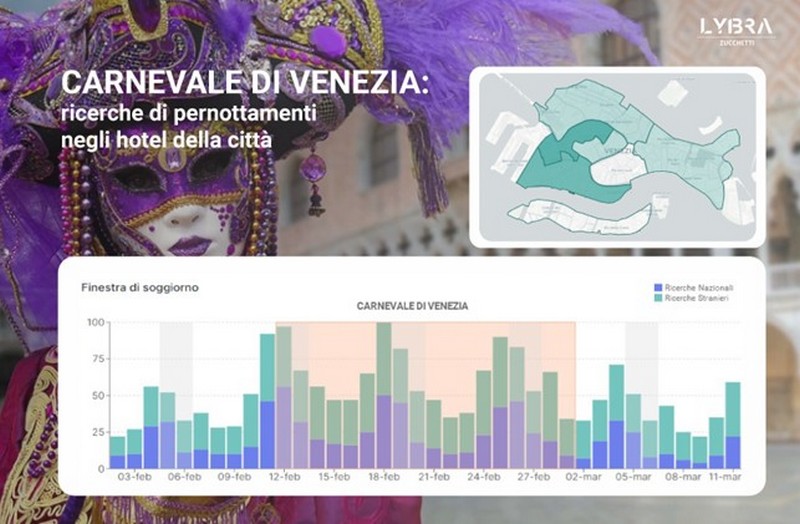
According to data from the city’s booking engines, searches for the Carnival period started as early as early January. From January 1 to today (February 15), searches for accommodations are increasing with an average daily rate of +5.4%. The trigger for users was the publication of the event calendar by the media: searches peaked on February 7 and 8, both by Italians and foreigners.
Unlike other Italian tourist destinations, which see Easter as the first period of interest for tourist demand, Venice’s interest peaks exactly during the Carnival period: the demand for beds on Easter Sunday is, in fact, 38% lower than on February 18, the day the Venetian Water Festival begins. Among the most chosen check-in dates are also February 11 and 12 for the opening ceremony and the last weekend of the event (February 25 and 26).
Among tourists searching for accommodations in Venice, many are Italian but the greater interest is from foreigners: they represent 59.4% of the total and, unlike Italians, they search for overnight stays even on weekdays. The most active markets are France in first place and the United States in second; followed by the United Kingdom, Germany, and Spain. Italians, who make up the remaining 40.6%, mainly seek stays for couples and have an average stay of 2.1 nights. For the French and Americans, couples are also the main segment but with different average stays: 3.2 and 2.5 nights respectively.
Pubblicato in Destinations, Digital Travel


Be the first to comment